
Jaishankar urges China to resolve border issues, calls for de-escalation, trust-building

By Anjali Sharma
WASHINGTON – External Affairs Minister S Jaishankar on Monday emphasized that India and China must now resolve outstanding issues related to their boundary dispute, including de-escalation in eastern Ladakh
He noted that considerable progress has been achieved over the past nine months toward normalizing bilateral relations.
Jaishankar is on a three-day visit to China to attend the Foreign Ministers’ Meeting of the Shanghai Cooperation Organisation in Tianjin.
He held talks with his Chinese counterpart, Wang Yi in Beijing.
Jaishankar stressed the importance of peace and tranquility along the border as a prerequisite for the smooth development of bilateral ties.
He reiterated India’s support for continued efforts toward de-escalation and effective border management.
EAM called for cooperation on trans-border rivers, including the resumption of the provision of hydrological data by the Chinese side.
He raised concerns over restrictive trade measures and other obstacles to economic cooperation.
They reviewed the current state of the India-China bilateral relationship.
Two leaders acknowledged recent progress in stabilizing and rebuilding ties, with a focus on people-centric initiatives, including events to commemorate the 75th anniversary of the establishment of diplomatic relations this year.
EAM appreciated China’s cooperation in resuming the Kailash Mansarovar Yatra, which had been suspended for five years.
Both sides agreed to take further practical steps to enhance people-to-people exchanges, such as facilitating travel and increasing direct flight connectivity.
“We have made good progress in the past nine months toward normalizing our bilateral relations. This progress stems from the resolution of border friction and our ability to maintain peace and tranquility. This forms the foundation for mutual strategic trust and the smooth development of bilateral relations. It is now incumbent upon us to address the remaining border-related issues, including de-escalation,” he said during the meeting.
He noted that, as neighboring nations and major global economies, the India-China relationship has many dimensions.
“Steps to normalize people-to-people exchanges can foster mutually beneficial cooperation. It is essential that restrictive trade practices and other roadblocks are avoided. I hope to discuss these matters in more detail,” he said.
Jaishankar added that the day’s talks would include an exchange of views on global and regional issues. “Tomorrow, we will meet under the SCO framework, which primarily aims to combat terrorism, separatism, and extremism. This is a shared concern, and India hopes that the principle of zero tolerance for terrorism will be strongly upheld,” he said.
He emphasized the need for a forward-looking and constructive approach to bilateral relations.
“Since our leaders’ meeting in Kazan in October 2024, the India-China relationship has been gradually moving in a positive direction. Our responsibility is to maintain that momentum,” he said.
Jaishankar highlighted the 75th anniversary of diplomatic relations, he reiterated his appreciation for the resumption of the Kailash Mansarovar Yatra and China’s cooperation on this matter.
He asserted “Stable and constructive ties between India and China are not only in our mutual interest but also beneficial for the world.”
“Such relations should be based on mutual respect, mutual interest, and mutual sensitivity.”
He recalled prior agreements between the two countries, noting,
“We have earlier agreed that differences should not become disputes, nor should competition ever turn into conflict. On this basis, we can continue to develop our ties positively.”
They also discussed regional and global issues of mutual concern.
Jaishankar expressed India’s support for China’s SCO Presidency and said the discussions were constructive and forward-looking.
They agreed to stay in touch, including through bilateral visits and meetings.
Jaishankar met Chinese Vice President Han Zheng in Beijing after his arrival.
He reaffirmed India’s support for China’s SCO leadership in his opening remarks and noted the improvement in bilateral relations since the Modi-Xi meeting in Kazan.
“My discussions during this visit aim to sustain the positive trajectory in our relations,” Jaishankar said.
He marked the 75th anniversary of diplomatic ties and highlighted the significance of resuming the Kailash Mansarovar Yatra, which had been suspended due to the Covid-19 pandemic and border tensions.
“The resumption of the Kailash Mansarovar Yatra has been widely appreciated in India. Continued normalization of our relations can yield mutually beneficial outcomes,” he said.
Jaishankar noted that “The international situation is highly complex today. As neighboring nations and major economies, an open exchange of perspectives between India and China is essential.”
He wrote on social media X “Pleased to meet Vice President Han Zheng soon after my arrival in Beijing today. Conveyed India’s support for China’s SCO Presidency. Noted the improvement in our bilateral ties and expressed confidence that my discussions here will sustain that momentum.”
Jaishankar marks his first visit to China since the deadly Galwan Valley clash in June 2020, which had severely strained bilateral relations.
EAM planted a pomegranate sapling at the Indian Embassy in Beijing and interacted with Embassy staff as part of the ‘Ek Ped Maa Ke Naam’ initiative.
“#EkPedMaaKeNaam Planted a pomegranate sapling earlier today at the Embassy. He also interacted with our Team @EOIBeijing.”
Jaishankar arrived in China after concluded a visit to Singapore and his first trip to Beijing in five years.
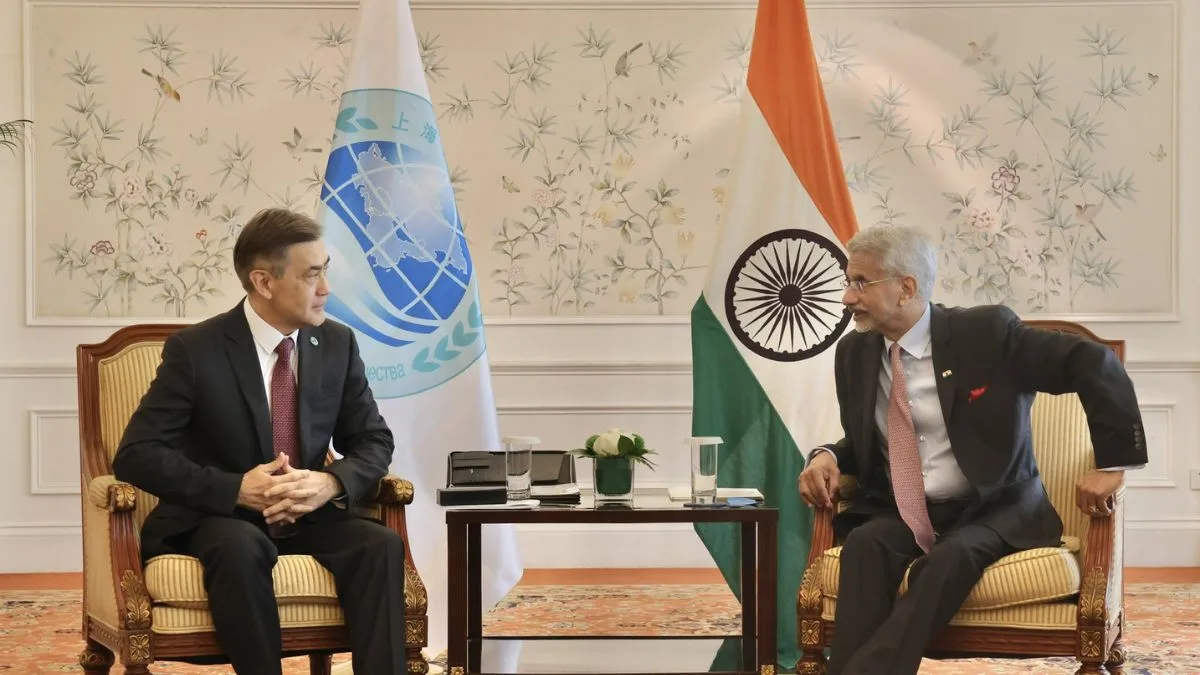
He met with Shanghai Cooperation Organisation Secretary-General Nurlan Yermekbayev.
“Glad to meet SCO SG Nurlan Yermekbayev in Beijing today. Discussed the contribution and importance of SCO, as well as the efforts to modernize its functioning,” Jaishankar posted on X.
