

Poonam Sharma
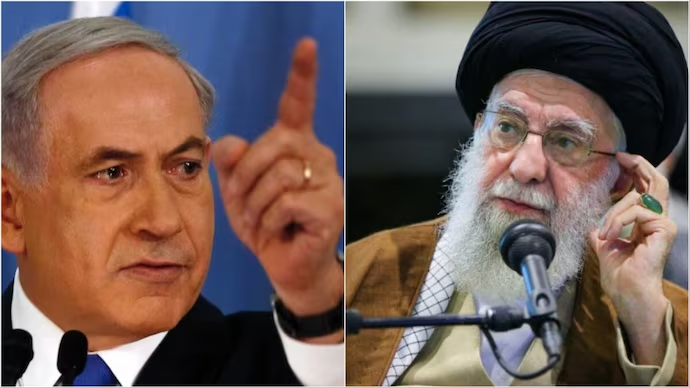
The Israel-Iran standoff, previously confined to shadow wars and proxy altercations, has now turned to an open and perilous confrontation—what many analysts interpret as the start of a protracted and unsettling period in West Asian geopolitics. What began as an air campaign has soon escalated into a war of data, a war of funds, and possibly, a war of political clout that extends way beyond the Middle East. The aftershocks are already being experienced from Washington to New Delhi.
This is no longer a test of tactical moves. This is a test of international alliances, military reserves, and diplomatic staying power.
900 Airstrikes: An Opening Statement, Not a Climax
As per open-source intelligence being shared on X (formerly Twitter), Israel has conducted nearly 900 precision airstrikes on Iranian military and nuclear-associated targets in recent days. Reports put the combined military cost of these strikes at approximately $800 million. By dividing the cost of a single high-precision missile by about $12.5 million, it’s deduced that more than 60-65 sophisticated American-origin missiles were fired.
The ramifications? If this is 15–20% of what America views as deployable in active theaters of war, the overall size of American inventories is in question now. And that is not solely Israel’s. It speaks to worldwide preparedness, particularly if additional conflicts break out at the same time—namely, in Taiwan or the South China Sea.
Lockheed Martin, the company that produces these missile systems, is said to produce nearly 120 of these missiles annually. The question thus becomes uncomfortable: Can even the strongest militaries of the world continue high-intensity warfare for more than a few months?
America’s Role: Silent Partner or Strategic Backer
As Israeli jets deliver the bombs, the fact is that American military assistance fuels the equipment. From intelligence exchange to defense system finance, the U.S. is heavily involved in the mission. Yet the $800 million incurred isn’t formally charged to Washington. Rather, it highlights how weapon systems constructed by America remain the initial weapons of contemporary warfare, even when America itself isn’t the one that pulls the trigger.
There’s minimal public information on how Israel’s Iron Dome has fared in this wave, strange silence that might denote either technical deficiencies or strategic secrecy. But the actual issue is the trend: this war isn’t meant to conclude abruptly. It’s meant to bleed.
Iran’s Response: A Calm Before the Bigger Storm?
Iran itself has made a show of more rhetoric than action—at least so far. Supreme Leader Ayatollah Khamenei rejected reports of widespread damage to nuclear facilities and threatened retaliation. Even as the missiles rain down, however, Iran has been measured in its response, perhaps waiting for the right moment—or the appropriate regional backing.
Former U.S. President Donald Trump entered the fray with his customary acerbic commentary on the Biden administration, taking pride in stating that Iran never crossed red lines under his presidency. His message wasn’t just to Tehran but also to the American public.
Gaza: The Forgotten Front
As focus continues to be on the Iran-Israel axis, Gaza has again become a stage for escalated Israeli action. Precision bombings, detentions of suspected militants, and combing operations at the neighborhood level have returned with renewed vigor. Military sources suggest that Israel might be trying a Lebanon-style “controlled fragmentation”—a sustained policy of fragmenting opposing leadership and precluding unified resistance.
This may be looked at as a wider Israeli creed: don’t defeat your foe—paralyze their ability to unify and regenerate.
Why This Is a Nightmare for the Global South
This protracted standoff presents a bad problem for nations such as India, which depend greatly on Middle Eastern stability. Increasingly expensive oil, broken supply lines, and diplomatic tinder points waiting to be lit are just the start.
More significantly, India has strong strategic relationships with Iran and Israel. Negotiating this balancing act may become more challenging, particularly if Washington asks allies to choose between the two sides.
Pakistan: The Next Wildcard?
Pakistan’s proximity to Iran and past connections to radical networks make it a surprising flashpoint in this budding conflict. Some of the Iranian logistics and missile development work could have indirect backing through Pakistani networks or intermediaries, defense experts posting online say.
If Israel or the U.S. were to secure verifiable evidence of Pakistani cooperation, preemptive attacks or clandestine operations could become an option—pulling South Asia into a fresh crisis.
Add to this, reports of Afghan-origin Pakistani operatives’ possible role in missile testing and coordination. If so, it creates opportunities for broader regional implications.
America’s Strategic Shift: Eyes on POK?
One of the least discussed consequences of this war is that it could redefine America’s military presence. It is thought by some Indian security experts that the U.S. could back India’s assertion over Pakistan-occupied Kashmir (POK) in return for access to bases or the building of corridors in the future.
It would achieve several U.S. aims: limit China’s dominance in the region, gain a logistical hub nearer Iran, and solidify its South Asian axis with India.
A Long War with Worldwide Costs
What we see isn’t a discrete Israel-Iran war—it is the playing out of a new doctrine of asymmetric, protracted war. A war of wear and tear, not of taking. A war waged not just on the battlefield but through economics, diplomacy, and control of information.
And this war has no near-term end date.
With every passing day, the war evolves into something more intractable. Whether it’s Tehran’s incremental revenge, Tel Aviv’s select executions, or Washington’s calculated reorganization—this is a game of long duration. And one that will define global politics for decades to come.
