
Is India’s White-Collar Economy Replacing the Agrarian Economy?

Poonam Sharma
White-collar jobs are a defining feature of today’s service- and knowledge-driven economies. From corporate offices and government departments to technology firms and financial institutions, white-collar professionals shape decisions, manage systems, and create value largely through intellectual and administrative work. But what exactly does “white collar” mean, why is it called so, and how has the concept evolved over time? This article explores the origins, meaning, characteristics, and contemporary relevance of white-collar employment.
India stands at an economic crossroad—fast-expanding white-collar sectors contrast sharply with a still large agrarian workforce. Headlines about booming IT parks, outsourcing, and technology hubs capture our imagination, often leading to a simplistic belief that the modern white-collar economy is outright replacing the agrarian one. But this narrative misses deeper structural complexities, lived realities, and the unique contours of India’s growth story. A humanised exploration shows that while a shift is visible, the story is not one of replacement but transformation and imbalance.
India’s Structural Reality: Data Speaks
The Indian economy’s structure reveals an enduring paradox. Roughly 46% of the workforce is still engaged in agriculture, yet the sector contributes only about 18–20% to India’s GDP. This stark gap highlights agriculture’s low productivity compared to other sectors.
By contrast, the services sector contributes more than 50% of GDP while employing roughly 29–30% of workers. This disproportion shows a shift towards higher-value, white-collar economic activity.
This structural pattern—large employment share but small income share in agriculture—is not unique to India. Advanced economies like the U.S. and France have minuscule agriculture employment shares (below 5%) and most of their GDP generated from services.
Still, India’s pattern is distinctive because agriculture’s employment share remains high even as its economic contribution lags, suggesting incomplete transformation.
Beyond Numbers: Why Agriculture Remains Central
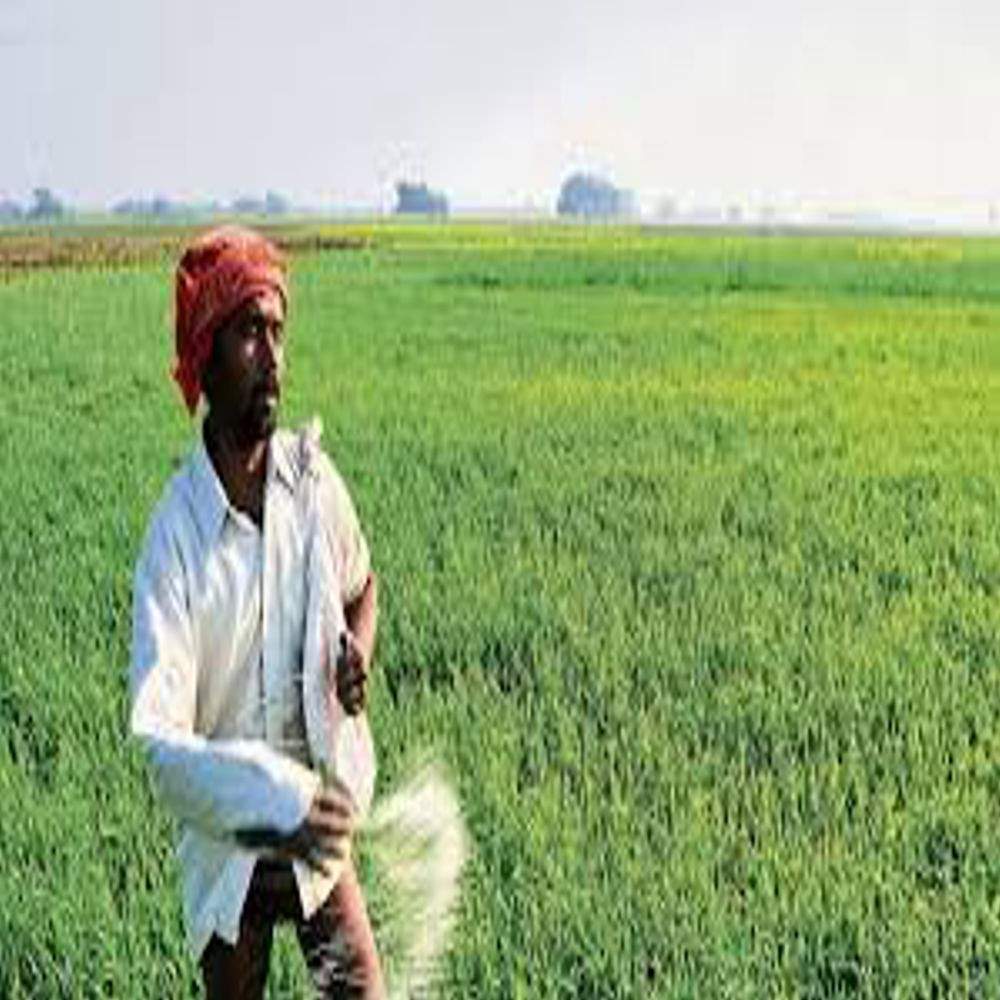
Agriculture in India is not just an economic sector — it is a social and cultural lifeline. Millions depend on farming for livelihood, identity, and sustenance. Rural communities centre life around land, seasons, and harvest—not just revenues. This is why 45–46% employment persists despite low productivity.
Several structural reasons explain this continuation:
Land Fragmentation: Small farms limit productivity and investment.
Informality: Most agricultural work lacks formal wages, social security, and stable markets.
Risk and Uncertainty: Farming is tied to monsoons, climate change, and volatile prices.
Limited Alternatives: Industrial expansion has historically lagged in rural India, slowing labour absorption elsewhere.
Thus, agriculture doesn’t shrink because it is unimportant, but because economic alternatives have not scaled sufficiently to absorb villagers into stable, productive jobs.
White-Collar Expansion: Opportunity and Challenge
The rise of India’s white-collar economy—IT services, business process outsourcing, finance, healthcare, digital enterprises—has been remarkable. The services sector has grown at around 7–9% annually, outpacing agriculture’s roughly 4–4.5% growth.
These sectors offer higher wages, formal contracts, and skills-based upward mobility. In urban centres like Bengaluru, Pune, Gurgaon, and Hyderabad, graduates find opportunities that never existed a generation ago.
However, this growth is uneven:
Many services jobs are concentrated in cities, not rural areas.
Skill and education gaps exclude many from accessing these jobs.
Services employment share (about 30%) still trails world averages where services often provide 50% or more of jobs.
Thus, while the white-collar economy is expanding in output and prestige, it has not yet replaced agrarian employment on a mass scale.
Global Comparisons: Lessons and Contrasts
To place India in perspective:
China: Services and manufacturing dominate, with agriculture contributing a small GDP share (~6–7%) and a smaller portion of employment compared to India.
Brazil & Developed Economies: Agriculture employs a minor fraction of the workforce and contributes little to GDP.
These patterns show that as countries develop, labour universally shifts away from agriculture. But economies like China did so through massive industrialisation, absorbing labour into factories before transitioning to services. India’s industrial-job creation has been slower, leaving many people in low-income agricultural and informal jobs instead of high-productivity sectors like manufacturing or services.
The Human and Policy Dimension
This transition is not merely economic—it is deeply human:
Rural families navigate uncertainty, weighing tradition against modern aspirations.
Youth increasingly pursue education and urban jobs, reshaping rural demographics.
Millions still struggle with informal work, seasonal jobs, and unstable income.
Policy must therefore aim for inclusive transformation:
Agricultural Modernisation: Invest in technology, irrigation, and supply chains so farming becomes more productive, resilient, and profitable.
Rural Services and Entrepreneurs: Promote agro-services, rural healthcare, education, and small enterprise clusters to create ‘white-collar’ jobs linked to local economies.
Manufacturing and Skills: Expand vocational education and scaled manufacturing jobs to absorb surplus labour.
Digital Inclusion: Use technology to bridge rural–urban divides and enable remote services jobs.
Not Replacement, But Reshaping
The narrative that the white-collar economy is replacing the agrarian economy misses the full picture. In India, there is clear movement toward modern, services-oriented growth, yet agriculture remains deeply woven into the socio-economic fabric. Rather than replacement, what we are witnessing is a restructuring—an imperfect, uneven transition where sectors coexist, overlap, and evolve.
The real challenge for India is not to eradicate agriculture, but to transform it, while creating meaningful, high-productivity opportunities across the economy. Only then can the aspirations of India’s vast population find fulfilment in both fields and offices—a balanced narrative where growth is both human and inclusive.
