
Insightful Idea of Ease of Voting by Shri Naveen Jindal: A Needonomics Perspective


Prof. Madan Mohan Goel Propounder, Needonomics & Former Vice-Chancellor (Thrice)
Democracy flourishes not only through its institutions but through the active and willing participation of its citizens. In India—the world’s largest democracy—this participation largely crystallizes during elections. Yet, voter turnout has remained between 60 to 70 percent, exposing a persistent gap between democratic potential and democratic practice. For a nation aspiring toward Viksit Bharat by 2047, this level of participation is inadequate and signals the urgent need to reimagine and redesign our electoral processes.
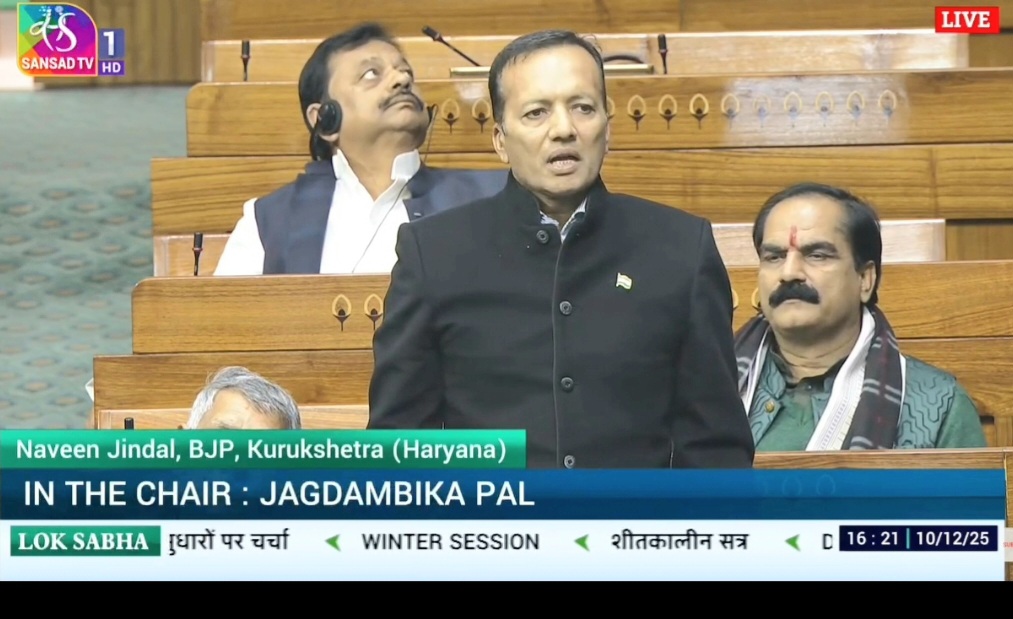
In this context, the insightful idea shared by Shri Naveen Jindal recently in Parliament “Ease of Voting in tune with Ease of Doing Business and Ease of Living” is timely, visionary, and nationally significant. It mirrors the aspirations of a modern India where convenience and efficiency enhance citizen empowerment. Needonomics School of Thought fully endorses this proposal, seeing it as essential for strengthening the democratic fabric of Bharat.
1 Democracy and the Challenge of Participation
A democracy derives legitimacy from the collective voice of its people. When a sizable proportion does not vote, the democratic mandate becomes less representative. India presents a paradox: political awareness has risen, youth engagement has grown, yet voting behaviour has not kept pace.
2 Several barriers weaken participation:
Urban migration and work-related mobility
Perceived procedural inconvenience
Long queues and limited infrastructure
Insufficient voter education
Weather-related obstacles
Distrust in political promises
Inadequate accessibility for senior citizens and persons with disabilities
For Bharat to truly become Viksit, voter turnout must rise towards 90 percent, matching global benchmarks of mature democracies.
3 Ease of Voting: A Timely and Transformative Reform
Just as reforms in ease of doing business and ease of living have unlocked economic potential, the idea of ease of voting must now become a national priority. The principles that transformed business procedures—reducing friction, simplifying processes, and leveraging technology—can equally strengthen electoral participation.
Key pillars include:
Simplified registration and verification
Wider accessibility and convenience
Ethical and secure use of technology
Empowering citizens regardless of location
Voting should feel less like a burden and more like an empowered civic privilege.
4 Online Voting: Lessons from Digital Platforms
Indians routinely engage in online voting for programmes such as Indian Idol and Bigg Boss. These platforms offer valuable insights:
Indians are digitally confident and ready.
With over 850 million internet users and affordable data, digital India spans both rural and urban Bharat.
Online voting is intuitive and accessible.
Entertainment platforms have perfected user-friendly designs that allow millions to vote effortlessly.
Digital infrastructure can handle massive participation.
If such platforms can manage millions of votes instantly, a secure government-run system can certainly be developed for elections.
Online voting need not replace physical polling booths; rather, it should complement them—especially for: Migrant workers, Students, Travelling professionals, NRIs,Senior citizens and persons with disabilities
A hybrid voting model will widen democratic access and reinforce trust.
5 Needonomics Perspective: Enhancing Value, Reducing Waste
Needonomics—rooted in the principle of need over greed—provides a strong economic and ethical foundation for the idea of ease of voting.
According to Needonomics:
Resources must serve meaningful societal needs.
Democracy derives its value from maximum participation. Investments in voting infrastructure thus fulfill a national need.
Processes should minimize waste.
Long queues, lost work hours, and travel costs represent societal inefficiency. Streamlined voting processes reduce these avoidable losses.
Citizens must be empowered with simplicity.
Systems designed with convenience promote responsibility and engagement.
Technology must be deployed ethically.
Secure digital voting aligns with the Needonomics mandate of ethical, transparent, and accountable innovation.
Thus, ease of voting is an ethical, economic, and human-centric reform essential for New Bharat.
6 Policy Recommendations for Implementing Ease of Voting
To operationalize this transformative idea, India must adopt the following measures:
1. Secure Online Voting Infrastructure
Aadhaar or DigiLocker-based verification
Blockchain-backed transparency
Multi-factor authentication
Remote voting for domestic migrants and NRIs
2. Stronger Voter Education
Nationwide campaigns emphasizing civic duty
Inclusion of electoral awareness in school and college curricula
Youth ambassadors for democratic participation
3. Flexible and Accessible Voting Options
Early voting windows
Home voting for senior citizens and PwDs
Mobile polling units in underserved regions
4. Simplified Voter Registration
One-time digital registration
Automatic updates through database integration
Mobile app-enabled voter services
5. Non-Monetary Incentives
Certificates recognizing democratic participation
CSR-led voting awareness drives
Community recognition for high-turnout localities
A Needonomics Call to Action
To conclude, India to emerge as Viksit Bharat and empowered nation, democracy must evolve from passive participation to proactive engagement. Ease of Voting is not merely a procedural reform-it is a national mission aligned with digital India, inclusive governance, and the principles of Needonomics. A democracy where voting is simple, accessible, and universal reflects moral strength and collective responsibility. As India marches toward 2047, let us ensure that every citizen’s voice becomes an active force in shaping Viksit Bharat. Ease of Voting is not just an electoral improvement—it is a democratic necessity and a patriotic responsibility. Now is the time to act.
