

Poonam Sharma
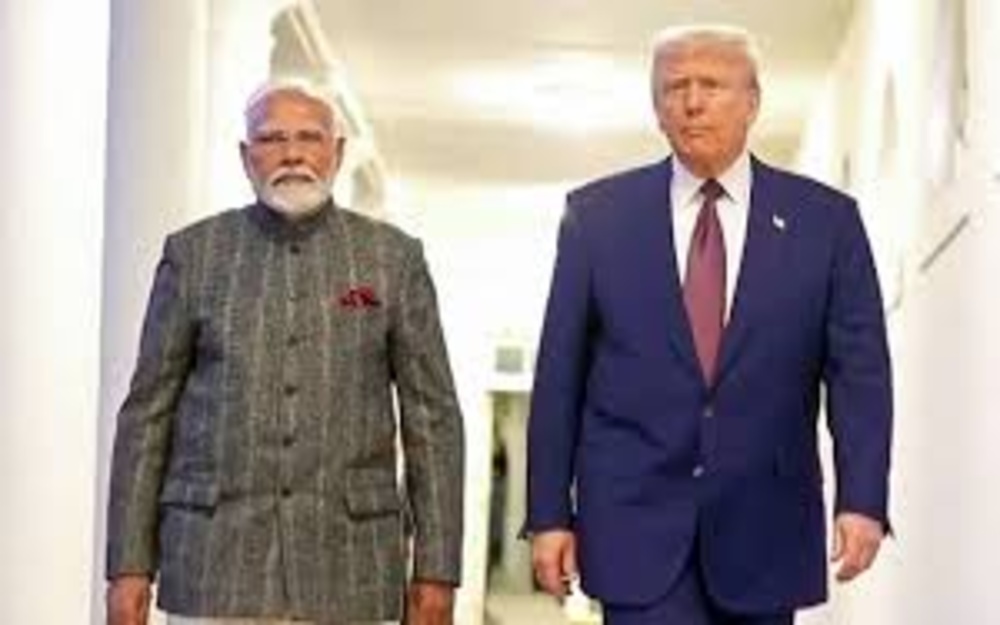
The digital ink on Donald Trump’s Truth Social post from February 2nd had barely dried before the geopolitical tectonic plates began to shift. By announcing a reduction in tariffs on Indian goods from a staggering 50% to 18%, the American President didn’t just sign a trade deal; he acknowledged a new reality. Prime Minister Narendra Modi’s warm response was more than a diplomatic courtesy—it was the victory lap of a “patient power.”
For nine months, the world watched a high-stakes game of economic chicken. Washington blustered about “reciprocity,” while New Delhi remained uncharacteristically quiet, focused on its internal plumbing: building semiconductor fabs, courting the European Union, and deepening its energy ties with the Global South. In the end, it wasn’t a shouting match that won the day; it was the sheer gravity of India’s economic trajectory that forced the U.S. to bend.
Beyond the Ticker: A Strategic Masterstroke
To view this 18% tariff figure as a mere “transactional tweak” is to miss the forest for the trees. This number is a surgical strike on the global supply chain hierarchy. By landing at 18%, India has effectively leaped over its neighbors. It now sits structurally ahead of Indonesia (19%), Vietnam (20%), and Bangladesh (20%), while remaining worlds apart from China’s 34% barrier.
In the ruthless world of manufacturing margins, this 1% or 2% difference is the “secret sauce” that will redirect billions in capital. This wasn’t charity from the White House; it was a calculated recognition that if Washington didn’t offer India a seat at the table, New Delhi was perfectly happy building its own table with Brussels, London, and Riyadh.
The deal’s handling of the “Russian Oil” conundrum is equally masterful. Trump framed it as a decisive halt to Indian purchases of Russian crude; New Delhi viewed it as “calibrated diversification.” While private refiners like Reliance might pivot toward Venezuelan crude or U.S. LNG, the public sector retains the flexibility to chase the best prices wherever they exist. It is an olive branch wrapped in pragmatism—a classic “Modi-style” adjustment that preserves strategic autonomy while giving the U.S. President a headline-grabbing win.
The Pax-Silica: From Back-Office to Backbone
While the headlines scream about “Washington Apples” and pulses, the real story is written in silicon and code. India is no longer the world’s “help desk”; it is becoming its hard drive. The $500 billion trade figure highlighted by the U.S. isn’t just about consumer goods—it’s about the “Pax-Silica.”
The numbers tell a story of a nation in a hurry. Electronics manufacturing has exploded six-fold in a decade, crossing the ₹11 lakh crore mark. But it’s the arrival of the Global Capability Centres (GCCs) that truly anchors this relationship. With over 1,700 GCCs—more than half the world’s total—India has become the nerve center for global AI, engineering, and life sciences.
When Microsoft commits $17.5 billion to Indian cloud infrastructure or Amazon pledges $35 billion, they aren’t doing it to be “nice.” They are doing it because India’s digital hard infrastructure—from the semiconductor mission to gigawatt-scale data centers—has become as vital as the Suez Canal once was. This deep integration makes economic “de-coupling” from India not just difficult, but industrially suicidal for the West.
The Multi-Polar Magnet: Why the World is Heading to Delhi
Washington’s sudden urgency to close the deal didn’t happen in a vacuum. It was a reaction to a “crowded calendar” in New Delhi. When you look at the diplomatic guest list for early 2026, it looks like a meeting of the new world order.
December 2025: Vladimir Putin visits to sign the RELOS defense logistics pact.
January 2026: German Chancellor Friedrich Merz arrives to deepen defense ties, followed by EU chief Ursula von der Leyen, who dubbed the pending Indo-EU pact the “mother of all trade deals.”
February/March 2026: France’s Emmanuel Macron arrives for a massive Rafale jet package, while Brazil’s Lula and Canada’s Mark Carney wait in the wings.
The United States realized it could no longer afford to be a bystander. While Washington was debating tariffs, the rest of the world was making a “beeline” for India’s 7.2% GDP growth.
Trump, a leader who famously respects strength and scale over sentiment, saw a nation that didn’t buckle under pressure. India didn’t posture; it simply waited, built alternatives, and let the sheer weight of its market do the talking. By securing similar deals with the UK, EU, and Oman, New Delhi proved it had “optionality”—the ultimate currency in modern diplomacy.
An Equilibrium of Equals
We are witnessing the arrival of India as a “rule-shaper” rather than a “rule-taker.” This trade agreement is the culmination of a strategy that values patience over optics. It is a civilizational state reclaiming its old glory, not through hegemonic dominance, but through equitable trade and strategic depth.
The Indo-US relationship has moved from a patron-client dynamic to a genuine equilibrium. India didn’t seek approval; it compelled adjustment. As the world fragments into competing blocs, India has emerged as the stabilizing anchor—the one “pole” that everyone needs to touch.
The message from New Delhi to the world is now crystal clear: India is open for business, but only on terms that respect its sovereignty and its future. The “Great Calibration” has begun, and the world is finally adjusting its clocks to Indian Standard Time.
