
India’s Trade Approach ‘Deliberate and Principled,’ says Piyush Goyal

GG News Bureau
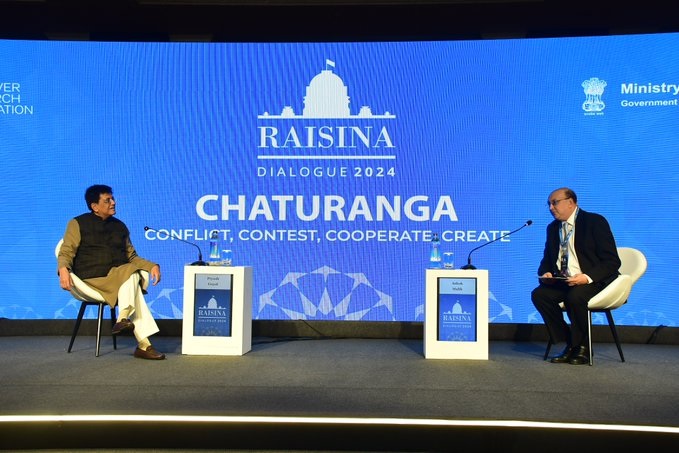
New Delhi, 24th Feb. Union Minister of Commerce & Industry, Consumer Affairs, Food and Public Distribution, and Textiles, Piyush Goyal, underscored India’s cautious stance on trade negotiations, emphasizing the need for a meticulous and balanced approach. Speaking at the Raisina Dialogue 2024, Minister Goyal highlighted the extensive consultations and deliberations undertaken before finalizing Free Trade Agreements (FTAs), recognizing their far-reaching implications for the nation.
Commitment to WTO Principles and Multilateral Trading System
Ahead of the WTO Ministerial Conference 13 (MC13) scheduled in Abu Dhabi, UAE, Shri Goyal reiterated India’s commitment to upholding the guiding principles of the World Trade Organization (WTO). He emphasized India’s historical role in the WTO and advocated for its reform to ensure a fair and robust multilateral trading system.
Addressing CBAM Issue with EU and WTO
Regarding the Carbon Border Adjustment Mechanism (CBAM) issue, Minister Goyal expressed India’s concerns over the tax imposition by the European Union (EU). He affirmed India’s intent to address the matter within the framework of the WTO and explore bilateral discussions with the EU. Assuring stakeholders, he affirmed the government’s dedication to transforming challenges into opportunities.
India’s Competitive Edge and Economic Transformation
Minister Goyal highlighted India’s willingness to engage globally and enhance competitiveness through participation in global value chains while maintaining self-reliance. He emphasized India’s vast domestic market and innovative capabilities, positioning the country as an attractive investment destination. The Minister underscored the government’s initiatives aimed at economic reform, development, and welfare, with a vision to transform India into a developed economy by 2047.
Government Initiatives Driving Growth and Development
Goyal lauded the government’s initiatives under the leadership of Prime Minister Shri Narendra Modi, spanning various sectors such as food security, healthcare, education, housing, and infrastructure. He cited flagship programs like Make in India, Startup India, Digital India, and Production-Linked Incentive (PLI) schemes as catalysts for India’s rapid economic development, fostering both public and private investment.
