
India’s Shubhanshu Shukla Docks at ISS Aboard Axiom-4 Mission, Calls Spaceflight ‘Magical’

GG News Bureau
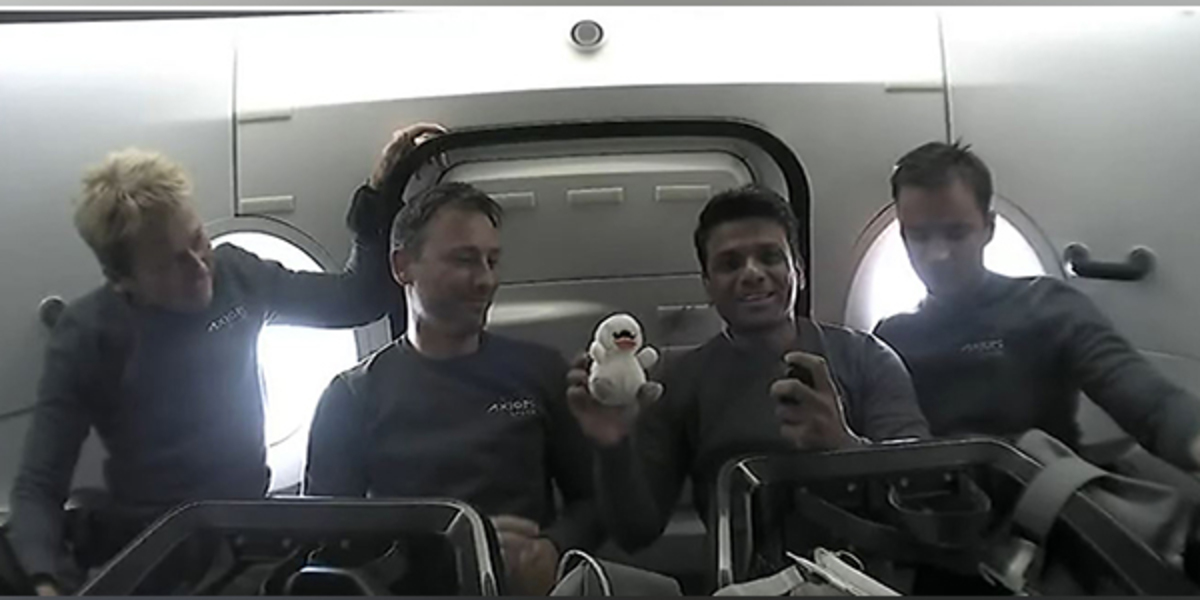
New Delhi, 26th June: In a landmark moment for India’s space journey, Air Force Group Captain Shubhanshu Shukla, as part of the Axiom-4 mission, successfully docked with the International Space Station (ISS) on Thursday evening, following a 28-hour journey aboard the Crew Dragon capsule launched by SpaceX.
The capsule — named Grace upon reaching orbit — docked with the space station at 4:01 PM IST, 424 km above the northern Atlantic Ocean. The soft capture was confirmed by Mission Control, allowing the capsule to absorb the kinetic energy from the initial contact. This was followed by a secure ‘hard capture’ at 4:15 PM IST, completing the docking procedure.
“We are honored to be here… thank you,” said Mission Commander Peggy Whitson, in a live stream moments after the docking. Shukla and his fellow astronauts — Whitson (USA), Slawoz Wisniewski (Poland), and Tibor Kapu (Hungary) — will join the seven existing members aboard the ISS once hatch integration is confirmed. The pressurised seal between the ISS and the capsule is undergoing checks, and the hatch is expected to open by 6:10 PM IST.
A Historic Launch from a Legendary Pad
Axiom-4 lifted off at 12:01 PM IST on Wednesday from Launch Complex 39A at Florida’s Kennedy Space Centre — the same pad that sent Neil Armstrong to the Moon during the Apollo 11 mission. After six launch delays and a near seventh caused by a software glitch, the rocket roared to life as the Falcon 9’s Merlin engines powered the spacecraft skyward.
“It was magical,” said Shubhanshu Shukla, describing the moment. “After 30 days of quarantine and delays, all I thought was, ‘Let’s just go!’ Once we launched… it was something else entirely. You’re pushed back into the seat, and then suddenly there’s silence. You’re just floating in the vacuum… and it’s magical.”
Science at the Forefront: 60 Experiments in 14 Days
During their 14-day mission, the Axiom-4 crew will conduct 60 experiments, including seven proposed by Indian institutions. These experiments focus on bio-astronautics, bio-manufacturing, and studies on ‘water bears’ (tardigrades) — tiny, resilient organisms used to understand life in microgravity conditions.
Shukla expressed deep appreciation for the engineers and scientists behind the mission. “This is a collective achievement. I truly appreciate the efforts of every individual who made this journey possible,” he said.
India in Orbit
Shubhanshu Shukla becomes a proud addition to India’s legacy in space exploration, joining the likes of Rakesh Sharma and Wing Commander Rakesh Roshan, further cementing India’s growing presence in the field of human spaceflight.
As the nation watches with pride, the Axiom-4 mission not only represents a scientific milestone but also serves as a powerful symbol of international collaboration, innovation, and India’s rising ambitions in space.
