
India’s Export Map Redrawn as US Slashes Tariffs to 18%
Trump-Modi trade breakthrough reshapes India’s global trade standing, boosts exporters and markets

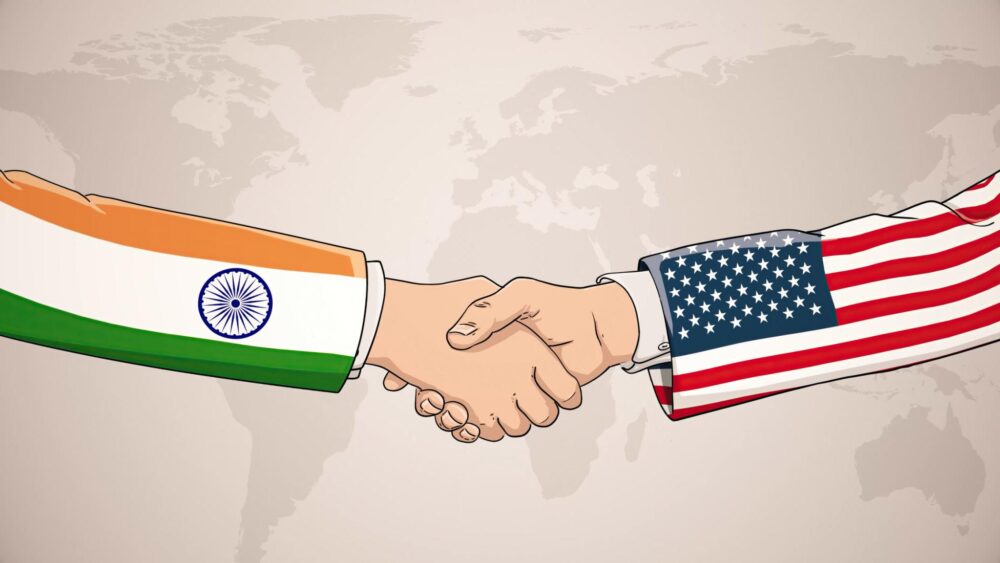
- US cuts tariffs on Indian goods from 50% to 18%
- India gains edge over China, Vietnam, Bangladesh in US market
- Textiles, pharma, engineering exports set to benefit most
- Markets rally as India-US trade momentum strengthens
GG News Bureau
New Delhi, 4th Feb: India’s export landscape has undergone a sharp realignment after the United States slashed tariffs on Indian goods to 18 per cent, a move that significantly improves India’s competitiveness in the world’s largest consumer market.
The tariff reduction was announced by US President Donald Trump following a call with Prime Minister Narendra Modi, marking the most substantial easing of trade friction between the two countries in over a year. Indian markets responded strongly, with benchmark indices jumping nearly three per cent in the first trading session after the announcement.
The revised tariff replaces a steep effective rate of 50 per cent, which included a 25 per cent reciprocal duty and an additional 25 per cent punitive surcharge imposed earlier over India’s continued purchases of discounted Russian crude oil. With the surcharge withdrawn and reciprocal tariffs lowered, Indian exports now face a flat 18 per cent levy.
The tariff cut is part of a broader trade understanding under which India is expected to gradually scale back imports of Russian oil, while Washington rolls back trade penalties linked to those purchases. Prime Minister Modi welcomed the decision, saying “Made in India products will now have a reduced tariff of 18 per cent”.
India Gains Edge Over Rivals
The reduced tariff places India in a stronger position than several regional and global competitors. China continues to face duties of around 34 per cent, while Vietnam, Indonesia and Bangladesh operate under higher or less predictable tariff regimes. Mexico and Canada face duties in the 30–35 per cent range on key categories, while Switzerland bears tariffs as high as 39 per cent.
By contrast, developed economies such as the UK enjoy lower duties near 10 per cent, while the European Union averages around 15 per cent. India’s new rate positions it favourably within US-linked supply chains, particularly in labour-intensive and value-added sectors.
Export Sectors Poised to Benefit
Indian exporters are expected to gain immediately in sectors such as textiles, apparel, seafood, pharmaceuticals, jewellery, engineering goods and specialty chemicals. Analysts say the tariff relief could emerge as one of the strongest external growth drivers for India in 2026, especially when combined with the recently concluded India–EU trade agreement.
Shifting Export and Import Trends
Data for 2025–26 shows the US as India’s largest export destination, followed by the UAE and major European economies. China, despite geopolitical tensions, recorded the fastest export growth among India’s top markets. Meanwhile, exports to Singapore and the Netherlands weakened due to softer global demand.
On the import side, China remained India’s largest supplier, followed by the UAE, Russia and the US. Imports from Russia, Iraq and Switzerland declined, while shipments from Hong Kong, Japan and Singapore rose sharply—highlighting diverging trade trends.
India–US trade has expanded steadily over the past decade. Exports to the US rose from $42.2 billion in FY17 to a peak of $86.5 billion in FY25, before moderating to $59 billion in FY26. Imports increased from $22.3 billion to $35.4 billion over the same period. India has consistently maintained a trade surplus with the US, touching a record $40.9 billion in FY25.
Markets Cheer Trade Reset
Indian equities surged following the announcement, with export-oriented sectors outperforming the broader market. The Nifty 50 jumped nearly three per cent, while stocks linked to textiles, engineering and chemicals saw strong gains.
With tariffs lowered and trade momentum back on track, India’s export map is being redrawn—strengthening its position in global markets and reinforcing the strategic depth of the India–US economic partnership.
