

Poonam Sharma
In geopolitics, the most consequential moves are often made quietly. Recent developments between India and the United Arab Emirates suggest that a new technological and financial axis may be taking shape—one that could gradually reshape global power structures without dramatic headlines.
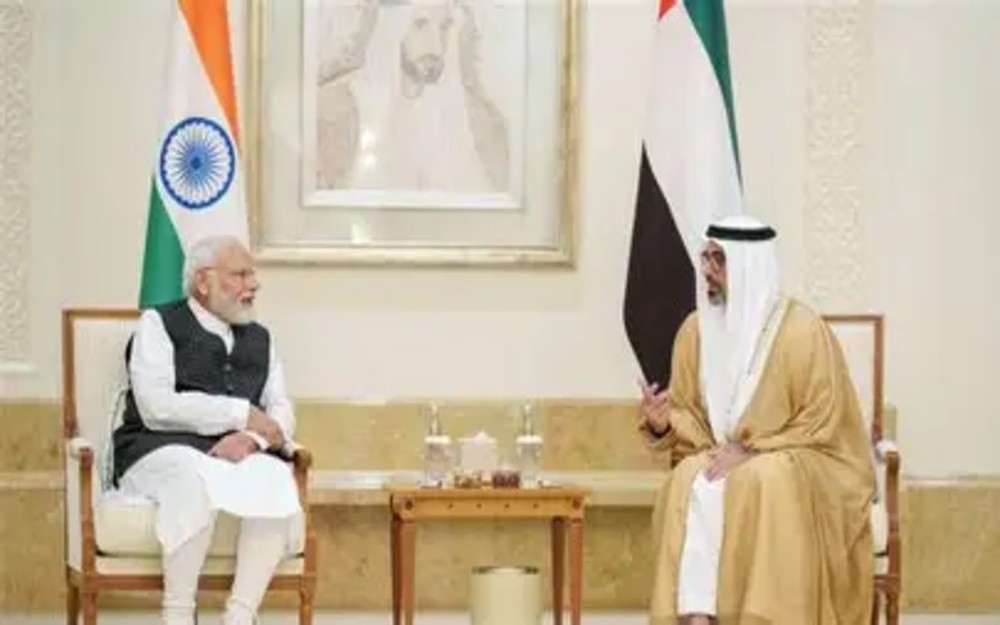
At the heart of this emerging partnership are Prime Minister Narendra Modi and UAE President Mohamed bin Zayed Al Nahyan, two leaders who appear aligned on a shared objective: preparing their nations for a post-oil, post-West-dominated technological order.
A Supercomputer Gambit
Central to the discussions has been the development of advanced supercomputing infrastructure in India, supported by UAE investment. The scale being discussed is significant enough to place India among the world’s most serious AI and high-performance computing contenders.
The proposed infrastructure would reportedly integrate with India’s advanced computing ecosystem and create a software backbone capable of supporting artificial intelligence applications at a sovereign scale. Unlike traditional Western-led tech collaborations, this initiative signals a direct partnership between two nations seeking technological autonomy.
For the UAE, whose sovereign wealth funds are backed by decades of oil revenue, diversification is no longer optional—it is urgent. Oil will not define the future. AI, deep tech, and nuclear energy will. India, with its vast engineering talent pool and digital public infrastructure, presents an ideal partner.
Beyond Oil: A Strategic Diversification
The UAE’s sovereign wealth capital has historically flowed into Western markets, China, and global property assets. However, global instability—from supply chain disruptions to energy crises and geopolitical conflicts—has exposed vulnerabilities.
Trade chokepoints, including those affecting routes near the Red Sea, have driven up shipping costs and squeezed profit margins. Western export controls and technology restrictions have added further complexity. In this environment, the logic of investing in a politically aligned, rapidly growing tech economy like India becomes clearer.
Rather than relying on legacy trade systems dominated by the United States or Europe, both India and the UAE appear to be exploring parallel channels—digital, financial, and technological—that reduce dependency on traditional power centers.
Digital Corridors and Financial Bypass
One of the less publicized but potentially transformative elements of the partnership is the linking of digital financial infrastructure. India’s digital public infrastructure model—known globally for real-time payment interoperability—has reportedly been connected with UAE systems.
This creates the possibility of a cross-border payment network that functions with reduced exposure to Western-controlled financial chokepoints. While not explicitly framed as a bypass mechanism, the implications are significant: a new corridor for trade settlements that operates on mutually aligned infrastructure.
In strategic terms, digital corridors may prove more resilient than physical ones. Fiber networks cannot be blockaded like shipping lanes. Payment protocols cannot be rerouted like oil tankers.
Deep Tech, Nuclear and Space Cooperation
The discussions extend beyond AI. There are signals of collaboration in:
Deep tech venture funding through UAE-backed investment vehicles
Small modular nuclear reactor technology for future energy security
Joint exploration in space and advanced research
If realized, such collaboration would place India at the center of a multi-sector technological upgrade funded in part by Gulf capital.
For the UAE, investing in India’s technology stack is also a hedge against overexposure to Western markets and Chinese volatility. For India, attracting sovereign capital into supercomputing, nuclear energy, and AI infrastructure strengthens its bid for technological sovereignty.
A Parallel Architecture?
What makes this development noteworthy is not a single signed treaty but the architecture being assembled: AI infrastructure, digital payments, nuclear collaboration, and space research—all moving simultaneously.
Importantly, much of this has unfolded without the kind of dramatic diplomatic theater that typically accompanies major geopolitical shifts. No sweeping declarations. No overt anti-West rhetoric. Instead, incremental integration.
The absence of noise may be strategic.
If successful, this India–UAE alignment could represent a prototype for a multipolar tech order—one in which emerging powers collaborate to build independent infrastructure rather than plug exclusively into Western frameworks.
The Global Implications
The United States still dominates advanced semiconductor supply chains and supercomputing capabilities. China remains a powerful AI competitor. But middle powers are no longer content to remain technology consumers.
India’s bet appears to be this: build domestic infrastructure, attract sovereign capital, integrate digital finance, and reduce exposure to external choke points.
The UAE’s bet is equally clear: invest oil wealth into the technologies that will define the next 40 years.
Whether this partnership evolves into a structural shift in global power will depend on execution. Supercomputers must be built. Payment systems must scale. Nuclear and space collaborations must materialize beyond announcements.
But if the blueprint becomes reality, historians may look back on these quiet summits not as routine diplomatic engagements—but as the early chapters of a new technological alignment.
In geopolitics, revolutions rarely begin with loud proclamations. Sometimes, they begin with infrastructure.
