
India-Oman Relations Get New Push with CEPA, Joint Vision
Leaders unveil wide-ranging roadmap during PM Modi’s Muscat visit marking 70 years of diplomatic ties

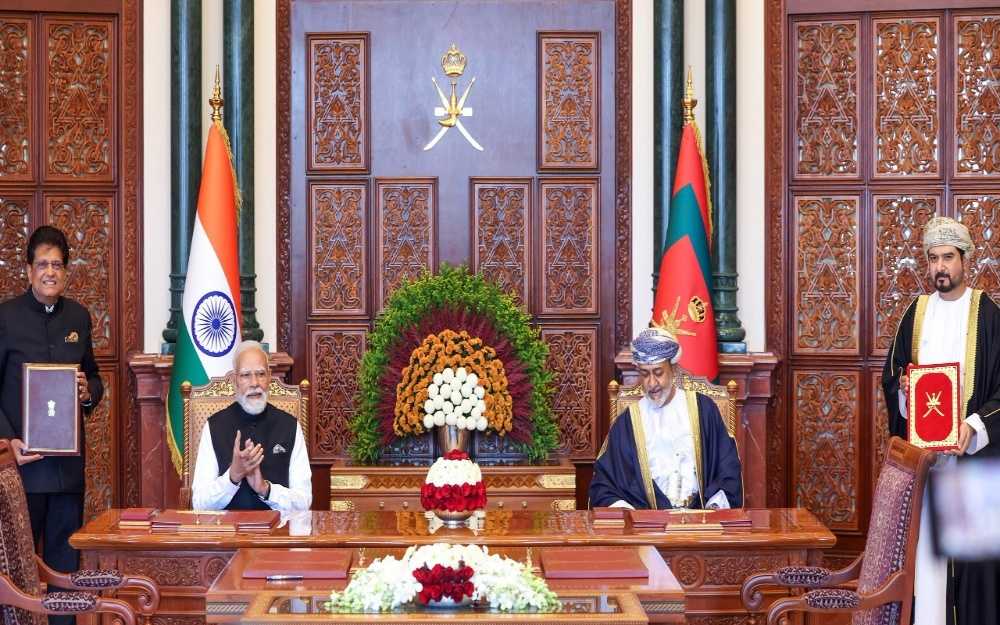
- India and Oman sign CEPA, aim to boost trade, investment and job creation
- Joint Vision Document on Maritime Cooperation adopted
- Focus on energy, defence, technology, agriculture, education and digital ties
- Strong emphasis on people-to-people links and regional stability
GG News Bureau
Muscat/New Delhi, 19th Dec: India and Oman on Thursday issued a comprehensive Joint Statement outlining a forward-looking roadmap for their Strategic Partnership during Prime Minister Narendra Modi’s official visit to the Sultanate from December 17–18, 2025.
The visit, at the invitation of His Majesty Sultan Haitham bin Tarik, assumes special significance as it coincides with the 70th anniversary of the establishment of diplomatic relations between the two countries. Prime Minister Modi was accorded a ceremonial welcome and held detailed consultations with the Sultan at Al Baraka Palace in Muscat.
Both leaders expressed satisfaction at the depth and breadth of bilateral ties spanning trade, investment, defence, security, energy, technology, space, education, agriculture, culture and people-to-people relations. They reviewed progress under the Joint Vision Document adopted during the Sultan’s State Visit to India in December 2023 and noted that the relationship between the two maritime neighbours has evolved into a multifaceted Strategic Partnership.
A key outcome of the visit was the signing of the India–Oman Comprehensive Economic Partnership Agreement (CEPA), described by both sides as a landmark in economic relations. The leaders said CEPA would reduce trade barriers, enhance market access, boost investment flows and create employment opportunities in both countries. They encouraged the private sector to fully leverage the agreement.
The two sides highlighted strong potential for expanding trade in sectors such as textiles, automobiles, chemicals, equipment and fertilisers. They also discussed investment opportunities in infrastructure, manufacturing, logistics, food security, hospitality and technology, noting the positive role of the Oman–India Joint Investment Fund.
Energy cooperation featured prominently, with both sides agreeing to deepen collaboration in oil and gas, renewable energy, green hydrogen and green ammonia, including joint investments and technology transfer. Defence and maritime security cooperation was reaffirmed through joint exercises, training, information-sharing and efforts to combat maritime crime and piracy.
During the visit, the two sides adopted a Joint Vision Document on Maritime Cooperation, reflecting shared commitment to regional security, the blue economy and sustainable use of ocean resources.
Cooperation in agriculture, health, education, digital infrastructure, IT services and space applications was also reviewed. Both sides welcomed MoUs on agriculture, higher education, maritime heritage and museum cooperation, along with initiatives on millet cultivation and agri-food innovation.
Cultural ties and people-to-people exchanges were highlighted as a cornerstone of the relationship. India expressed appreciation for Oman’s support to the Indian community of around 675,000 people, while Oman acknowledged the diaspora’s contribution to its development.
On regional and global issues, the leaders condemned terrorism in all forms and expressed concern over the humanitarian situation in Gaza, reiterating support for humanitarian aid and a just, lasting solution through dialogue and diplomacy.
Prime Minister Modi thanked Sultan Haitham bin Tarik for the warm hospitality and invited him to visit India at a mutually convenient time.
