
“India Is Shaping the Future of Space Science,” says Dr. Jitendra Singh on ISS Mission

By Dr. Kumar Rakesh
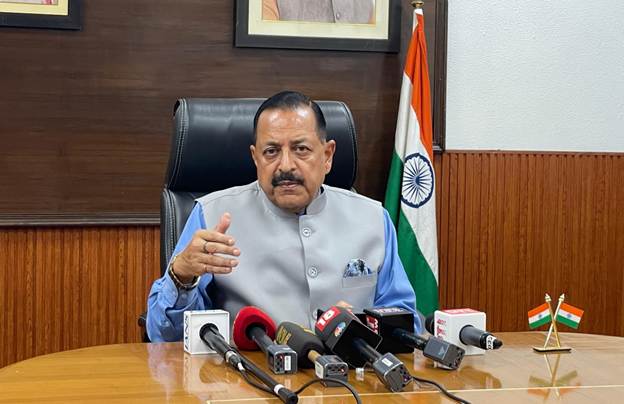
Union Minister of State (Independent Charge) for Science & Technology Dr. Jitendra Singh today celebrated a landmark moment in India’s space journey, as the Dragon spacecraft carrying Indian Air Force Group Captain Shubhanshu Shukla successfully docked with the International Space Station (ISS). The historic mission, part of Axiom-4, includes the execution of seven fully indigenous experiments developed by Indian research institutions, underlining India’s growing global leadership in space biosciences.
Dr. Singh, who also oversees Earth Sciences, Space, and Atomic Energy, described the milestone as a triumph of the spirit of ‘Atmanirbhar Bharat’ and ‘Vishwabandhu Bharat’, asserting that the scientific outcomes of these experiments will be shared with the international community.
“India’s role in space exploration is no longer confined to the launchpad. We are shaping the future of life and science in space,” said Dr. Singh.
Seven Indigenous Experiments to Unlock Microgravity Insights
Shukla will conduct seven groundbreaking experiments designed and developed by premier Indian institutions, each aimed at advancing sustainable life support systems in space and contributing to health, nutrition, and agriculture on Earth.
1. Microalgae Growth & Metabolism
Developed by ICGEB and BRIC-NIPGR, New Delhi, this study examines the growth of edible microalgae in microgravity — crucial for crew nutrition, oxygen regeneration, and wastewater recycling.
2. Sprouting Seeds in Space
A collaborative experiment by UAS Dharwad and IIT Dharwad, this project tests moong and methi seed germination in space, targeting nutritional supplements for astronauts and assessing medicinal benefits.
3. Muscle Regeneration Study
Led by BRIC-InStem, Bengaluru, this research aims to understand muscle loss and regeneration in zero gravity, with implications for astronaut health and rehabilitation therapies on Earth.
4. Survival of Tardigrades
An IISc Bengaluru experiment investigates the adaptability of tardigrades — resilient microscopic organisms — offering clues into human survival in extreme environments.
5. Human-Interface Interaction
Also from IISc Bengaluru, this study evaluates astronaut interaction with digital displays in microgravity, helping to design more effective spacecraft control systems.
6. Cyanobacteria Cultivation
This ICGEB New Delhi experiment explores using urea as a nitrogen source to grow cyanobacteria, which may lead to innovations in closed-loop life support and superfood development for long-duration missions.
7. Seed Resilience Trials
Testing rice, cowpea, sesame, brinjal, and tomato seeds exposed to microgravity, this project assesses how space impacts crop growth — a key step toward space agriculture and climate-resilient farming on Earth.
“India is Leading Missions of Planetary Relevance”: Dr. Singh
Dr. Jitendra Singh emphasized that these experiments represent India’s transformation from a spacefaring nation to a global space science innovator, helping shape resilient ecosystems in both space and on Earth.
“India is no longer a follower. These efforts reflect our leadership in missions of planetary relevance. The knowledge gained will not only benefit India but will serve as a gift to humanity,” he affirmed.
Shubhanshu Shukla’s presence aboard the ISS — conducting purely ‘Made-in-India’ scientific work — is being hailed as a giant leap for Indian science and a moment of pride for the country, aligning with Prime Minister Narendra Modi’s vision of self-reliance and global responsibility in scientific advancement.
