

By Anjali Sharma
WASHINGTON – India on Thursday launched a sharp counter attack at Pakistan during the 61st session of the UN Human Rights Council in Geneva dismissed Islamabad’s allegations on Jammu and Kashmir and accused Islamabad of recycling propaganda driven by “envy”.
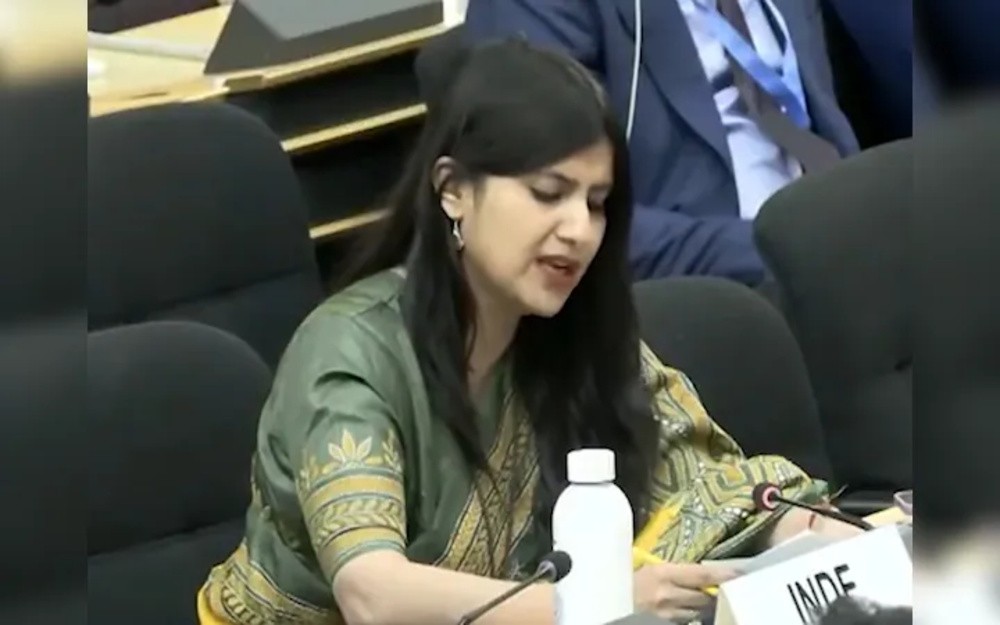
New Delhi exercised its Right to Reply on February 25 during the high-level segment of the Council.
The exchange added to the long-running diplomatic contest between the two neighburs at global forums, where Jammu and Kashmir routinely becomes the flashpoint.
India’s envoy to Geneva Anupama Singh firmly rejected statements made by Pakistan and the Organization of Islamic Cooperation stated the grouping had reduced itself to an “echo chamber” for one country.
“We categorically reject these allegations,” Singh said, asserting that Pakistan’s “incessant propaganda now reeks of envy.”
India restated legal position on Jammu and Kashmir
She reaffirmed India’s established stand, Singh told the Council that Jammu and Kashmir “was, is, and will always remain an integral and inalienable part of India.”
Ms. Singh described the region’s accession in 1947 as “completely legal and irrevocable,” carried out in line with the Indian Independence Act and international law.
“The only outstanding dispute regarding this region is the illegal occupation of Indian territories by Pakistan,” she said, urging Islamabad to vacate areas under its control.
Chenab bridge and IMF bailout used to counter Pakistan’s claims
Singh referred to the Chenab Rail Bridge, described as the world’s highest railway bridge, inaugurated in Jammu and Kashmir last year.
“If the Chenab Rail Bridge, the world’s highest bridge, inaugurated in Jammu and Kashmir last year, is fake then Pakistan must be hallucinating or living in the ‘La-la-land’,” she said.
She also drew a financial comparison, claimed that Jammu and Kashmir’s development budget is “more than double the recent bailout package” Pakistan asked for from the International Monetary Fund.
The contrast, she suggested, reflected differences in governance and economic direction.
In response to criticism of democratic processes, Singh remarked that it was “hard to take lectures on democracy from a country where civilian governments rarely complete their terms.”
She pointed to voter participation in recent general and assembly elections in Jammu and Kashmir as proof that people in the region have “rejected the ideology of terrorism and violence” and are choosing development.
Singh in her closing remarks accused Pakistan of pursuing “relentless state-sponsored terrorism” aimed at destabilizing the region, while maintaining that Jammu and Kashmir continues to advance economically, politically, and socially.
“Pakistan would do well if it focuses on fixing its deepening internal crisis rather than masking it with grandstanding at such a platform,” she said.
She added that “the world can certainly see through its charade.”
The UNHRC session is underway in Geneva from February 23 to March 31.
