

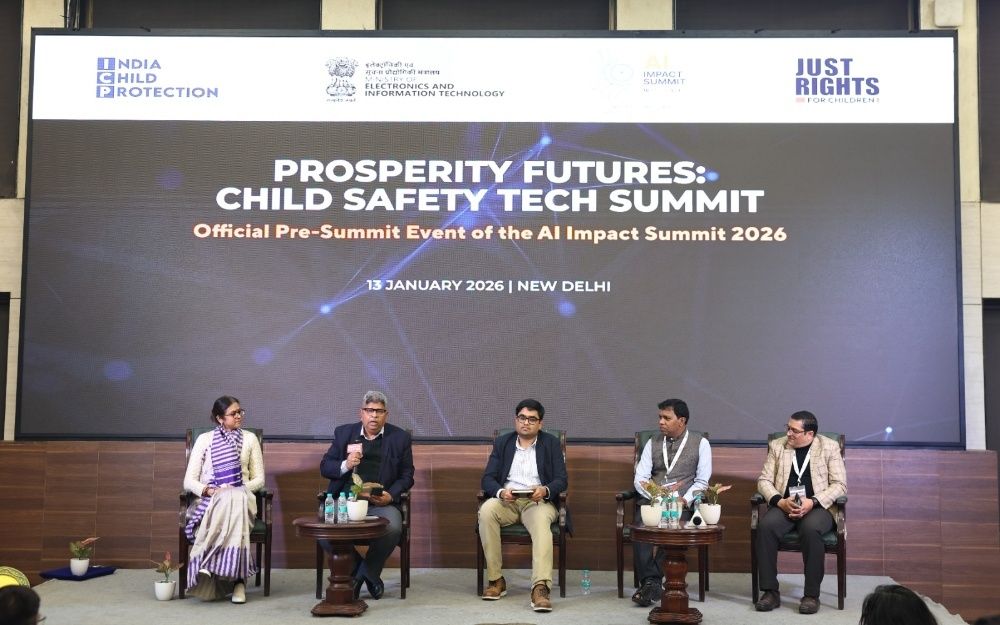
- World’s First AI-Led Child Protection Tool: India launches ‘Raksha’ to combat child trafficking, child marriage and online sexual exploitation (CSEAM).
- Launched Ahead of India-AI Impact Summit 2026: Unveiled at the official pre-summit event, highlighting India’s leadership in AI for social good.
- Advanced Predictive Prevention Capabilities: Uses real-time data analysis to map risk zones, identify vulnerable children and disrupt organized trafficking networks.
- Three-Pronged Protection Framework: Focuses on preventing child marriage, dismantling trafficking syndicates, and strengthening digital child safety.
- Powered by Strong Grassroots Network: Built by Just Rights for Children with support from 250+ civil society organisations across 451 districts.
GG News Bureau
New Delhi 14th January :India has taken a decisive global lead in child protection by launching ‘Raksha’, the world’s first comprehensive AI-powered tool aimed at preventing crimes against children. The initiative targets child trafficking, child marriage, and the circulation of Child Sexual Exploitative and Abuse Material (CSEAM), positioning India at the forefront of technology-driven child safety solutions.
India-AI Impact Summit 2026
The landmark launch comes ahead of the Government of India’s India-AI Impact Summit 2026, scheduled from February 16 to 20, and reflects the country’s growing commitment to deploying artificial intelligence for social good. ‘Raksha’ was unveiled at the Prosperity Futures: Child Safety Tech Summit, the official pre-summit event, by Jitin Prasada, Union Minister of State for Electronics and Information Technology and Commerce and Industry.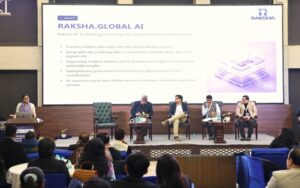
Raksha
Developed by Just Rights for Children (JRC) in partnership with India Child Protection and supported by the Ministry of Electronics and Information Technology (MeitY), Raksha leverages advanced AI capabilities along with JRC’s extensive on-ground network of over 250 civil society organisations operating across 451 districts. This integration of grassroots action and cutting-edge technology enables stronger prevention, early detection, and rapid response to crimes against children.
At its core, Raksha analyses nationwide datasets to generate real-time intelligence. It maps trafficking and child marriage heat zones, identifies vulnerable children and communities, tracks source and destination routes of organized trafficking networks, and detects emerging patterns of exploitation. The tool is designed not merely for post-crime intervention but for predictive prevention, enabling authorities and civil society to act before harm occurs.
Addressing the summit digitally, Minister Jitin Prasada underscored that the true value of technology lies in safeguarding the most vulnerable. He noted that children represent the future and emphasized the collective responsibility to ensure that the digital world they inherit is safe, inclusive, and empowering. He congratulated Just Rights for Children for leading this initiative and fostering collaboration among government, technologists, and civil society.
Rights for Children
Bhuwan Ribhu, Founder of Just Rights for Children, described Raksha as a milestone in India’s global leadership in child protection. He stated that by transforming data into actionable intelligence, Raksha can expand access to justice, improve service delivery to vulnerable families, and help track every child in need of care and protection through ethical and responsible use of technology.
Member of Parliament Lavu Sri Krishna Devarayalu, Convenor of MPs for Children, highlighted that artificial intelligence has moved from promise to present reality. He emphasized AI’s role in shifting systems from reaction to prevention, allowing early warnings based on patterns linked to migration, education, geography, and socio-economic factors, while reinforcing—not replacing—human judgment.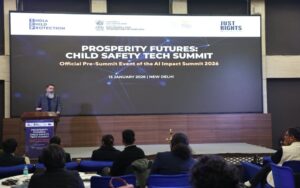
Raksha operates through three focused tools: one addressing economic vulnerability to prevent child marriage, another disrupting organized trafficking by tracking financial and logistical networks, and a third strengthening digital child protection by identifying online CSEAM hotspots and IP-level activity.
In 2025 alone, JRC’s work with NITI Aayog connected over 2 million vulnerable families to welfare schemes, prevented nearly 200,000 child marriages, and rescued more than 55,000 children from trafficking and exploitation—demonstrating the scale at which Raksha is poised t
