
IMF’s Numbers Tell the Real Story: Bharat Soars While Rahul Gandhi Scoffs
“Rahul Gandhi Called It a ‘Dead Economy’ — The IMF Just Proved Him Wrong”

Paromita Das
New Delhi, 17th October: In a world grappling with inflationary shocks, fragile supply chains, and renewed trade wars, Bharat has surged ahead with confidence. The International Monetary Fund (IMF), in its October 2025 World Economic Outlook, has upgraded its forecast for Bharat’s GDP growth to 6.6 % for the fiscal year 2025–26—0.2 percentage points higher than its July projection. This outstanding revision places Bharat firmly atop the list of fastest-growing major economies, leaving the United States at 2.0 %, China at 4.8 %, and others such as Japan and Germany inching at 1.1 % and 0.2 % respectively.
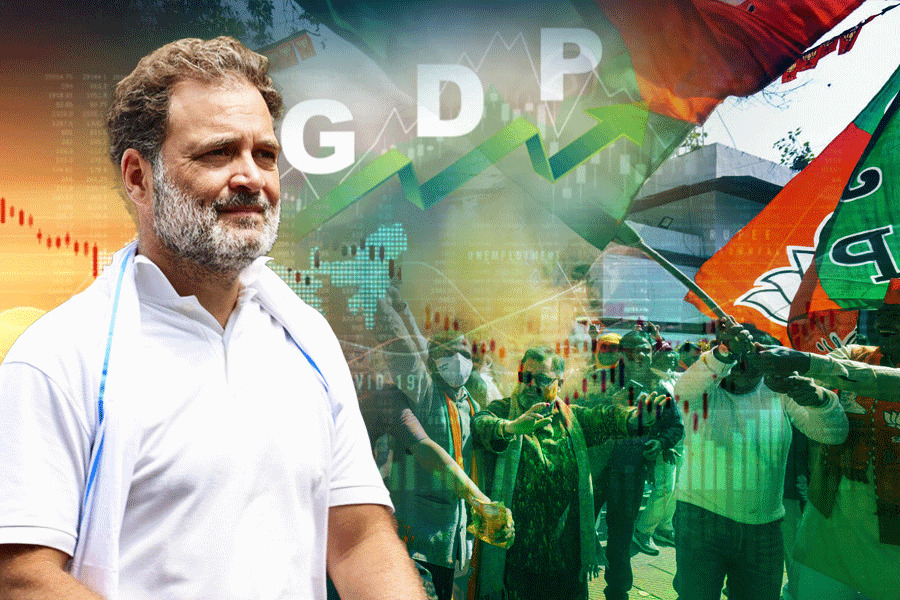
This isn’t just numbers on a page. In the public discourse, a bold allegation had recently surfaced—Congress leader Rahul Gandhi had echoed former U.S. President Donald Trump’s stark labeling of Bharat as a “dead economy.” But in a striking reversal of narrative, the IMF’s upgraded outlook delivers a powerful rebuttal: Bharat is not just alive economically—it is surging forward.
Bharat Stands Apart Amid Global Headwinds

While most advanced economies struggle under headwinds of sluggish demand and trade disruption, Bharat’s momentum stems from robust domestic demand, policy continuity, and structural reforms. The IMF specifically cites a “strong Q1 momentum” and resilient consumer spending as key pillars sustaining growth.
Even with the imposition of steep U.S. tariffs on Bharatiya imports—some estimates placing the effective tariff burden at 35.8 %, second only to China—Bharat’s internal growth engines remain firmer than many anticipate. The IMF notes that the first quarter’s carryover has more than compensated for the drag from those tariffs.
In comparison, the United States is projected to grow by only 2.0 %, China by 4.8 %, and other advanced economies like Germany and Japan remain mired in sub-1 % growth zones. Even the earlier IMF forecasts that had pegged Bharat’s growth at 6.4 % now give way to this more assertive projection.
Rahul’s “Dead Economy” Line Cuts Hollow

In July 2025, Rahul Gandhi publicly endorsed Trump’s remark that the Bharatiya economy was “dead,” adding that he was “glad” Trump expressed what he claimed was a hard truth. The statement stirred controversy even within Congress, with senior party leaders pushing back. At the time, it looked like a rhetorical gambit—but now, the IMF’s clear affirmation of Bharat’s resilience makes that stance look ill-conceived, if not opportunistic.
In political terms, Gandhi’s alignment with a foreign leader’s insult undermined the ethos of national interest. While opposition leaders are entitled to critique policies, lending legitimacy to a claim of economic death—amid rising global growth expectations—placed the narrative in troubling territory. The IMF’s data now stands as a strong counterpunch to that narrative—and arguably, a symbolic vindication of Bharat’s self-belief.
Why Bharat Surges: Structural Strengths & Strategy

Bharat’s rebound is not a fluke—it flows from deliberate policy and structural advantage. Analysts point to these key factors:
- Demographics & Workforce: A young and growing labor force continues to drive consumption, attract investment, and push innovation.
- Policy Continuity: Reforms in taxation, ease of doing business, and manufacturing (like “Make in India”) provide an enabling ecosystem.
- Macroeconomic Stability: Inflation has remained contained, interest rates manageable, and fiscal discipline largely maintained—earning praise from multilateral institutions.
- Digital & Green Growth: Bharat’s push into digital infrastructure, energy transition, and tech services acts as shock absorbers against external shocks.
Even as the IMF flags risks—especially from escalating U.S.–China trade tensions—it acknowledges Bharat’s internal buffers. While the global economy is forecast to grow more modestly (around 3.0 – 3.2 % in 2025), Bharat’s divergence underscores its exceptional trajectory.
Politics Should Not Trump Progress

The impeachment of economic credibility through rhetoric happens when political grandstanding overrides substance. Rahul Gandhi’s “dead economy” echo may have played to domestic audiences, but it also recklessly aligned with a foreign leader’s insult. In contrast, the IMF’s assertion is grounded in rigorous data, model calibration, and global benchmarks. The differentiation is critical.
In a democratic polity, opposition voices must hold power to account. But when critique devolves into undermining national confidence, it does a disservice to citizens. The IMF’s projection should prompt all political actors—regardless of stripe—to recalibrate—from hyperbole to constructive debate.
Bharat’s Ascent Is Real, Not Rhetoric
Bharat’s revised 6.6 % growth forecast is more than an optimistic statistic—it is a mark of resilience, strategy, and sustained policymaking. In the face of headwinds like tariffs, inflationary pressures, and global uncertainty, the economy not only held ground—it accelerated.
Rahul Gandhi’s alignment with a claim of Bharat as a “dead economy” now looks painfully out of sync with evolving facts. The IMF’s data-driven verdict doesn’t just elevate Bharat’s economic standing—it challenges political posturing detached from empirical reality.
At this junction, Bharat’s story is being written in factories, startups, farms, and service sectors—not in slogans abroad. And the new forecast is not just a rebuttal—it’s an invitation: to all political voices, to meet the facts, elevate discourse, and contribute to an Bharat whose growth speaks louder than their criticisms
