

Anjali Sharma
GG News Bureau
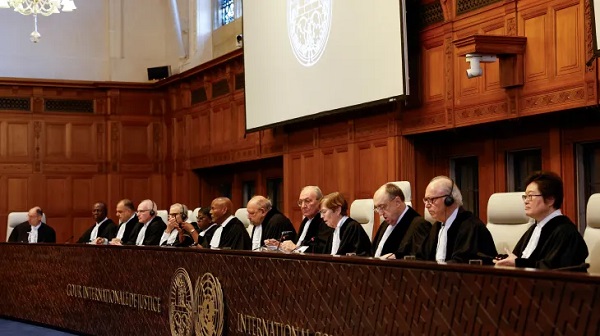
UNITED NATIONS, 27th Jan. International Court of Justice on Friday issued an order declared that Palestinians had a right to be protected from acts of genocide, called on Israel to “take all measures within its power” to prevent such actions and allow the entry of desperately needed humanitarian aid into Gaza strip.
The order at the ICJ in response to allegations of genocide against Israel by South Africa which Israel denied.
ICJ President Joan Donoghue also called for the release of all remaining hostages taken from Israel during the Hamas-led attacks on Israeli communities in which some 1,200 people were massacred on 7 October.
There was no explicit call for an immediate halt to Israel’s full-scale military operation in Gaza which is believed to have left more than 26,000 dead, according to Gaza health authorities.
Judge Donoghue highlighted that the ICJ was “acutely aware of the extent of the human tragedy unfolding in the region” since war erupted in Gaza.
He said that the court remained “deeply concerned about the continuing loss of life and human suffering”.
Secretary-General António Guterres noted in a statement issued in New York by UN spokesman office stated that the measures pertaining to the Israeli military laid out in the provisional ruling.
He stressed that “decisions of the Court are binding” and trusts that all parties will duly comply with the order from the Court.
“In accordance with the Statute of the Court, the Secretary-General will promptly transmit the notice of the provisional measures ordered by the court to the Security Council,” UN Spokesperson Stéphane Dujarric said.
South Africa asked the ICJ to indicate provisional measures in order to “protect against further severe and irreparable harm to the rights of the Palestinian people under the Genocide Convention”.
The measures South Africa asked for was the immediate suspension of military operations by Israel in the Strip and that its forces take “all reasonable measures” to prevent genocide.
South Africa also asked the world court to order Israel to prevent forced displacement, allow adequate food and water to reach civilians and ensure that evidence of any potential genocide is preserved.
Provisional measures are a type of temporary injunction ahead of a final decision on the dispute. It is likely to take years before a judgement is reached, the court papers stated.
The measures are considered “mandatory for implementation”, but the Court has no means of enforcing them.
Israel argued and presented its case that the war on Hamas was one purely of defence and “not against the Palestinian people”.
Lawyers for Israel said that provisional measures, if granted, would amount to “an attempt to deny Israel its ability to meet its obligations to the defence of its citizens, to the hostages and to over 110,000 displaced Israelis”.
ICJ judge noted that both South Africa and Israel were States parties to Genocide Convention and therefore had agreed “to prevent and to punish the crime of genocide” detailing the provisional measures that Israel should implement.
Judge Donoghue quoted article 2 of the key international treaty signed in the aftermath of the Second World War explained that genocide was defined as “acts committed with an intent to destroy, in whole or in part, a national, ethnical, racial or religious group”.
She said that 2 million Palestinian population did indeed constitute a distinct group in the court’s view.
On the article 3 of the Genocide Convention, which prohibits “conspiracy to commit genocide” and public incitement to commit genocide, the judge said that the ICJ had taken note of a number of statements made by senior Israeli officials.
These included comments by Yoav Galant, Defense Minister of Israel, who reportedly told troops on the border with the enclave that they were fighting “human animals” who were the “ISIS of Gaza”.
Judge Donoghue noted the international community’s longstanding concerns about the deteriorating humanitarian situation in Gaza which had formed part of its deliberations.
Guterres in a written letter warned the Security Council on 6 December 2023 in which he said that “nowhere is safe in Gaza amid constant bombarding by the Israeli Defense Forces” and that the situation was “fast-deteriorating into a catastrophe with potentially irreversible implications for Palestinians as a whole and for peace and security in the region”.
The dire situation in Gaza from UN Emergency Relief Coordinator Martin Griffiths, reports from WHO and UN Palestine relief agency chief Philippe Lazzarini were quoted directly in the court’s decision.
ICJ also asked Israel to submit a report within a month “on all measures taken to give effect to this order” In addition to the provisional measures delivered on Friday.
