
Mohan Bhagwat – About Hindu Civilization
Hindu civilizaton is Rooted in Acceptance, Mutual Respect, and Shared Consciousness

Poonam Sharma
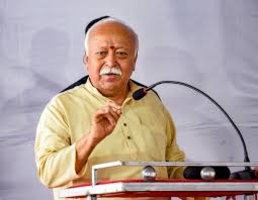
During the “Sangh@100” series event organized at Imphal, RSS Sarsanghchalak Shri Mohan Bhagwat delivered a comprehensive address on the philosophical foundations, cultural responsibilities, and civilizational continuity of Hindu society. While addressing the swayamsevaks, academicians, social leaders, and representatives of civil society, Bhagwat talked about the essence of Hindu civilization, which he identified as “open, inclusive, and deeply rooted in acceptance.”
His address, replete with historical reflections and contemporary relevance, laid out a broader framework for how Hindu thought can shape India’s internal harmony as well as its role in global affairs.
A Civilisation of Acceptance Rather Than Assertion
Bhagwat explained at the outset that Hindu civilization was not defined by territorial or political boundaries but by values and a worldview. At the root of it all, he emphasized, lay one basic principle: स्वीकार — acceptance.
“Hindu civilization thrives not by rejecting the other,” Bhagwat said, “but by accommodating diverse ways of thinking, worshipping, living, and believing.” This, he said, was not tolerance alone but an active, conscious acceptance of diversity.
He reminded the audience that India’s civilizational traditions never insisted on a single path, but let many schools of thought prosper—from Advaita to Sikh philosophy, from folk traditions to organized practices. This plurality, he argued, is the true strength of Indian society.
Mutual Respect as the Basis of Social Harmony
Bhagwat linked acceptance with mutual respect and argued that genuine harmony cannot be based on uniformity but rather comes when people and communities recognize the experiences, aspirations, and dignity of one another.
He said that Hindu society traditionally viewed the world as one family—Vasudhaiva Kutumbakam—and gave equal reverence to nature and people. Indian civilization has always emphasized coexistence over conflict, be it in the form of river worship, respect for animals, or spiritual democracy.
He did concede, however, that divisive politics, imported ideological conflicts, and rampant materialism of late have steadily eroded that sense of mutual respect. He called on society to reinstate those values through dialogue and collective action.
Shared Consciousness: The Unifying Thread
Elaborating on the idea of a “shared consciousness,” Bhagwat explained that India’s unity wasn’t superficial or forced but emanated from deeper, civilizational memory. Beyond the differentiation in languages, customs, and local traditions, Indians have a common cultural identity shaped through centuries of shared experiences, epics, festivals, pilgrimages, and quests for spirituality.
He said that this was the civilizational consciousness that held India together through all the centuries of change, invasions, kingdoms, and empires. It is the same consciousness that shapes the modern idea of India.
Bhagwat clarified that such unified consciousness does not imply homogenization but coherence, a sense of belonging to the larger cultural whole.
RSS at 100: A Century of Service and Social Responsibility
Speaking on the centenary of the Rashtriya Swayamsevak Sangh, Bhagwat reflected on its journey during the last hundred years. He said the Sangh has always worked to strengthen the society from the grassroots through discipline, dedication, and service.
He also recalled that RSS volunteers have played major roles in social movements, disaster relief, national reconstruction, and the preservation of culture. The organization had always believed in “nation-building through character-building,” he said.
Yet, he reminded the swayamsevaks that their work is not to seek credit for themselves or political gains but to discharge a larger responsibility: strengthening society so that it stands united and confident.
Addressing Contemporary Challenges
Bhagwat’s address also referred to several modern issues: conflicts over identity, misinformation, social fragmentation, and global uncertainties. He said India could find a way through such problems not by emulating other countries but by re-engaging with its own civilizational values.
He reproached the trend of interpreting Indian society through Western ideological glasses and said that most of these frameworks are incapable of comprehending India’s social complexity. Instead, he urged scholars, youth, and policymakers to develop perspectives rooted in Indian knowledge systems, ethics, and cultural realities.
At the same time, he emphasized the need for the Indian traditions to be dynamic, saying, “Our values are eternal, but our expressions have to change with times.”
Call for Unity, Responsibility, and Cultural Confidence
In his concluding remarks, Bhagwat urged citizens to rise above narrow divisive politics and rediscover their cultural confidence. He said India today stands at a crossroads—where internal unity and external responsibilities both demand seriousness and maturity.
He called on youth to embrace curiosity, not cynicism; communities to uphold cooperation over division; and leaders to promote consensus over confrontation. Finally, he said that India’s role in the world depends on its social harmony internally.
He reiterated that Hindu civilization does not claim superiority but offers a model of coexistence, which the world increasingly needs, especially in light of rising geopolitical tensions and clashes between cultures. A Message Rooted in Continuity and Hope Mohan Bhagwat’s message in Imphal was both philosophical and practical: an appeal to India to look within for strength and outside with confidence. His emphasis on acceptance, mutual respect, and shared consciousness reflects a larger push for social cohesion as India undergoes a rapid transformation. As RSS enters its 100th year, Bhagwat’s address framed the organization as not merely a cultural movement but one ensconced in long-term civilizational effort anchored in service, harmony, and national integration.
