
Guterres tells world body to finance “our future and ‘change course’

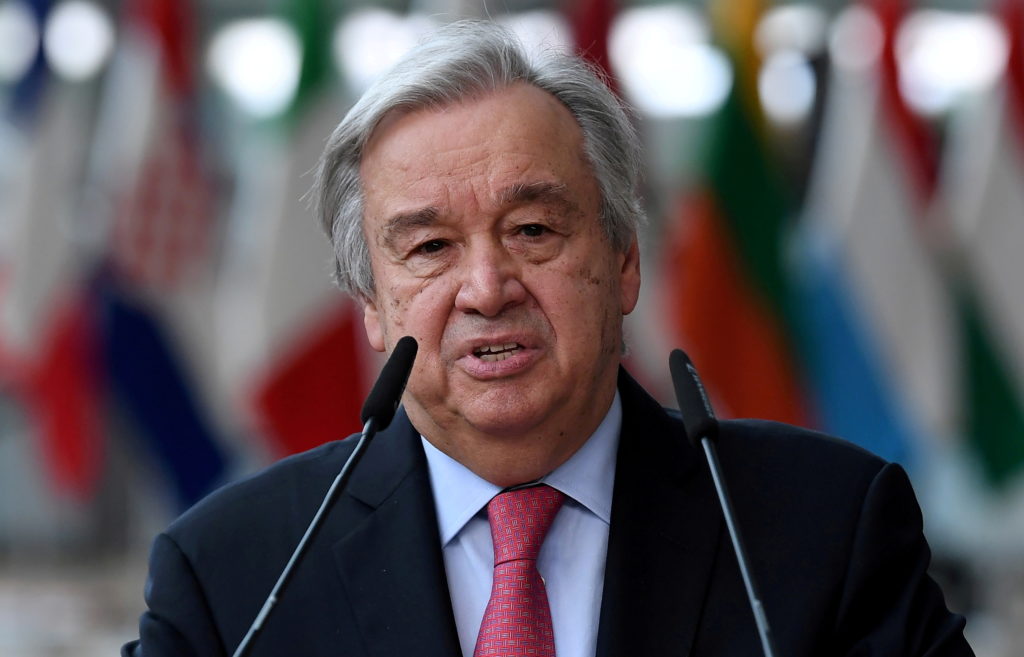
By Anjali Sharma
UNITED NATIONS – UN Secretary General Antonio Guterres on Monday told world leaders “We’re here in Sevilla to change course,” as he called to grasp a once-in-a-decade opportunity to close a $4 trillion financing gap facing developing countries to meet sustainable development goals and build a better world for all.
Guterres issued his clarion call noted that sustainable development powered by international cooperation, is now facing “massive headwinds.”
Guterres noted that multilateralism itself is also feeling the heat, while trust between nations and institutions fray at the opening session of the 4th Financing for Development Conference in Sevilla, Spain.
He said that the world is on fire, shaken by inequalities, climate chaos and raging conflicts “Financing is the engine of development and right now, this engine is sputtering,” he told the conference.
It was attended by close to 60 world leaders, over 150 nations and around 15,000 delegates.
“As we meet, the 2030 Agenda for Sustainable Development – our global promise to transform our world for a better, fairer future – is in danger.”
Some two-thirds of the ambitious Sustainable Development Goals targets agreed in 2015 are significantly off track but the staggering $4 trillion investment needed to turn it around.
“We are here in Sevilla to change course. To repair and rev up the engine of development to accelerate investment at the scale and speed required,” said Mr. Guterres.
He described the outcome known as the Sevilla Commitment adopted on Monday – without the United States which pulled out of the process earlier this month – as a “global promise” to low-income nations to lift them up the development ladder.
He insisted first, get resources flowing fast at home to spur sustainable growth, and for richer countries to honor their pledge under the accord to double aid to poorer countries to boost development. This includes tripling the lending capacity of Multilateral Development Banks and innovative solutions to unlock private cash.
Second, fix the “unsustainable, unfair and unaffordable” global debt system. Right now, poorer countries are spending around $1.4 trillion just servicing their vast debts in the form of interest payments. Among the innovations, a new borrowers’ forum will ensure fairer debt resolution and action.
Third, reform the global financial architecture, with major shareholders playing their part, so that it empowers every country. “We need a fairer global tax system shaped by all, not just a few.”
The current crisis of affordability and stalled development is “a crisis of people,” he continued, which leaves families hungry, children unvaccinated, and girls left out of education.
“This conference is not about charity. It’s about restoring justice and to facilitate the ability of all people to live in dignity,” said Mr. Guterres.
“This conference is not about money – it’s about investments in the future we wish to build together.”
King Felipe of Spain spoke ahead of the official opening, telling delegates the multicultural city of Sevilla welcomes the world “with open arms”.
He said a new roadmap would emerge that is based on what is “concrete and tangible and actionable”.
King said that the conference must be a success, because cooperation is one of our fundamental pillars of the multilateral world and “the ultimate embodiment of the values that sustain it – especially at this particular point in history where many certainties are melting away and many fears and uncertainties are taking shape.”
Spain’s Prime Minister Pedro Sánchez told delegates “our time is now and our place is here.” Millions of lives will depend on the choices made in Sevilla and going forward.
“We must choose “ambition over paralysis, solidarity over indifference and courage over convenience,” he continued.
He added that the eyes of world are on this hall, to see what we are ready to do together and in the face of this historic challenge we must prove our worth.”
Sevilla was “the New York of the 16th century” in diplomatic terms he told delegates and a cradle of globalism we must all do that legacy justice today.
Head of the conference, Li Junhua who’s in charge of the UN’s Department of Economic and Social Affairs said the week in Sevilla is key moment to mobilize the resources necessary to build a just, inclusive and sustainable future.
He said that the UN effort to finance development has been anchored in multilateralism and solidarity but today, the whole framework is under “profound stress.”
Li Junhua said never has sustainable development been so tested but the pact made in Sevilla puts people back at the centre.
“Sevilla is not an end point it is a launch pad for a new era of implementation, accountability and solidarity.” UNDESA is ready to support all nations to translate the commitment into international action, he underscored.
President of the General Assembly Philémon Yang told delegates above all, “we need leadership to guide the world forward into a brighter more prosperous future for everyone, everywhere.”
He said the Sevilla framework will renew global partnership for the decade ahead and provide a focus on a debt burden which is crippling the developing world.
President of the UN Economic and Social Council Bob Rae said trust between countries had to be strengthened, because its absence “creates chaos.”
“Most of all I want to congratulate states for bringing forward the ambition, deepening engagement between financial institutions.”
The week represents a real commitment to action, he said.
Ajay Banga, President of the World Bank Group, told delegates to end poverty remains his key mission and the surge in population underway in developing countries requires resources “at an unprecedented scale and pace.”
He said everyone knew that governments, philanthropies and institutions are unable to meet every projection or promise – which is why the private sector is essential to the Sevilla Agreement so that capital can flow.
Mr. Banga added that the bank’s reforms of recent years are about being a better partner to the private sector and government clients.
He said that improving response time, boosting capital and systems of growth are key but much more is needed to deliver for the next generation.
Ngozi Okonjo-Iweala, Director-General of World Trade Organization said the conference was gathering at a time of unprecedented difficulty.
She noted that after decades of positive contributions, the global trading system has now been “severely disrupted” leaving exports so hampered by unilateral tariff measures and policy uncertainty that the WTO has sharply downgraded growth forecasts.
The tariff barriers on 9 July – the deadline set by the US administration – will only make the contraction in global trade worse.
She reminded that the WTO has argued for the least developed nations and Africa overall to be exempted from the tariffs, “so we can better integrate them into the world trading system, not further exclude them.”
Ngozi Okonjo-Iweala said the Sevilla Agreement rightly recognizes international trade as an engine of development.
“We therefore need to bolster stability and predictability in global trade,” through action at many levels that can grow national resources through exports, she told delegates.
Nigel Clarke, Deputy Managing Director of the International Monetary Fund called for broadening the tax base, building strong financial management systems, coordinating support and addressing debt more sustainably.
“Many countries continue to struggle with high interest costs,” he said.
He called on the international community to improve debt restructuring processes.
Through its capacity development, the Fund is equipping members to chart their own paths and is also providing financial support when they need it most, he added.
Emmanuel Macron, President of France said that “We must see the most vulnerable countries as partners rather than prey. We must respect their development choices”
“Collective mobilization can still work,” he said.
He called for greater mobilization of new funding, leveraging Government to draw more on private sector funding, providing assistance for sustainable healthcare policy and supporting fair domestic taxation.
Banks, agencies and funds must become more pragmatic, he said.
He stressed the need to be more project based, he said, adding that when assuming the presidency of the Group of Seven (G7) next year, France will ensure pragmatic reform of the international financial architecture.
Mohamed Younis A Menfi, Chairman of the Presidential Council of Libya said that the road ahead is still long. We cannot go it alone. We need the support of the international community.”
He called for technical assistance; capacity building; knowledge exchange, particularly through partnerships; ensuring stability and security within the framework of sustainable development; and auditing measures to ensure investments are used efficiently.
Mohamed Younis A Menfi, stressed that Libya’s rich natural resources, robust sovereign fund and strategic location in the Mediterranean make it a valuable regional and international development partner, he made a “simple and urgent request” to support the country’s development efforts. Developing countries like Libya need help alleviating their debt burdens and reducing the cost of their debt servicing.
“We want the Sevilla Commitment to be translated into reality and to build better future for Africans and the world,” he said.
Yamandú Orsi, President of Uruguay said “If development is truly a shared goal, the means by which we achieve that shared goal must be shared.”
He stressed that “social justice cannot be built when you treat what is not the same as if it were”.
Yamandú Orsi called for significantly increasing official development assistance and building sustainable and predictable financing mechanisms that support productive social and environmental transitions in developing countries.
Poverty eradication must be put back at the centre of the global financing and trade pact, he sai.
He stressed that it must lead to decent employment and real opportunities that truly lift people out of poverty.
King Mswati III, Head of State of Eswatini said that “We appeal to the developed nations to share technology transfer to enhance renewed strategies for sustainable financing.”
He stressed that doing so will boost development of new industries such as science and technology parks, mining, pharmaceuticals, agriculture, tourism, small and medium-sized enterprises and infrastructure development.
King Mswati II added that the quest to ensure a fair financing system for developing countries “must not be misinterpreted as a matter of charity, but as a necessity.”
He called for reforms in credit-rating agencies, more equitable allocation of Special Drawing Rights and a move towards more innovative mechanisms, such as climate bonds, blended finance and debt-for-nature swaps.
“These instruments must be scaled up to unlock the catalytic potential of both public and private capital” in order to finance the $4.3 trillion SDG gap, he said.
Deputy Secretary-General of the UN Amina J. Mohammed, gave the opening remarks said that the Conference holds its first multi-stakeholder round table this afternoon on “Mobilizing and aligning domestic public resources”.
It was co-Chaired by Alar Karis, President of Estonia, and Mohamed Juldeh Jalloh, Vice-President of Sierra Leone, it will feature a special address Daniel Noboa Azin, President Ecuador. Denys Shmyhal, Prime Minister of Ukraine, gave a keynote address.
Gilbert F. Houngbo, Director-General of the International Labour Organization moderated the discussion.
Panellists include: José Manuel Albares Bueno, Minister for Foreign Affairs for European Union and Cooperation of Spain; Reem Alabali Radovan, Federal Minister for Economic Cooperation and Development of Germany; Cheikh Diba, Minister for Finance and Budget of Senegal; and Nigel Clarke, Deputy Managing Director of the International Monetary Fund.
Nadia Calvino, President of the European Investment Bank, and Yingming Yang, Vice President of the Asian Development Bank, discussed the panel.
Ursula von der Leyen, President of the European Commission, said “Our commitment is here to stay,” pledged the bloc’s commitment to reform the international financial architecture and mobilize new sources of financing.
She said that as the Sustainable Development Goals financing gap is in the trillions of dollars, a “change of paradigm” is needed to close it and that is “exactly what Europe aims to deliver”.
António Costa, President of the European Council spoke for the European Union and its Member States pointed out that the bloc provides 42 per cent of official development assistance totaling €95 billion in 2023.
João Manuel Gonçalves Lourenço, President of Angola on behalf of the African Group said “We should engage in a profound reflection on the reforms required in the international financial system, wherein those most in need must have an active role and be included in decision-making processes.”
“Only with these conditions assured will it be possible to realize the goals set forth in the aforementioned development agendas, thereby preventing the Sustainable Development Goals from becoming merely a declaration of good intentions.”
He spotlighted the issue of Africa’s debt, which “acts as a brake on development” and “consumes more resources than those allocated to health and education combined”.
He added that he is “confident” that the conference will adopt decisions that will reduce the costs of indebtedness and strengthen African countries’ influence in global financial governance.
Abdul Latif Rashid, President of Iraq, spoke on behalf of the Group of 77 and China said “We support this document as a balanced, constructive and forward-looking framework that reflects the collective aspiration to scale up efforts in mobilizing financing for sustainable development, particularly for developing countries.”
He stressed that the document must “ensure that the voices, needs and priorities of developing countries are meaningfully addressed”, he reiterated the centrality of North-South cooperation.
Abdul Latif Rashid added “South-South cooperation is a complement, not a substitute.”
He underscored the need to strengthen domestic resource mobilization, improve the international tax system, reform the international financial architecture, ensure fair representation of developing countries in international financial institutions and eliminate all unilateral economic, financial or trade measures against developing countries, among others.
World leaders unanimously adopt “Sevilla Commitment” outcome document recommended that the General Assembly endorse it at its seventy-ninth session.
Heads of State and Government and high representatives commit to a renewed global financing for development framework and action in three key areas by the terms of the document.
The first area – domestic public resources – includes access to financing, remittances and correspondent banking relationships; international development cooperation and development effectiveness; international development cooperation and development effectiveness; debt and debt sustainability; and international financial architecture and systemic issues.
The second area is science, technology, innovation and capacity-building, and the third is data, monitoring and follow-up.
