
Guterres says wars, climate chaos, food crisis ‘threats to global order’

Anjali Sharma
GG News Bureau
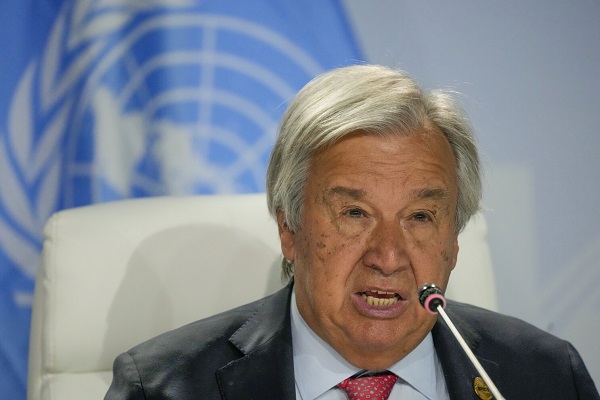
UNITED NATIONS, 14th Feb. UN chief António Guterres said on Tuesday addressed the Security Council meeting focused conflict, climate and food insecurity and urged countries to must act now to break the deadly links between these challenges.
He said that “Climate chaos and food crises are serious and mounting threats to global peace and security. It is only right that they are addressed by this Council”.
Over 90 countries took part in the debate, convened by Guyana which holds the presidency of the Security Council for this month.
Mr. Guterres said climate disasters and conflict both inflame inequalities, imperil livelihoods, and force people from their homes. They are two of the leading drivers of the global food crisis, with almost 174 million worldwide affected in 2022.
He was dismayed that the world is teeming with examples of the devastating relationships between hunger and conflict.
Guterres said one such situation is Gaza, where “no one has enough to eat,” . “Of the 700,000 hungriest people in the world, four in five inhabit that tiny strip of land.”
The climate disasters add another dimension to the suffering in many places. All 14 countries that are most at risk from climate change are experiencing conflict, with 13 also facing humanitarian crisis, he said.
He noted that affected nations include Haiti, where hurricanes combine with gang violence and lawlessness, putting millions at risk.
OCHA said that in Ethiopia 16 million people need food assistance after war followed by drought – a situation that is exacerbated by the influx of refugees fleeing the conflict in neighboring Sudan.
Guterres said “Meanwhile, globally, we risk a resurgence of food inflation as droughts sap the Panama Canal and violence hits the Red Sea – throwing supply chains into disarray”.
He called for action with the climate crisis set to deepen as emissions continue to rise, and hunger increasing each year, urged all warring parties to abide by international humanitarian law.
SG stressed humanitarian operations must be fully funded “to prevent disaster and conflict from feeding hunger,”
He noted that last year they were less than 40 per cent funded.
“We must create the conditions to resolve conflict and preserve peace – within countries and between countries,” he said.
“Turbocharging progress towards the Sustainable Development Goals (SDGs) – including our goal of zero hunger – is the answer.”
Mr. Guterres further called for “massive investment” to create healthy, equitable and sustainable food systems that “feed the planet without wrecking the planet.”
He emphasized on building and financing social protection systems, and strengthening and renewing global peace and security frameworks.
Countries “must get a grip on the climate crisis to limit the rise in global temperature to 1.5 degrees Celsius,” he added.
He reiterated his call for richer nations to lead the way in phasing out fossil fuel use.
Guterres declared that the international community needs to “get serious” about climate adaptation, including through ensuring that all people everywhere are protected by early warning systems by 2027.
He recalled his proposal for a $500 billion annual SDG stimulus plan to boost sustainable development and climate action and noted greater investment in the SDGs needs to occur.
Head of the UNFCCC Simon Stiell suggested that the Security Council should request regular updates on climate security risks.
Simon Stiell added that every country must implement a National Climate Action Plan to protect people, livelihoods and the natural environment.
“Investing in climate resilience and adaptation, including changing agricultural practices towards regenerative food production while working to nurture and conserve nature, would not only blunt the damage from extreme climate events but can also ensure that future food security needs are ensured sustainably and universally, leaving no one behind,” he said.
He added that countries need money for adaptation, particularly developing nations that are vulnerable to climate shocks. They require $2.4 trillion annually to build clean energy economies and adapt to climate impacts, and funding gaps remain.
Beth Bechdol, Deputy Director-General of the FAO briefed the Council.
She reported that 258 million people in 58 countries are facing high levels of acute food insecurity, with over two-thirds due to climate and conflict.
She told that the climate crisis spares no one, “it does not affect everyone equally or in the same way,”.
“We know that the populations at greatest risk are those that depend on agriculture and natural resources. They live in rural areas, and they are farmers themselves,” she concluded.
