
Guterres calls for Gaza ceasefire, deplores ‘collective punishment’ of Palestinians

Anjali Sharma
GG News Bureau
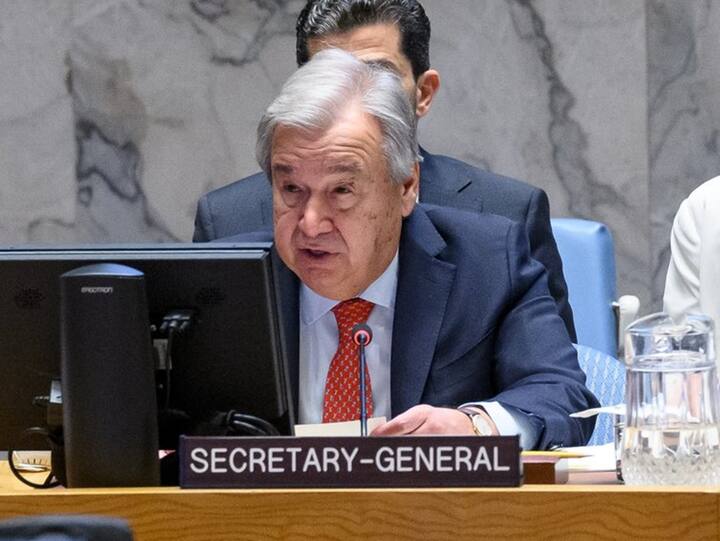
UNITED NATIONS, 16th Jan. UN chief António Guterres on Monday has emphasized the imperative to establish “basic conditions” to facilitate safe and full-scale aid delivery to civilians in Gaza as he stressed that only a ceasefire will prevent the crisis from escalating.
He expressed deep concern about the “unprecedented” level of civilian casualties and the “catastrophic” humanitarian conditions in Gaza at the press conference in New York.
“There is one solution to help address all these issues. We need an immediate humanitarian ceasefire,” Guterres said.
He recalled the 7 October terror attacks by Hamas and other militants on Israeli civilians and the taken of hostages, demanded their immediate and unconditional release.
Guterres called for a thorough investigation and prosecution of allegations of sexual violence committed by Palestinian militants.
He noted that the “onslaught” had resulted in “wholesale destruction” and an unprecedented rate of civilian killings during his tenure as Secretary-General, he was commenting on the Israeli forces’ actions in the Gaza Strip.
“Nothing can justify the collective punishment of the Palestinian people. The humanitarian situation in Gaza is beyond words. Nowhere and no one is safe.”
According to the UN agency assisting Palestine refugees, 1.9 million people in Gaza 85 per cent of the population have been displaced, some multiple times.
According Gaza’s Ministry of Health, over 23,700 Palestinians have been killed and some 60,000 more injured.
The crisis has also claimed the lives of 152 UN staff members – the largest single loss of life in the history of the Organization.
He said “Aid workers, under enormous pressure and with no safety guarantees, are doing their best to deliver inside Gaza,”.
Mr. Guterres outlined clear obstacles hindering aid into Gaza, identified not only by the UN but also by officials globally who have witnessed the situation.
He emphasized that effective humanitarian aid delivery is impossible under the heavy, widespread, and unrelenting bombardment, citing significant hurdles at the enclave’s border.
UN emphasized that vital materials, including life-saving medical equipment and parts which are critical for the repair of water facilities and infrastructure, have been rejected with little or no explanation, disrupting the flow of critical supplies and the resumption of basic services.
Guterres added “And when one item is denied, the time-consuming approval process starts again from scratch for the entire cargo.”
He noted other obstacles including denials of access, unsafe routes and frequent telecommunications blackouts.
Mr. Guterres called on the parties to respect international humanitarian law, “respect and protect civilians, and ensure their essential needs are met,” as he stressed that the UN’s efforts to increase aid.
There must be an immediate and massive increase in the commercial supply of essential goods, he added.
He noted that necessities should also be available in markets to the entire population.
Guterres warned of rising tensions in the wider Middle East.
“Tensions are sky-high in the Red Sea and beyond – and may soon be impossible to contain,” he said.
He voiced concerns that exchanges of fire across the Blue Line –he demarcation separating Israeli and Lebanese armies – risks triggering a broader escalation between the two nations and profoundly affecting regional stability.
UN chief expressed that he is “profoundly worried” by what is unfolding.
He also stressed that it is his “duty” to convey a simple and direct message to all sides:
“Stop playing with fire across the Blue Line, deescalate, and bring hostilities to an end in accordance with Security Council Resolution 1701.”
He reiterated that “Only a ceasefire can “tamp down the flames of wider war”, because the longer it continues the greater the risk of escalation and miscalculation.
“We cannot see in Lebanon what we are seeing in Gaza”, he concluded “and we cannot allow what has been happening in Gaza to continue,” he concluded his remarks.
