
From Turmoil to Tracks: Modi’s Kashmir Mission Rebuilds with Resolve

Paromita Das
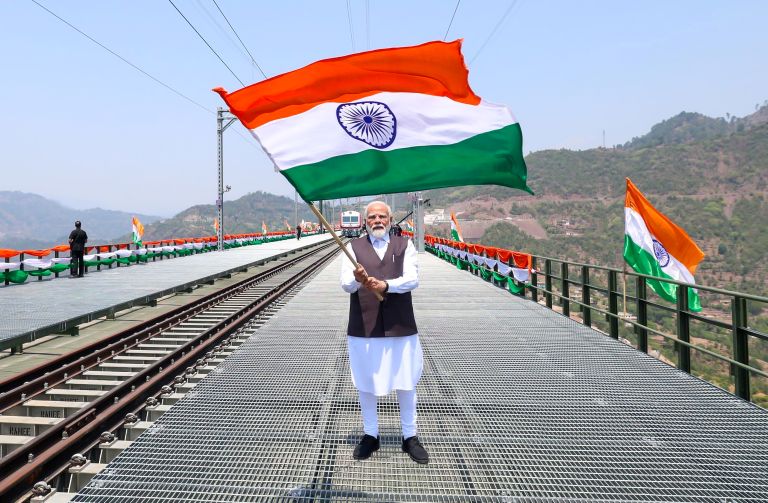
New Delhi, 11th June: Prime Minister Narendra Modi’s recent visit to Jammu and Kashmir was not merely a political engagement or a ceremonial ribbon-cutting of infrastructure. It was a moment charged with symbolism, a national assertion in the face of relentless adversity. In a region long scarred by terrorism and uncertainty, Modi’s presence — hot on the heels of the brutal Pahalgam attack and a tense military skirmish with Pakistan — served as a defiant proclamation: Bharat will not be broken by violence. It will respond not only with strength but with vision, rebuilding what terror seeks to destroy.
A Landmark Project with Deeper Significance
- More Than Metal and Concrete
The inauguration of the long-anticipated railway link connecting Kashmir to the broader Bharatiya railway network is a technological marvel, especially with the completion of the world’s highest railway arch. However, its significance lies far beyond engineering. This is infrastructure as assertion — a message that Kashmir is and remains an integral part of Bharat, both physically and emotionally. Over 28 years in the making, the project embodies the perseverance of a nation committed to inclusion and progress.
- Symbolism of Connectivity
In a region often portrayed as peripheral, such projects push against that narrative. Connectivity is not just logistical but ideological. By linking Kashmir to the rest of Bharat, the government reinforces the idea of unity — a seamless nation where barriers, whether physical or mental, are dismantled. While terrorists attempt to isolate and divide, the Bharatiya state responds by building, connecting, and integrating.
Restoration Beyond Security
- An Answer to Terrorism
The April attack in Pahalgam that claimed 26 innocent lives was not merely an act of terror — it was an attempt to attack the very spirit of Kashmir. By targeting Hindu tourists, the perpetrators aimed to strike at both communal harmony and the region’s economic lifeblood: tourism. The government’s response, however, was not limited to military retaliation or tightened security. Instead, it chose visible and proactive development — new roads, upgraded hospitals, and robust civic projects — as its instruments of resistance.
- Economic Revival and Psychological Reassurance
Such initiatives are not just about GDP figures or headlines. They send a signal to the people of Kashmir: that their future is being actively safeguarded, and their place in Bharat is non-negotiable. This is critical in a region where decades of insurgency have bred disillusionment and fear. Rebuilding must be as much about psychological healing as it is about physical development.
Contrasting Realities: Kashmir and PoK
One cannot overlook the stark contrast between Bharat’s efforts in Kashmir and the stagnant situation in Pakistan-occupied Kashmir (PoK). While Bharat invests in hospitals, railways, and economic corridors, the PoK region languishes under neglect and military control. This difference serves as a silent yet potent argument — not only to international observers but to the people on both sides of the Line of Control.
A Political Tug-of-War that Costs Lives
The Bharat-Pakistan conflict over Kashmir continues to turn every tragedy into a political talking point. When lives are lost, instead of joint condemnation or empathy, both nations retreat into rehearsed rhetoric. This zero-sum diplomacy has created a loop where tragedy begets blame, and justice remains elusive. It is time this cycle is broken — not through appeasement, but through consistent, inclusive development that speaks louder than provocation.
Development as the Strongest Defence
As an observer, one cannot help but view Bharat’s strategy — development over destruction — as both morally and strategically sound. Terrorists may operate in shadows and with explosives, but Bharat is laying foundations of light, law, and long-term stability. This is not weakness. It is patience and wisdom at play. In the age of modern warfare, the true victory lies not in conquering land but in winning hearts — and nothing achieves that better than opportunity, safety, and dignity.
Yet, the road ahead is not without its potholes. Development must be sensitive to local needs and culture. Kashmir is not just a piece of land; it is a people, a heritage, and a lived experience. Projects imposed without local consultation risk breeding the very alienation they aim to cure.
Kashmir’s Tomorrow, Bharat’s Promise
Narendra Modi’s visit to Jammu and Kashmir, especially amid recent turmoil, was more than symbolic. It was a reaffirmation of Bharat’s long-term vision for the Valley — one where terror is countered not just with force but with foresight. The rail link stands as a physical metaphor of this philosophy: stretching across valleys and rivers, resilient against the odds, and connecting what once seemed divided.
Bharat’s path is clear. While its enemies plant bombs, it will plant seeds — of growth, of unity, and of peace. Kashmir’s story belongs to its people, and to the democratic nation that calls them its own. And if this vision continues with sincerity and inclusivity, the Valley will not just survive. It will flourish.
