
From Johannesburg to New Delhi: Gupta Scandal’s Bharatiya Nexu
“As the Enforcement Directorate cracks down on businessman Piyoosh Goyal and Gupta-linked firms, the spotlight shifts to a complex web of money laundering, political connections, and unanswered questions about Kapil Sibal’s financial dealings.”

Paromita Das
New Delhi, 29th August: On August 26, 2025, the Enforcement Directorate (ED) launched raids across Delhi, Mumbai, and Ahmedabad, targeting premises linked to businessman Piyoosh Goyal of the World Window Group and companies tied to South Africa’s infamous Gupta brothers. Conducted under the Prevention of Money Laundering Act (PMLA), the raids were part of a broader effort requested by South African authorities probing the “State Capture” scandal that shook their nation.
This operation has once again turned global attention to the Guptas’ illicit financial networks, their ties to Bharat, and the unanswered questions about how deeply Bharatiya business and political circles may have been entangled in their empire of corruption.
The Web of Money Laundering
According to ED officials, investigators searched multiple properties connected to Goyal’s World Window Group and associated firms, including Sahara Computers and ITJ Retails Pvt Ltd. A key focus of the probe is suspected money laundering routed across Bharat, South Africa, and the UAE through shell companies.
One such company, JJ Trading FZE in Dubai, allegedly played a pivotal role in funnelling illicit funds for both Goyal and the Guptas. Officials revealed that financial records and electronic data are under review to trace the complex money trail, which could result in asset seizures and account freezes.
Who Are the Gupta Brothers?
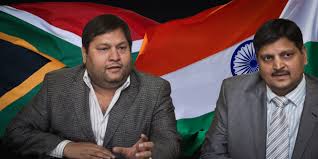
Originally from Saharanpur, Uttar Pradesh, the Gupta brothers — Ajay, Atul, and Rajesh — rose to prominence in South Africa through their ties with former President Jacob Zuma. They allegedly influenced cabinet appointments, secured lucrative state contracts, and siphoned off public funds, a process so entrenched that South Africans coined a new term: “State Capture.”
After facing mounting investigations, the Guptas fled South Africa in 2018 and relocated to Dubai. While Atul and Rajesh were arrested there in 2022, their extradition was rejected by UAE authorities. Ajay Gupta and his brother-in-law Anil Gupta were also arrested in Bharat in 2024 in a separate case.
The latest ED raids underline the seriousness with which Bharat is now cooperating with Pretoria to dismantle financial crime networks stretching across continents.
The Bharatiya Connection: Piyoosh Goyal’s Role
At the heart of the Bharatiya chapter is businessman Piyoosh Goyal, described by investigators as a “key player” in laundering funds for the Guptas. His World Window Group has long been under scrutiny, with past cases — including a bribery-for-loan scandal involving the State Bank of India — tarnishing his reputation.
The new raids suggest that Goyal may have been instrumental in providing a bridge between Bharatiya business networks and the Guptas’ illicit financial operations abroad. Allegations also link his corporate dealings with questionable property transfers and shell company manoeuvres, raising uncomfortable questions about the political connections that shielded him for years.
Unanswered Questions About Political Links
The Guptas’ story in South Africa is one of corruption eroding state institutions. But the Bharatiya dimension adds another layer — the involvement of political figures.
Public records and corporate filings suggest that opaque property deals connected to Goyal also benefited senior political families in Bharat. One particularly controversial transaction involved the takeover of a Delhi-based company that owned land worth crores, allegedly transferred at a fraction of its true value.
What remains unclear is whether these deals were merely coincidental business arrangements or part of a wider network of financial favours and quid pro quo relationships between businessmen and politicians.
Why the Raids Matter for Bharat
The ED’s latest action is more than just another financial crime case. It has geopolitical, economic, and political implications:
- For Bharat-South Africa relations: The raids demonstrate that New Delhi is serious about assisting Pretoria in holding the Guptas accountable, an important step for bilateral trust.
- For Bharat’s financial system: They highlight how easily shell companies and opaque transactions can be used to launder money across borders.
- For Bharatiya politics: The case raises questions about whether political leaders benefited, directly or indirectly, from their proximity to businessmen like Goyal.
If unanswered, these questions risk undermining public confidence in both financial oversight mechanisms and political accountability.
A Test of Political Will
The scandal has all the hallmarks of a classic corruption saga — powerful businessmen, political enablers, cross-border laundering, and selective silence from mainstream media until official agencies step in.
What stands out is not just the audacity of the financial manoeuvres but also the reluctance of political elites to confront uncomfortable truths. The evasions, denials, and threats issued when these matters were first raised only deepened the suspicion.
If Bharat’s institutions are serious about combating corruption, then investigations must go beyond businessmen like Goyal and examine whether politicians benefited from these opaque networks. Anything less risks reducing this to yet another incomplete probe that fades from memory.
Sunlight as the Best Disinfectant
The ED raids of August 26 have opened a Pandora’s box that links South Africa’s “State Capture” scandal to Bharat’s corridors of power. The Guptas may have fled South Africa, but their legacy — and networks — continue to haunt both countries.
For Bharat, this is an opportunity to demonstrate that rule of law applies equally to businessmen and politicians alike. The truth about these financial entanglements will not only shape the credibility of Bharat’s investigative institutions but also signal whether corruption can still be hidden behind influence and intimidation.
As the saying goes, sunlight is the best disinfectant. The ED raids may just be the first ray of light in exposing a web of corruption that has thrived for too long in the shadows.
