
From “Iron Brother” to Strategic Backstab: Pakistan’s Rare Earth Pivot
“As Pakistan courts Washington with rare earth diplomacy, its pivot from Beijing exposes a deeper crisis of trust, strategy, and survival.”

Paromita Das
New Delhi, 17th October: Every few years, Pakistan discovers a new savior to rescue it from the storm — sometimes dressed in the fatigues of military aid, sometimes in the promise of foreign investment. In 2025, that savior happens to mine rare earths. With the global race for critical minerals intensifying, Islamabad’s sudden pivot from Beijing’s embrace to Washington’s wallet has sparked both intrigue and suspicion. What seems like a new dawn of opportunity might, in truth, be another performance in Pakistan’s long-running theater of strategic duplicity.
From “Iron Brothers” to Calculated Bargains

For more than a decade, Pakistan has proudly celebrated its “iron brotherhood” with China — a relationship that found expression in the sprawling Belt and Road Initiative (BRI). The China–Pakistan Economic Corridor (CPEC) was billed as a lifeline for Pakistan’s struggling economy, complete with high-speed roads, energy projects, and the glittering dream of Gwadar Port.
In return, Islamabad granted China access to its reserves of rare earth elements (REEs) — minerals critical to developing smartphones, defense tech, electric vehicles, and renewable energy equipment. Chinese engineers brought machinery and capital, while Pakistan provided terrain and cheap labor. Yet behind the rhetoric of partnership lay an uncomfortable truth: many saw Pakistan turning into a raw-material appendage to China’s industrial machine. Environmental risks—particularly in Balochistan and Khyber Pakhtunkhwa—grew alongside debt burdens, feeding resentment over the illusion of sovereignty.
2025: The American Reentry

By mid-2025, Islamabad’s economy was unravelling. Inflation hit record highs; the rupee’s collapse strained every household. Confronted with a financial abyss, Pakistan began searching for another partner — this time across the Atlantic.
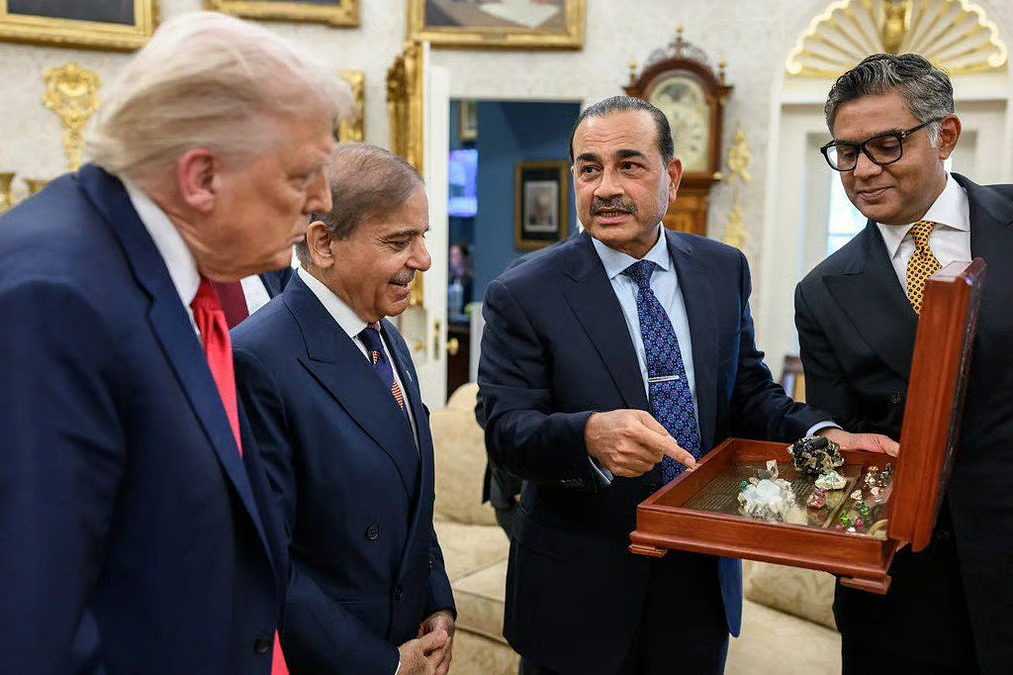
Army Chief General Asim Munir’s visits to Washington signaled a clear shift: Pakistan was ready to reset ties. Soon thereafter, Prime Minister Shehbaz Sharif joined Munir to meet President Donald Trump at the White House. The optics were striking. When the Pakistani delegation gifted Trump a wooden box of rare earth samples, it was both an investment pitch and a diplomatic statement — a message that Pakistan was open to rebranding itself as an alternative supplier of critical minerals outside Chinese control.
Within weeks, a $500 million deal was inked between Islamabad and an American mining consortium to build a poly-metallic refinery, targeting minerals including neodymium, praseodymium, tungsten, and copper. Pakistani media hailed the deal as a landmark step toward industrial independence. Yet, beneath that optimism simmered a quiet betrayal — the refinery’s operations still relied on Chinese-origin equipment. Pakistan had used China’s technology to feed American demand.
Beijing’s Silent Countermove

China didn’t erupt in anger. It didn’t need to. Its leverage lay not in words but control. Shortly after Pakistan’s shipment of refined minerals to the U.S., Beijing announced export controls on 12 rare earth elements, citing global chip tensions. Official narratives denied any link to Pakistan, but insiders revealed a tightening chokehold on Islamabad’s supply chain.
Technical cooperation slowed. Machinery shipments were “re-evaluated.” Feasibility studies on CPEC’s mining wing went mysteriously dark. Beijing was reminding Islamabad of a harsh truth — in the rare earth world, China still sets the rules. Diplomacy may prefer restraint, but silence can cut deeper than sanctions.
A Legacy of Contradictions

To observers of South Asian geopolitics, Pakistan’s double play feels déjà vu. In 2011, when Osama bin Laden was discovered in Abbottabad, mere meters from a military academy, the world saw the depth of Pakistan’s duplicity firsthand. A decade later, history’s script repeats itself: the same Washington once accusing Islamabad of “harboring deceit” now finds it offering partnership over minerals.
President Trump’s transactional worldview fits neatly with Pakistan’s opportunistic strategy — both seeking tactical wins, neither promising permanence. Islamabad is once again wagering short-term access for long-term ambiguity. The old question returns: can a nation that trades trust as a commodity ever secure credibility?
Realpolitik or Recklessness?

Proponents of Islamabad’s new direction defend it as economic realism. In their view, a crisis-ridden Pakistan cannot afford loyalty; it must keep every door open — American, Chinese, or Gulf. They argue that engaging multiple powers prevents strategic dependency, that pragmatism is not the same as betrayal.
Critics see something darker. Pakistan’s pivot, they argue, is not a balancing act but a gamble with credibility as collateral. By using Chinese expertise to fuel U.S. industry, Pakistan risks alienating its biggest financier while earning a token friendship from a historically skeptical Washington. The United States sees Pakistan less as a partner and more as a temporary strategic pawn in its competition with China. Once that purpose fades, so does the partnership.
At home, the repercussions may be even more severe. Local resentment in mineral-rich provinces could flare into unrest, especially in Balochistan, where insurgents already view foreign-controlled mining as exploitation. The narrative of “selling the soil” for dollars may further erode national unity.
The Hypocrite’s Trap

Pakistan’s rare earth diplomacy looks impressive on paper — modern, global, forward-looking. But in practice, it mirrors a historic pattern: short-term relief in exchange for long-term risk. Islamabad has mastered the art of appearing indispensable while remaining unreliable.
If past trends hold, this new alliance with Washington will bring loans, not liberation; contracts, not confidence. China’s inevitable countermeasures could leave Pakistan cornered — cut off from technology, stripped of subsidies, and isolated in a market where trust matters as much as trade.
In seeking to serve both Beijing and Washington, Islamabad may soon discover the limits of double allegiance. The world has little patience left for duplicity dressed as diplomacy.
Between Opportunism and Survival
One cannot deny Pakistan’s existential need to diversify its economic lifelines. Yet, survival cannot be built upon serial betrayals. The rare earth pivot exposes the fragility of Pakistan’s foreign policy — led not by strategy but by desperation. Until Islamabad learns that strategic autonomy demands consistency, not convenience, its alliances will remain as unstable as the markets it seeks to exploit.
The story of Pakistan’s rare earth gamble is not about minerals alone; it’s about identity, loyalty, and the politics of survival. For a nation caught between the geopolitical giants of our age, hypocrisy may yield temporary dividends — but never permanence. The world’s patience, much like Pakistan’s reserves, is finite.
