
Four eminent National Institutes, under the Ministry of Science & Technology provided technical assistance for the construction of Shri Ram Mandir

GG News Bureau
New Delhi, 21th Jan. At least four eminent National Institutes of CSIR (Council of Scientific & Industrial Research) and DST (Department of Science & Technology) under the Ministry of Science & Technology have provided technical assistance for the construction of Shri Ram Mandir. Other contributions have also come from IITs and ISRO (Indian Space Research Organization).
The four institutes that made a significant contribution are CSIR-Central Building Research Institute (CBRI) Roorkee; CSIR-National Geophysical Research Institute (NGRI) Hyderabad; DST-Indian Institute of Astrophysics (IIA) Bengaluru; and CSIR-Institute of Himalayan Bioresource Technology (IHBT) Palampur (HP). This was revealed by Union Minister of State (Independent Charge) Science & Technology, Dr. Jitendra Singh, and today.
The Union Science Minister stated that CSIR-CBRI Roorkee made a major contribution to the construction of the Ram Temple, CSIR-NGRI Hyderabad made a significant contribution to the design of the foundation and seismic safety, DST-IIA Bengaluru provided technical support on Sun’s path for Surya Tilak, and CSIR-IHBT Palampur made tulips bloom for the holy Ram Mandir Pran Pratishtha ceremony in Ayodhya on January 22.
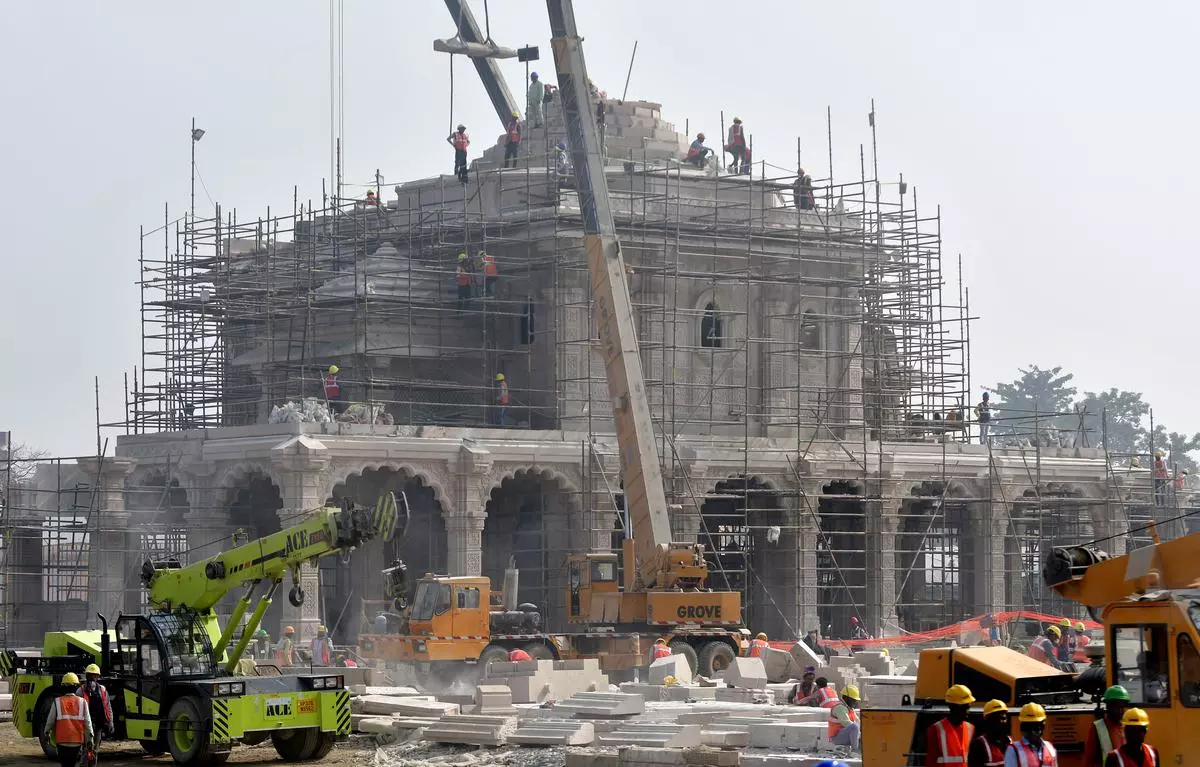
The primary temple structure, measuring 360 feet long by 235 feet wide by 161 feet high, was constructed using sandstone that was quarried in Bansi Pahadpur, Rajasthan, according to Dr. Jitendra Singh. Its structure makes no use of cement, iron, or steel.
According to him, the three-story temple’s structural design is earthquake resistant and can endure powerful earthquakes up to 2,500 years in duration, measured in Richter scale magnitude 8.
“From the beginning, CSIR-CBRI Roorkee has been involved in the construction of Ram Mandir.” According to him, the Institute made contributions to the main temple’s structural design, Surya Tilak mechanism design, foundation design review, and structural health monitoring.
In addition to CBRI, Dr. Jitendra Singh stated that the CSIR-NGRI Hyderabad made a substantial contribution to the design of foundations and seismic/quake safety. He added that just a small number of IITs were on the expert advisory council and that the opulent building was built using ISRO space technologies.
According to Dr Jitendra Singh, one of the Ram Temple’s distinctive features is the Surya Tilak mechanism, which is built so that, on Sriram Navami day each year, the sun’s rays fall on Lord Ram’s idol’s forehead for almost six minutes. According to him, Lord Rama, the seventh incarnation of Lord Vishnu, was born on the ninth day of the first month of the Hindu calendar, which falls between March and April. This festival is known as Ram Navami.
The Minister of Science and Technology stated that Optica, Bangalore is involved in the production of brass tubes and lenses, and that the Indian Institute of Astrophysics, Bengaluru, gave technical help on the Sun’s route.
He explained, “Using well-known principles of tracking Sun’s path, gear box and reflective mirrors/lenses have been arranged so sun rays from third floor near shikara will be brought to Garbha Griha.”
According to Dr. Jitendra Singh, CSIR will participate in the consecration ceremony as well. According to him, CSIR-IHBT Palampur (HP) is sending Tulip Blooms to the heavenly Ram Mandir Pran Pratishtha ceremony in Ayodhya on January 22nd as a celebration of faith, unity, and the spirit of devotion.
“This season is not flowering for tulips. It grows exclusively in the springtime in Jammu & Kashmir and a few other upper Himalayan locations. Tulips might now be made available all year round without having to wait for their season thanks to a new indigenous technology created by the Institute of Himalayan Bioresource Technology in Palampur, he said.
According to Dr. Jitendra Singh, CSIR technologies are also being widely deployed in daily life as India, led by Prime Minister Shri Narendra Modi, is poised to emerge as an Atmanirbhar and VikasitBharat@2047 during the Amritkaal.
According to Dr Jitendra Singh, CSIR laboratories located all over the nation stand in for New India’s contemporary landmarks. According to him, the Purple Revolution and Aroma Mission are being led by the Indian Institute of Integrative Medicines (IIIM) in Jammu. Likewise, the Minister announced that a new lotus variety known as “NBRI Namoh 108” has been created by the National Botanical Research Institute (NBRI) in Lucknow. The nutrient-rich Namoh 108 lotus variety blooms from March to December. According to him, this is the first lotus variety whose genome has been fully sequenced for its specific traits.
According to Dr Jitendra Singh, PM Modi has placed a strong emphasis over the past ten years on integrating traditional and modern knowledge by extending the integration of all schools of thought.
“India’s economy went from being the tenth to the fifth largest in the world, and we will soon reach the fourth and third ranks,” the speaker declared.
