
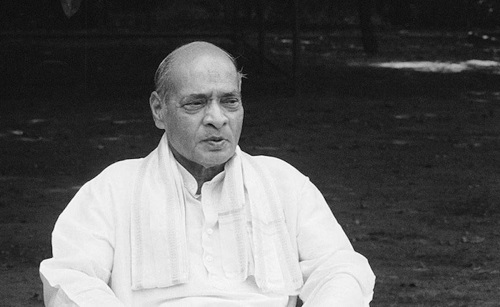
Former Prime Minister PV Narasimha Rao to be Awarded “Bharat Ratna”

GG News Bureau
New Delhi, 9th Feb. In a momentous announcement, Prime Minister Narendra Modi declared on Friday that the late P V Narasimha Rao, a former Prime Minister and veteran leader of the Congress party, would be posthumously honored with the Bharat Ratna, India’s highest civilian award.
Expressing his delight, PM Modi posted on X, highlighting Narasimha Rao’s extensive service to India across various roles.
“Delighted to share that our former Prime Minister, Shri PV Narasimha Rao Garu, will be honoured with the Bharat Ratna.
As a distinguished scholar and statesman, Narasimha Rao Garu served India extensively in various capacities. He is equally remembered for the work he did as Chief Minister of Andhra Pradesh, Union Minister, and as a Member of Parliament and Legislative Assembly for many years. His visionary leadership was instrumental in making India economically advanced, laying a solid foundation for the country’s prosperity and growth.
Narasimha Rao Garu’s tenure as Prime Minister was marked by significant measures that opened India to global markets, fostering a new era of economic development. Furthermore, his contributions to India’s foreign policy, language and education sectors underscore his multifaceted legacy as a leader who not only steered India through critical transformations but also enriched its cultural and intellectual heritage,” said PM Modi.
Delighted to share that our former Prime Minister, Shri PV Narasimha Rao Garu, will be honoured with the Bharat Ratna.
As a distinguished scholar and statesman, Narasimha Rao Garu served India extensively in various capacities. He is equally remembered for the work he did as… pic.twitter.com/lihdk2BzDU
— Narendra Modi (@narendramodi) February 9, 2024
Narasimha Rao’s tenure as the 9th Prime Minister of India, spanning from 1991 to 1996, was marked by significant measures that facilitated India’s integration into global markets, ushering in a new era of economic development.
Born on June 28, 1921, in Karimnagar, Telangana, Rao, initially an agriculturist and advocate, ventured into politics and held several important portfolios. He served as the Minister of Law and Information (1962-64), Law and Endowments (1964-67), Health and Medicine (1967), and Education (1968-71) in the Government of Andhra Pradesh. Additionally, he assumed the role of Chief Minister of Andhra Pradesh from 1971 to 1973 and served as the General Secretary of the All India Congress Committee from 1975 to 1976.
Beyond his political career, Rao exhibited a diverse array of interests, including Indian philosophy, literature, and multilingualism. He authored translations of renowned literary works, delivered lectures at universities in the U.S.A. and West Germany, and actively engaged in political discourse on various platforms.
During his tenure as Minister of External Affairs, Rao effectively used his academic background and political acumen to navigate international diplomacy. He chaired significant conferences and missions, contributing to India’s diplomatic endeavors on the global stage.
Rao’s most notable achievement as Prime Minister was his implementation of economic reforms, notably dismantling the License Raj, a bureaucratic system that stifled economic growth. He appointed Manmohan Singh as Finance Minister, who initiated a series of reforms that revitalized the country’s economy amidst a challenging economic climate.
A six-time Member of Parliament, Rao passed away at the age of 83 in 2004, leaving behind a lasting legacy of leadership and reform in Indian politics and economics.
