
“Enough with the Begging Bowl”: Shehbaz Sharif Calls for a New Pakistan

Paromita Das
GG News Bureau
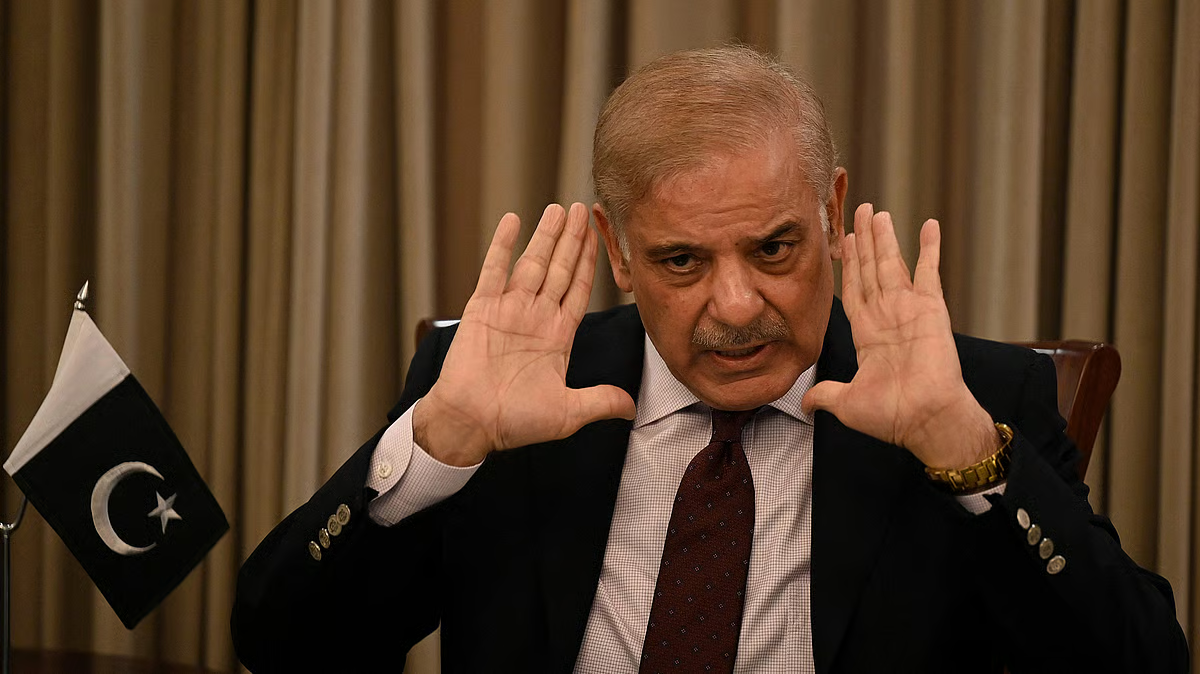
New Delhi, 3rd June: In a recent address to senior military officials in Quetta, Prime Minister Shehbaz Sharif struck a tone that was both urgent and unusually introspective for a sitting Pakistani leader. While he did not echo the oft-quoted critique that “Pakistan is never considered a serious state”—a line historically attributed to analysts and critics rather than statesmen—Sharif’s speech came close to acknowledging the consequences of that perception. His focus on ending Pakistan’s dependency on international aid, especially from strategic allies like China, Saudi Arabia, and the UAE, and his call for a pivot toward trade, investment, and innovation signaled a growing awareness within Pakistan’s leadership that the country’s global reputation needs rehabilitation.
Framing Pakistan’s reliance on external bailouts as a burden both he and Field Marshal Asim Munir are unwilling to pass on, Sharif’s rhetoric emphasized a break from the past—one in which the country repeatedly turned to allies with a “begging bowl” rather than a business proposal. Coupled with his candid admissions about India’s military superiority during Operation Sindoor and the damage inflicted on Pakistani airbases, the Prime Minister’s remarks amounted to a rare moment of national self-appraisal. Not by echoing harsh critiques, but by suggesting that Pakistan must now earn the world’s respect through self-reliance and reform, not sympathy.
A Reputation Marred by Chronic Dependency
Since its independence in 1947, Pakistan has struggled with questions of identity, governance, and strategic coherence. Over the years, its image has become increasingly synonymous with instability—military coups, rising extremism, inconsistent democratic processes, and more recently, economic collapse. Prime Minister Sharif’s speech directly tackled one of the most enduring symbols of this dysfunction: the so-called “begging bowl.”
🚨🇵🇰BEGGING BOWL ERA OVER FOR PAKISTAN?
🗣 Pakistan’s allies no longer expect it to ‘come with a begging bowl,’ says PM Shehbaz Sharif — but as equals looking to foster mutual innovation and development. pic.twitter.com/nw8gtk3HJy
— Sputnik India (@Sputnik_India) June 1, 2025
Pakistan has approached the International Monetary Fund (IMF) 25 times since 1958, with the latest proposal being a $2.3 billion package. Critics argue that the frequency of these bailouts reflects a broken economic model, one that leans heavily on external lenders while resisting the internal reforms—tax broadening, deregulation, transparency—that are essential for self-sustaining growth. Bharat, in its opposition to the new IMF loan, voiced international skepticism that mirrors long-standing concerns: that Pakistan’s misuse of financial aid, especially when defense budgets remain protected and terrorism networks are left unchecked, poses a global risk.
Despite abundant natural resources and a population exceeding 240 million—making it the world’s fifth most populous nation—Pakistan’s GDP remains under $400 billion. Per capita income is below $1,500, inflation is over 20%, and the rupee continues to slide against the dollar. These figures don’t just paint a portrait of economic decay—they reinforce the narrative that Pakistan’s institutions are ill-equipped to manage national wealth productively.
The Military’s Paradoxical Role
Shehbaz Sharif’s invocation of Field Marshal Asim Munir, with whom he shares the “burden” of national rehabilitation, highlights another enduring paradox: the military’s dual role as both protector and policymaker. While Munir may have provided momentary clarity during times of conflict, such as the Bharatiya missile strikes in May under Operation Sindoor, his role—as with his predecessors—remains controversial. For decades, military dominance has obstructed the growth of Pakistan’s civilian institutions, curtailed judicial independence, and silenced dissent.
Sharif’s acknowledgement of the military’s preeminent role could either be a plea for cooperation or a quiet capitulation. Either way, it underscores how deeply embedded the military is in not just defense but governance itself. His message, essentially, was one of shared failure and shared responsibility—but also, implicitly, a call for redefining boundaries between civilian leadership and military authority.
Allies and Expectations: A Changing Diplomatic Tide
Another major element of Sharif’s speech focused on Pakistan’s global partnerships. He cited long-standing allies—China, Saudi Arabia, the UAE, Turkey, and Azerbaijan—as crucial to Pakistan’s development trajectory. But his tone was markedly different from previous leaders who would emphasize unconditional support from these states.
This time, the narrative had shifted. “They no longer expect us to come with a begging bowl,” Sharif admitted. “They expect trade, commerce, innovation, R&D, education, and health.” In essence, Pakistan’s allies are signaling a new framework for engagement—one based on reciprocal investment and mutual growth, not dependency or transactional diplomacy.
This reorientation is particularly visible in the context of recent events. Azerbaijan and Turkey supported Pakistan militarily during Operation Sindoor, but the underlying expectation appears to be long-term strategic cooperation, not short-term crisis management. Meanwhile, China’s repeated calls for security guarantees for its investments under the China-Pakistan Economic Corridor (CPEC) reveal growing unease over Pakistan’s inability to deliver internal stability.
Bharat’s Calculated Pressure
Sharif’s candidness also follows a wave of military and diplomatic pressure from Bharat, whose response to terror threats with precision strikes—including the May 10 BrahMos missile attacks under Operation Sindoor—caught Pakistani defenses off guard. Sharif himself admitted that Bharatiya missiles struck targets, including the Nur Khan Airbase, before Pakistan’s planned retaliation could begin. This not only exposed vulnerabilities in Pakistan’s early warning and air defense systems but also diminished its deterrence narrative.
By confessing these gaps, Sharif is not just recounting a military episode—he is acknowledging a growing asymmetry in South Asia’s strategic architecture. Bharat’s rising diplomatic stature and technological military edge have left Pakistan with fewer options, forcing it to reassess its reliance on outdated strategies of reactive confrontation and proxy warfare.
A Moment of Rare Clarity
It’s worth noting that such transparency from a Pakistani leader could have been unthinkable just a few years ago. Political discourse has often relied on populist deflection and nationalist bravado. But Sharif’s recent speeches, in both Quetta and Azerbaijan, represent a significant shift in tone. They reflect a leadership that—at least rhetorically—recognizes the limitations of past strategies and the need for urgent reform.
Whether this rhetoric translates into concrete action remains to be seen. Pakistan’s system is heavily resistant to change. Corruption, bureaucratic inertia, and deep-rooted elite interests have long obstructed reform efforts. Still, the Prime Minister’s words matter, if only because they lay the groundwork for what could be a national reckoning.
Rhetoric or Reckoning?
Shehbaz Sharif’s admission that “Pakistan is not considered a serious state” may well be one of the most significant public statements made by a Pakistani prime minister in recent years. It encapsulates decades of lost opportunities, flawed priorities, and international disillusionment. More importantly, it throws open a question to Pakistan’s political, military, and civic establishments: is the country finally ready to take itself seriously?
This is a turning point—perhaps even a point of no return. The choice is stark. Pakistan can continue the cycle of dependency and denial, or it can chart a new course based on transparency, accountability, and economic sovereignty. The world, and more crucially, its own people, are watching.
