
Echoes of a Forgotten Night: The Noakhali Hindu Genocide of 1946
“When the Moon Rose Over Bengal, Humanity Fell Silent – The Untold Tragedy of the Noakhali Hindu Genocide of 1946.”

Paromita Das
New Delhi, 10th October: It was meant to be a night of radiance and reverence. On Kojagari Lakshmi Puja, the full moon gleamed over Bengal’s serene fields as Hindu families of Noakhali gathered to worship the Goddess of Prosperity. Yet, before the lamps could fade, the air grew thick with terror.
Under the command of Gholam Sarwar, the hereditary Pir of Daira Sharif, his private militia—the Miyar Fauj—descended upon villages with unspeakable cruelty. The beheading of Rajendra Lal Roy Chowdhury, the respected zamindar of Noakhali, marked the beginning of a night drenched in blood. What followed was a slaughter so savage that even time seems reluctant to revisit it: temples desecrated, women violated, homes reduced to ashes, and entire Hindu settlements erased.
That night alone claimed nearly 400 lives, and over the following days, more than 5,000 men, women, and children were brutally killed. It was not merely a riot—it was an orchestrated genocide that scarred Bengal’s soul forever.
From Direct Action Day to Noakhali: The Seeds of Hatred

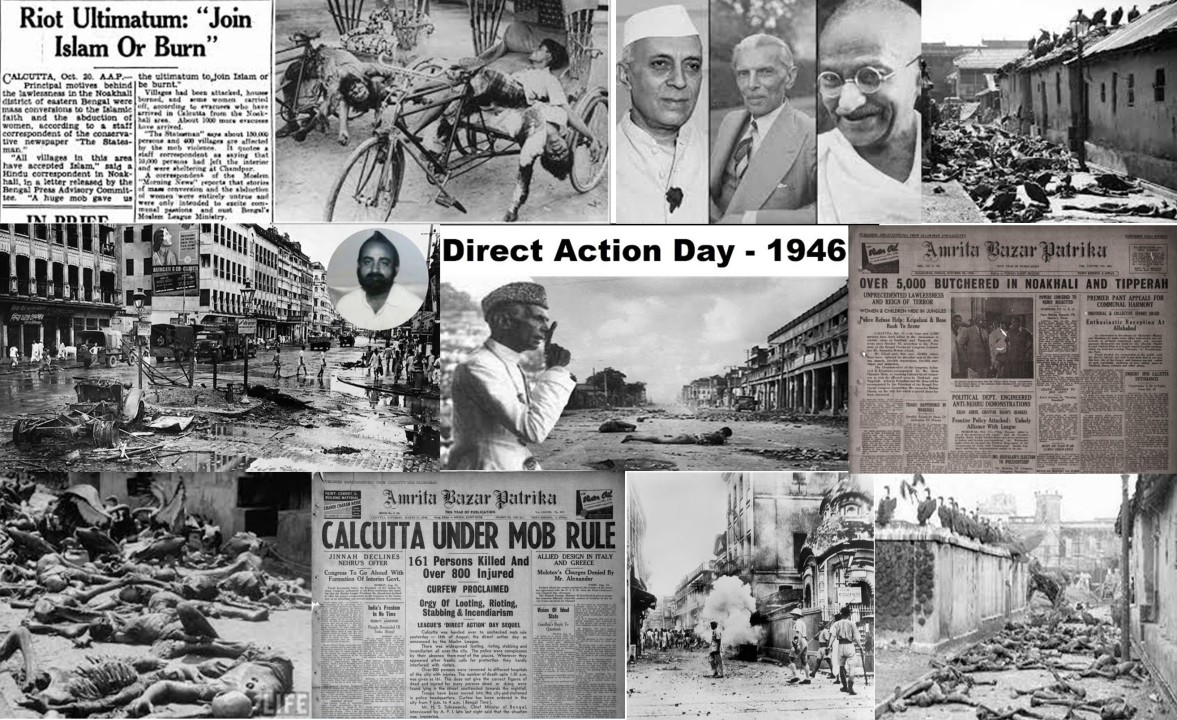
The massacre did not emerge in isolation. It was the continuation of a political firestorm ignited two months earlier—Direct Action Day, declared by Mohammed Ali Jinnah and executed under Huseyn Shaheed Suhrawardy, then Premier of Bengal.
Calcutta had already burned with communal frenzy, and when the flames died, they spread eastward to Noakhali. The cry of “Pakistan or Perish” transformed into a call for religious cleansing. Mobs, armed with blades and slogans of jihad, encircled Hindu hamlets. Conversions were forced under the shadow of death; resistance was punished with annihilation.
What’s perhaps more chilling is the complicity of silence. Suhrawardy refused to intervene, and the British administration, exhausted by its collapsing empire, saw the chaos as a convenient prelude to Partition—a grim “solution” to their imperial fatigue.
The Political Silence: Congress and the Cost of Indifference

As Noakhali burned, Bharat’s political elite looked away. The Indian National Congress, preoccupied with negotiations for independence, offered little solace to Bengal’s dying Hindus.
Even Jawaharlal Nehru, head of the Interim Government, appeared disturbingly detached. For him, the violence in East Bengal was a “communal issue,” not a humanitarian crisis. In letters written during that period, Nehru’s tone reflected a troubling moral equivalence—he cautioned against retaliatory violence in Bihar, asking whether Hindus planned to “repeat the unfortunate happenings in Bengal.”
Such rhetoric erased victimhood, framing genocide as “mutual unrest.” Gandhi’s later visit to Noakhali, where he walked barefoot through ravaged villages, remains one of history’s most poignant yet powerless gestures—a saint among ruins, lamenting what politics had failed to prevent.
The Erasure of Memory and the Politics of Forgetting

Perhaps the cruelest aftermath of Noakhali was not the massacre itself but the systematic erasure that followed. Official British records minimized the death toll to mere “hundreds,” while survivors spoke of thousands. Reports by foreign journalists were buried under bureaucratic silence.
Those who escaped fled to Tripura, Assam, and West Bengal, carrying with them nothing but trauma and the ashes of their homes. Yet, post-independence Bharat, eager to project an image of unity, omitted Noakhali from its historical conscience. Schoolbooks mentioned it in passing, if at all. The survivors became refugees in their own land—ignored, displaced, and forgotten.
Even decades later, the wounds persist. Many descendants of East Bengali Hindus still face the echoes of displacement, living reminders of a tragedy their own country seldom acknowledges.
Remembering Noakhali: A Moral Imperative

The Noakhali Hindu Genocide stands as a grim reminder of what happens when fanaticism outpaces fraternity. It was not just an episode of communal violence—it was a civilizational rupture.
To remember Noakhali is not to reopen wounds but to honor truth. Every nation must confront its darkness to preserve its light. Bharat’s commitment to pluralism means little if its history omits those who perished defending their faith.
The least we owe the victims is remembrance—through education, documentation, and commemoration. Acknowledging Noakhali is not about division; it is about justice, empathy, and accountability.
History’s Silence Is the Real Crime

The true crime of Noakhali is not only what happened in 1946 but what has happened since—a silence cultivated in the name of peace. Reconciliation built on denial is fragile. By refusing to remember Noakhali, Bharat risks eroding its moral foundation.
Recognition of genocide is not about blame; it is about truth. A nation that buries its pain will one day stumble upon its consequences. The Noakhali victims were not statistics—they were symbols of faith, endurance, and identity. Remembering them is not optional; it is an ethical duty.
The Light That Refuses to Fade
The full moon that rose over Noakhali on 10 October 1946 witnessed the collapse of humanity—but it also witnessed resilience. Amidst ruin, survivors carried forward the flickering lamp of faith, refusing to let darkness claim their identity.
Today, as Bengal and Bharat look back, the lesson remains unambiguous: a nation that forgets its martyrs forfeits its moral compass. To remember Noakhali is to remember who we are—a civilisation that must never again allow hatred to eclipse humanity.
