
Diplomatic Balancing Act: Modi–Zelensky Call Amid US Criticism
As the Russia–Ukraine war grinds on and Washington turns up the heat over Russian oil imports, Prime Minister Narendra Modi and President Volodymyr Zelensky’s latest conversation underscores Bharat’s high-stakes balancing act — walking the razor’s edge between strategic autonomy, humanitarian diplomacy, and mounting US pressure.

Paromita Das
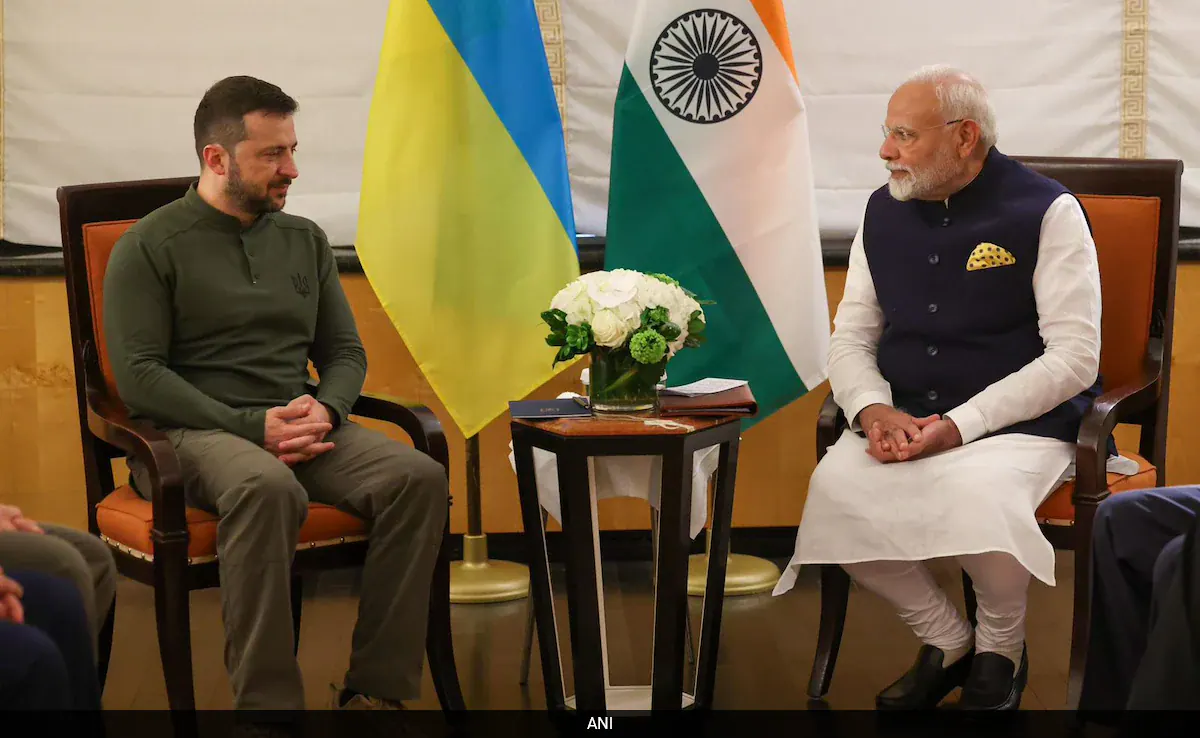
New Delhi, 14th August: On August 11, Ukrainian President Volodymyr Zelensky held a telephonic discussion with Bharatiya Prime Minister Narendra Modi, touching on the Russia–Ukraine war and potential areas of cooperation. The timing of the conversation could hardly be more sensitive. With the United Nations General Assembly (UNGA) just weeks away, both leaders are expected to meet in person, even as the shadow of US pressure looms large over Bharat’s foreign policy.
In recent weeks, US President Donald Trump has accused Bharat of “indirectly funding” Moscow’s war effort by continuing to purchase Russian oil. Washington’s message has been blunt: stop buying cheap Russian crude or risk a diplomatic chill. Yet, Bharat has stood its ground, signaling that its energy security and strategic autonomy remain non-negotiable. Against this backdrop, the Modi–Zelensky call carried both diplomatic symbolism and geopolitical weight.
Bilateral Ties Amid the Turmoil of War

According to the Prime Minister’s Office, the two leaders reviewed the status of the Bharat–Ukraine partnership, focusing on sectors disrupted by the war. For decades, trade, defense cooperation, and educational exchanges formed the backbone of their relations. The conflict has fractured these channels, but both leaders expressed hope that economic stability and humanitarian safety could be restored.
Zelensky emphasised Ukraine’s desire to deepen not only economic engagement with Bharat but also collaboration in international advocacy. Kyiv views New Delhi as a crucial voice in global forums, capable of influencing multilateral debates on peace, sovereignty, and international law. Modi, for his part, reiterated Bharat’s commitment to dialogue and peaceful solutions, highlighting that Bharat’s approach has been rooted in neutrality and humanitarian outreach rather than military intervention.
War Updates and a Plea for Global Support

Zelensky briefed Modi on recent developments on the battlefield, citing a missile strike on a bus station in Zaporizhzhia that left dozens injured. According to Ukrainian authorities, the target had no military significance, framing the attack as yet another example of Moscow’s disregard for civilian life.
The Ukrainian president lamented Russia’s lack of interest in meaningful peace talks, arguing that sustained global attention is necessary to keep pressure on Moscow. He also reaffirmed a core principle of Ukraine’s diplomacy: any settlement that excludes Ukraine from the negotiating table is unacceptable. The message was clear — Kyiv wants friends like Bharat not only to call for peace but to ensure that any roadmap to peace includes Ukraine’s full participation.
Bharat’s Tightrope Walk Between Moscow and Kyiv

While Zelensky’s appeal was heartfelt, Modi’s position remains a careful balancing act. Bharat has historic defence and energy ties with Russia, relying heavily on Russian military hardware and discounted crude oil imports. At the same time, New Delhi has consistently sent humanitarian aid to Ukraine, engaged in high-level talks with Zelensky, and called for de-escalation in conversations with President Vladimir Putin.
This ability to maintain open channels with both warring sides is rare in today’s polarized diplomatic environment. However, it comes at a cost — Bharat faces growing scrutiny from Washington and certain European capitals, which see continued Russian oil purchases as undermining sanctions. Trump’s latest remarks have only sharpened that pressure.
The UNGA Meeting: Symbolism and Strategy

The planned meeting between Modi and Zelensky at the UNGA in September could serve as a high-profile demonstration of Bharat’s role as a mediator. It will also allow Bharat to showcase that it can engage with Ukraine without severing ties with Russia — a stance that reflects its broader foreign policy doctrine of strategic autonomy.
For Zelensky, such a meeting offers a platform to court one of the few major powers that can talk to both sides, potentially nudging Russia towards a less intransigent position. For Modi, it is an opportunity to underline Bharat’s identity as an independent global actor, one that does not yield to bloc politics or external diktats.
Bharat’s Stand Is Consistent, Not Contradictory

Critics in the West often frame Bharat’s position as opportunistic — buying Russian oil while speaking of peace. But this is a misreading. In reality, Bharat’s approach is consistent with its history of non-alignment: safeguarding its own economic stability while engaging in humanitarian diplomacy.
Energy security is a cornerstone of national security. By purchasing discounted Russian oil, Bharat shields its economy from global price shocks, which in turn protects its developmental agenda. At the same time, by sending aid to Ukraine and maintaining regular dialogue, it signals genuine concern for human suffering. This dual-track approach is not fence-sitting; it is a pragmatic response to a deeply polarized conflict in which taking sides outright could close doors to constructive diplomacy.
A Test for Bharat’s Global Mediation Role

The Modi–Zelensky conversation is more than just another diplomatic phone call; it is a snapshot of Bharat’s evolving role in the international system. As the Russia–Ukraine war grinds on, Bharat is uniquely placed to act as a bridge — one foot in the Moscow camp for strategic needs, the other extended towards Kyiv for humanitarian and diplomatic engagement.
The coming UNGA meeting could mark a pivotal moment. If Bharat manages to sustain relations with both Russia and Ukraine while resisting US pressure, it will strengthen its position as a credible, independent global player. But the road ahead will be fraught with challenges, especially as geopolitical tensions intertwine with economic pressures. In this arena of oil, war, and diplomacy, Bharat’s ability to balance principles with pragmatism will be closely watched by friends and rivals alike.
