
Delhi Chokes Under Toxic Smog as AQI Hits 323, Visibility Drops Across City
Several Pockets Record ‘Very Poor’ Air; Thick Haze Engulfs Anand Vihar, Ghazipur, Akshardham

GG News Bureau
New Delhi, 5th Dec: Despite a marginal improvement compared to previous weeks, Delhi woke up to a grey and suffocating morning on Friday, with the city once again blanketed by toxic smog. According to the Central Pollution Control Board (CPCB), the national capital recorded an average AQI of 323 at 8 am, placing it firmly in the “very poor” category and posing serious health risks for millions of residents.
Capital’s Air Turns Hazardous Again
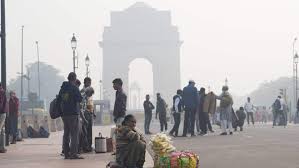
Thick haze reduced visibility across several pockets of the city — most notably Ghazipur, Sonia Vihar, Wazirpur, and Akshardham — where commuters moved slowly through a smoky layer that muted sunlight and turned the horizon grey.
At Anand Vihar, which has remained one of Delhi’s chronic pollution hotspots, the AQI touched 348, indicating alarming toxic levels. Wazirpur, too, registered a dangerous 358, while Sonia Vihar reported 343, all of them falling into the “very poor” band.
In Bawana, the AQI stood at 325, also categorised as “very poor,” making it one of the most polluted zones this morning. Comparatively, NSIT Dwarka recorded an AQI of 269, placing it in the “poor” category — slightly better, but still harmful for sensitive groups.
Images and early morning visuals from Akshardham showed the iconic landscape veiled under heavy smog, with the AQI there also touching 348.
What the AQI Really Means for Delhi
The CPCB classifies AQI in a scale of 0 to 500, divided into six health-related categories:
- 0–50: Good
- 51–100: Satisfactory
- 101–200: Moderate
- 201–300: Poor
- 301–400: Very Poor
- 401–500: Severe
Doctors warn that “very poor” levels — such as those seen today — can trigger respiratory issues in healthy individuals and worsen conditions like asthma, bronchitis, and heart disease. Long-term exposure at these levels can lead to chronic lung damage.
As winter sets in, Delhi typically sees pollution levels rise due to a combination of stubble burning, low wind speeds, vehicular emissions, and temperature inversion, which traps pollutants close to the ground.
Government Reviews Emergency Response
Amid worsening conditions, Delhi Chief Minister Rekha Gupta held a review meeting on Wednesday at the Delhi Secretariat to assess ongoing pollution-control measures. Officials discussed strategies to curb emissions, improve air monitoring, and intensify enforcement in highly affected zones.
With forecasts suggesting that pollution may remain in the ‘poor to very poor’ zone in the coming days, authorities are expected to roll out additional restrictions under the Graded Response Action Plan (GRAP).
As the smog thickens and temperatures dip, Delhi’s tryst with winter pollution appears to have entered yet another difficult phase — one that leaves residents hoping for cleaner skies, yet bracing for more toxic days ahead.
