
Delegation Diplomacy and the Evolution of Bharatiya Political Identity Abroad

Paromita Das
GG News Bureau
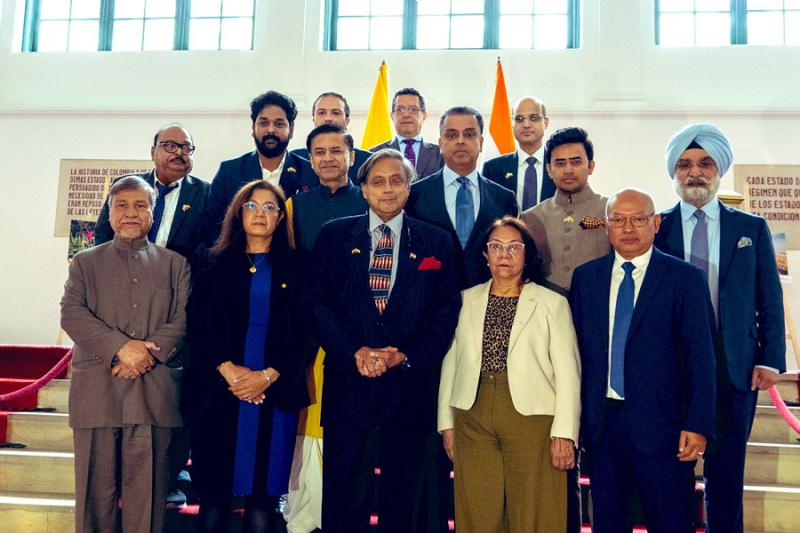
New Delhi, 3rd June: Foreign policy is often considered the exclusive domain of a nation’s executive leadership, especially in countries like Bharat where diplomacy has traditionally been centralized within the Prime Minister’s Office and the Ministry of External Affairs. However, under the Modi government, a new dimension has been added to Bharat’s global engagement toolkit: structured political delegations composed of Members of Parliament (MPs), civil society leaders, and public intellectuals. These missions, strategically dispatched across continents, have extended the boundaries of diplomacy beyond the formal walls of embassies—and, unexpectedly, have begun to reshape the domestic political landscape as well.
What began as a soft power strategy to project Bharat’s image more effectively abroad has morphed into something more potent: a reframing of internal political dynamics through international engagement. The case of AIMIM leader Asaduddin Owaisi, a long-time critic of the ruling BJP, is perhaps the most emblematic of this change. Once seen through a narrow ideological lens by both his supporters and detractors, Owaisi’s evolving role in international forums reveals the quiet impact of Bharat’s delegation diplomacy—not just on foreign perceptions, but on how Bharatiya leaders perceive, position, and project themselves.
The Rise of Delegation Diplomacy
Since 2019, but more intensively after 2023, Bharat has deployed cross-party delegations to regions critical to its strategic interests: the Gulf, Southeast Asia, Western Europe, and North America. This strategy reached a new peak following Operation Sindoor, a major counterterrorism mission launched in early 2025 to neutralize threats emanating from across the Line of Control. Bharat’s efforts to shape the global narrative surrounding its security operations led to a multi-pronged outreach initiative. It included diplomatic briefings, media engagement, and a wave of political visits led by both ruling and opposition MPs.
The rationale was clear. In an age of decentralized media, traditional diplomacy often lags behind the rapid pace of global opinion formation. Delegation diplomacy helps close that gap. By placing influential Bharatiya voices—including critics of the central government—in front of international stakeholders, New Delhi presented a more pluralistic and complex picture of the nation’s democratic character.
Owaisi on the Global Stage
Asaduddin Owaisi has built his political career around advocacy for minority rights and secular values, often clashing vocally with the BJP over issues ranging from the Citizenship Amendment Act to the handling of communal violence. His core support base, concentrated in Hyderabad and parts of Maharashtra and Bihar, views him as a fearless defender of Bharat’s constitutional framework.
Yet, Owaisi’s participation in recent foreign delegations has signaled a subtle but important evolution. On a recent visit to Riyadh as part of a broader outreach to Gulf nations, he spoke at a roundtable on regional security and humanitarian challenges, where his comments were notably aligned with Bharat’s diplomatic posture. While advocating for humanitarian aid in Gaza, Owaisi refrained from criticizing the Bharatiya government’s abstentions in UN votes—something he might have once done vocally on domestic platforms.
This shift has not gone unnoticed. Observers abroad viewed Owaisi’s remarks as statesmanlike—reflecting national consensus over partisan divides. At home, the effect has been more layered. His supporters now see a leader capable of transcending domestic rhetoric in favor of strategic clarity, while his critics in the right-wing establishment have, for the first time, acknowledged his role in reinforcing Bharat’s diplomatic credibility.
This is not a case of ideological conversion. Rather, it illustrates how political figures can find new voices when placed on international platforms, especially those requiring articulation of shared national interests. In Owaisi’s case, the opportunity to represent Bharat on the world stage has added depth to a political profile long caricatured as oppositional.
Domestic Ramifications of International Engagement
Delegation diplomacy, in this context, becomes more than just an extension of foreign policy—it becomes a mirror held up to the nation’s internal democracy. The participation of opposition leaders like Owaisi complicates simplistic narratives of an Bharat divided along rigid political lines. It signals to international observers that Bharat’s democracy, though noisy and often polarized, retains a capacity for collective representation when it matters most.
This has had subtle electoral implications as well. In certain urban constituencies, surveys conducted by think tanks like CSDS and Lokniti suggest that politicians seen as engaging constructively on global issues tend to enjoy higher approval ratings among educated, middle-class voters. For Owaisi, this offers the chance to widen his appeal beyond traditional bastions.
At the same time, the government gains from this approach by broadening its representational canvas. When a Muslim opposition leader supports Bharat’s stance on a conflict like Gaza or speaks against global mischaracterizations of Bharat’s religious harmony, it strengthens Bharat’s soft power and reduces the risk of foreign governments adopting adversarial postures.
A Blurred Line, or a New Beginning?
The Modi government’s willingness to include ideological opponents in sensitive foreign engagements reflects a shift in political thinking. It suggests a realization that Bharat’s global challenges—be it terrorism, misinformation, or economic alignment—require domestic consensus and shared messaging.
This blurring of lines also indicates that foreign policy is becoming a more public and participatory exercise in Bharat. Citizens increasingly track international developments; diaspora communities lobby for homeland issues abroad. In this environment, empowering elected representatives from across the political spectrum to speak for Bharat is both a democratic necessity and a strategic move.
Redefining the Diplomacy of Politics
Delegation diplomacy may have started as a tactical tool of foreign engagement under the Modi government, but its consequences are rapidly spilling into the domestic arena. It has given politicians like Asaduddin Owaisi a new platform—one that allows them to contribute to the shaping of national narratives without compromising their ideological stance at home.
This approach subtly transforms both governance and opposition. It enables the government to project inclusivity while pushing back against hostile narratives, and allows the opposition to remain relevant not just as critics, but as contributors to Bharat’s global identity.
In an age where political branding extends far beyond borders, Bharat’s experiment with delegation diplomacy could prove to be one of the most quietly transformative shifts in its democratic journey.
