
“Cooperatives Are India’s Way of Life, Not Just an Economic Model”: HM Amit Shah

GG News Bureau
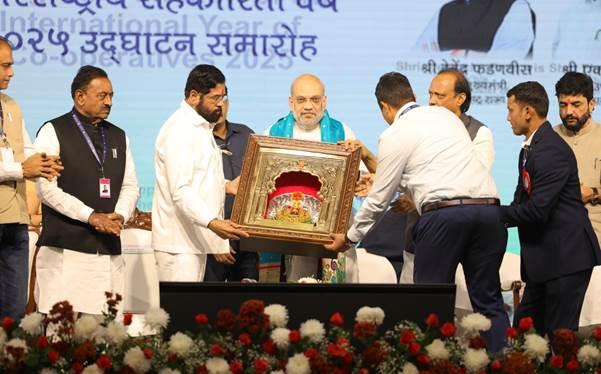
Mumbai, 20th June: Union Home and Cooperation Minister Amit Shah, while addressing a packed national seminar in Mumbai to mark the International Year of Cooperatives 2025, outlined an ambitious and people-centric roadmap to revitalise India’s cooperative movement. Joined by Maharashtra Chief Minister Devendra Fadnavis and Union Minister of State for Cooperation Murlidhar Mohol, Shah’s speech resonated with a clear message: cooperatives must become engines of rural empowerment.
“Cooperation may be an economic model for the world, but for India, it’s a way of life,” Shah said. “Living together, working together, and sharing both happiness and hardship — that’s the Indian spirit.”
He credited this philosophy for the success stories of organisations like Amul and NAFED, pointing out how over 36 lakh rural women have helped turn Amul into an ₹80,000 crore enterprise — many having started with just ₹100.
Shah announced a series of measures aimed at making the cooperative sector more inclusive and efficient. Farmers registered on the NAFED App, he said, will now have the option to sell 100% of their pulses and maize at Minimum Support Price (MSP). And if market prices are higher, they’ll be free to earn more. “This model will empower our farmers to make informed choices about their crops,” he said.
In a major push to expand the reach of Primary Agricultural Credit Societies (PACS), Shah said the government will set up two lakh PACS across the country — one in every panchayat. These will no longer just provide credit. They’ll also offer 24 essential services — from Jan Aushadhi Kendras and petrol pumps to air ticket booking and water supply management. “We’ve already computerised 52,000 PACS, and we’re just getting started,” he noted.
One of the standout announcements was the launch of a cooperative-based taxi service where drivers will also be the owners — a model designed to ensure that earnings go straight into their bank accounts. Shah also revealed that a fully cooperative-owned insurance company will soon be operational, further strengthening the sector’s economic backbone.
He pointed to new national cooperative entities such as NCEL, NCOL and BBSSL, which will help farmers sell organic and traditional produce globally. These products will be branded ‘Bharat Organic’ and, Shah assured, profits will go directly to the farmers’ accounts.
Addressing the cooperative imbalance across the country, Shah acknowledged that while states like Maharashtra and Gujarat have thriving cooperative movements, the northern and eastern regions lag behind. “We’re actively mapping the gaps. Our goal is to ensure no village in India is left behind,” he affirmed.
He also touched on reforms aimed at easing the financial burden on cooperatives. Tax rates for cooperatives have been reduced, and sugarcane mill disputes have been resolved. “We’re aligning the cooperative sector with the corporate sector when it comes to taxation,” he said.
Looking to the future, Shah said the foundation of Tribhuvan Sahkari University will be laid soon, offering specialised education and training in cooperative management.
“The next 10 years will see these new institutions — NCEL, NCOL, BBSSL — become as iconic as Amul, IFFCO and NAFED,” he said, expressing confidence in the cooperative sector’s ability to scale new heights.
Shah concluded with a broader reflection: “India cannot become strong just with GDP growth. We need to ensure that every rural youth, every woman, and every small farmer has a role in the country’s journey. Cooperatives offer that opportunity — low investment, high returns, and shared prosperity.”
With the International Year of Cooperatives 2025 now underway, Shah called upon every village, district, and tehsil to embrace the cooperative model and turn this year into a turning point for inclusive development.
