
Congress Haunted by 1984: Why Jagdish Tytler’s Presence Sparks Outrage Again
"On a day meant to celebrate unity, Congress found itself caught in yet another storm as Rahul Gandhi hoisted the tricolour with Jagdish Tytler, an accused in the 1984 anti-Sikh riots, standing behind him. The presence sparked a fierce political battle, with BJP accusing the Gandhis of being “unapologetic” about the massacre, while Congress hit back citing BJP’s own controversies".

Paromita Das
New Delhi, 18th August: It is almost as if the Congress Party has an incurable obsession with controversy. Whenever the spotlight begins to fade on its dwindling relevance, it manages to stage an act that drags it back into the headlines—for all the wrong reasons. Independence Day 2025 should have been a moment of national unity and dignity, but instead, the Congress party chose optics that reopened one of Bharat’s darkest wounds.
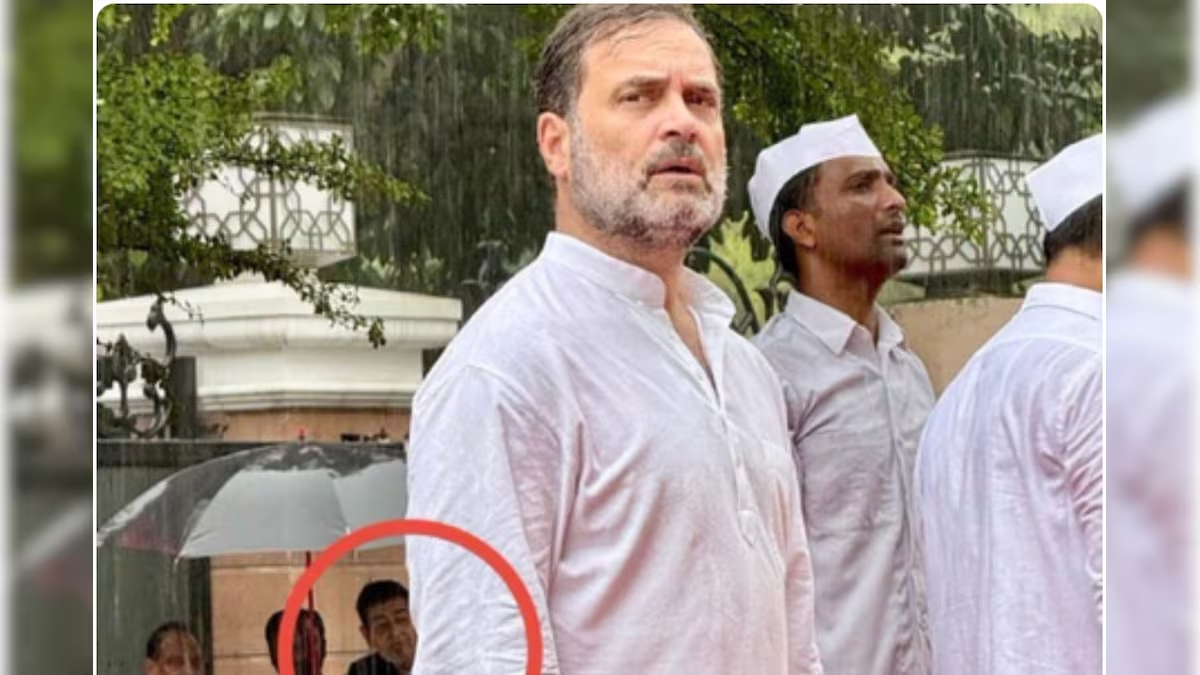
The image of Jagdish Tytler—an accused in the 1984 anti-Sikh riots—standing right behind Rahul Gandhi during the flag-hoisting ceremony at the party headquarters has unleashed a storm. For millions, it was not just a political misstep; it was a chilling reminder of Congress’ callousness, its tone-deaf leadership, and its desperation to cling to relevance. The moment has predictably handed the Bharatiya Janata Party (BJP) a fresh weapon of attack.
The Ghost of 1984 Returns

The 1984 anti-Sikh riots remain an open wound in Bharat’s collective memory. Nearly 3,000 Sikhs were massacred in Delhi, with survivors consistently accusing Congress leaders of instigating mobs. Among those accused, Jagdish Tytler has long stood at the center of allegations.
Eyewitness accounts and even a 2023 CBI chargesheet suggest that Tytler incited mobs at Pul Bangash Gurudwara, urging them to “kill the Sikhs.” An affidavit once alleged that he even complained about the “low number of killings” in his constituency compared to other areas.
And yet, on Independence Day, there he was—just a few feet behind Rahul Gandhi, smiling in the background, as though history had never happened. For many, this was not just poor optics. It was a deliberate signal that Congress refuses to reckon with its past.
BJP’s Swift Counterattack
The BJP wasted no time in capitalizing on the moment. Amit Malviya of the BJP IT cell posted a photo of Tytler’s presence, declaring:
“Jagdish Tytler, the man who unleashed genocide on Sikhs at Rajiv Gandhi’s behest, is once again seen alongside Rahul Gandhi. Some stains don’t wash away.”
Jagdish Tytler, the man who unleashed genocide on Sikhs at Rajiv Gandhi’s behest, is once again seen alongside Rahul Gandhi at the Congress HQ.
Some stains don’t wash away, no matter how much time passes. The Gandhis are unapologetic too. pic.twitter.com/X4aClhTS7D
— Amit Malviya (@amitmalviya) August 15, 2025
Party spokesperson Radhika Khera mocked Rahul Gandhi for skipping the official Red Fort ceremony to hoist the tricolour at Indira Bhawan, adding:
“Even on the day of patriotism, the ‘prince’ stands with a rioter. This is the true face of Congress: a legacy of conspiracy and betrayal against the nation.”
15 अगस्त को लाल क़िले की परंपरा से गायब नेता प्रतिपक्ष @RahulGandhi
पर कांग्रेस मुख्यालय में तिरंगा फहराते वक्त हाज़िरपीछे वही 1984 सिख नरसंहार का क़ातिल-आरोपपत्रित Jagdish Tytler
जिसके खूनी हाथों को उनके पिता राजीव गांधी ने ‘स्वाभाविक प्रतिक्रिया’ कहकर ढक दिया थादेशभक्ति के… pic.twitter.com/9VRU8n2JrD
— Radhika Khera (@Radhika_Khera) August 15, 2025
The charge was sharp and simple: Congress continues to flaunt the very faces that symbolize betrayal for thousands of Sikh families.
Congress’ Defensive Whataboutery

As expected, Congress tried to counter the criticism. Spokesperson Shama Mohammad argued that Tytler has never been convicted and accused the BJP of hypocrisy by pointing to the release of convicts in the Bilkis Bano case.
But this defense missed the larger moral question. Independence Day was not about balancing political scorecards. It was a chance for Congress to demonstrate maturity, inclusivity, and respect for national sentiment. Instead, the party chose to showcase Rahul Gandhi next to a man synonymous with one of Bharat’s bloodiest riots.
The comparison to Bilkis Bano may score a debating point, but it does not answer why Tytler was given prime visibility on such a solemn occasion. If anything, it reinforced the impression that Congress is addicted to whataboutery instead of accountability.
Punjab Politics and the Fallout

The timing of this misstep could not have been worse. Congress has been struggling to revive its fortunes in Punjab, where the Sikh community’s memories of 1984 remain raw. Analysts warn that the image of Tytler behind Rahul Gandhi could seriously damage the party’s standing in the state.
Even beyond Punjab, the optics have cemented Rahul Gandhi’s reputation as a leader out of touch with political realities. By allowing such a figure to stand beside him on Independence Day, he handed his opponents a powerful narrative on a silver platter
A Pattern of Callousness

This controversy is not an isolated incident. Congress has repeatedly shown a startling inability to anticipate public sentiment. From ill-timed comments to tone-deaf alliances, the party has developed a reputation for scoring self-goals.
Instead of positioning itself as a credible national alternative to the BJP, it often ends up reinforcing public doubts: arrogant, insensitive, and out of touch with the people it claims to represent.
A Party Trapped in Its Past

What makes the Tytler controversy especially damaging is not just the optics but the symbolism. By continuing to normalize individuals linked with the 1984 riots, Congress signals that it has neither learned nor repented.
Politics is not only about legalities; it is about morality, perception, and trust. Tytler may not have been convicted, but his presence on the stage screams hypocrisy for a party that claims to uphold secularism, justice, and inclusivity.
When Silence Speaks Louder Than the Tricolour
On a day when Bharat celebrated freedom, Congress reminded the nation of one of its darkest imprisonments—in blood, prejudice, and violence. The BJP did not need to engineer this controversy; Congress created it for them.
The episode is not just about Jagdish Tytler. It is about a party that refuses to confront its past, acknowledge its mistakes, or respect the sentiments of millions. If Congress continues down this path of desperation and callousness, it may not need an opponent to defeat it. The party will collapse under the weight of its own contradictions.
