
Cleaning Electoral Rolls India’s Landmark Step Nationwide
Special International Review-SIR

Poonam Sharma
The integrity of Indian democracy has always reposed in one fundamental pillar-the accuracy and credibility of its electoral rolls. Of late, allegations of discrepancies in the voter lists have raised quite a few searching questions on the very fairness of elections and the protection of citizens’ votes. At more places, reports came in detailing how hundreds and even thousands of voters were registered at the same address, raising suspicion about the accuracy of the electoral rolls. Some areas reportedly had over 800 names listed at a single address, therefore creating the potential for electoral manipulation.
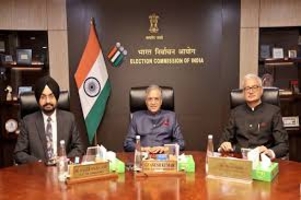
Amid the growing controversy, the Election Commission of India has initiated a bold measure to protect the democratic process by implementing a nationwide Special International Review of electoral rolls. After the pilot in Bihar, SIR would expand to 12 states and union territories in what will be the first national review to this extent in 21 years. This move is in direct response to sharp political criticism and public demand for transparent electoral procedures.
The SIR will begin , and the voter lists in these states would be frozen to stop any more additions or modifications. The 12 states and union territories that were selected for the first phase include Andaman & Nicobar Islands, Goa, Gujarat, Lakshadweep, Madhya Pradesh, Puducherry, Rajasthan, Tamil Nadu, Uttar Pradesh, and West Bengal. The selection is all across different regions and political landscapes, and the states were selected without political considerations. BJP-ruled Uttar Pradesh and Gujarat, TMC-ruled West Bengal, and DMK-ruled Tamil Nadu were among the selected states to ensure that the move was nondiscriminatory and had been uniformly implemented across the country.
According to the Election Commission, about 510 million voters will be involved in the all-India SIR, with around 533,000 polling-level officers and more than 700,000 observers appointed by political parties to ensure full coverage without any unauthorized entries in the voter lists. An operation of such gigantic scale aims at deleting every illegal or duplicate voter and correcting the discrepancies so that the electoral rolls are representative of the actual demographic pattern in each constituency.
The SIR process in Bihar underlined the importance of this exercise. The voter lists drawn up after review showed 4.7 million extra voters who should not be on the rolls in Bihar, while many genuine ones were left out. Extrapolating these numbers countrywide brings into sharp focus why such an intense review was essential. Incorrect voter rolls compromise not only election fairness but also people’s faith in the democratic process.
Three features are particularly important in this SIR:
The comprehensive coverage of SIR will start in the states where the elections are due, such as West Bengal, Kerala, Tamil Nadu, and Puducherry, to ensure that the voters there have a free and fair, hence credible, electoral environment. States like Goa, Gujarat, and Uttar Pradesh, which go to elections in 2017 and onwards, will be covered to pre-empt discrepancies.
Systematic Voter Verification: A unique verification form will be dispatched to every registered voter. It will be disseminated directly to the households where the citizens will be required to verify their details. The polling-level officers will cross-check entries to remove duplicates and eliminate illegal entries, including foreign nationals who may be listed as voters.
Targeted Approach for Sensitive Regions: Assam will be left out of this phase of the SIR because it has special rules that will verify its citizenship. For Assam, the Election Commission plans a separate process, keeping in mind the specific legal and administrative requirements of this state.
Despite these efforts, the SIR has not been free from political controversy. Congress and other opposition parties have charged that the exercise is motivated by the goal of selective purging of voter lists. However, the Election Commission has denied this, reiterating that cleaning up, accuracy, and transparency in rolls are what SIR is exclusively aimed at, and the agency has affirmed its commitment to impartiality.
Experts say a credible electoral roll is not only an administrative requirement but also central to democratic accountability. A recent controversy in Maharashtra over reportedly finding millions of duplicate entries in Mumbai’s voter lists demonstrates what could go wrong if the integrity of the voter lists is not taken seriously. Leaders such as Raj Thackeray have said that elections mean nothing if the voter list itself is flawed. Every citizen needs to be very confident that their vote is not being cancelled out and that fraudulent entries get deleted.
The SIR has also underlined the Election Commission’s role as a constitutional guardian in this respect. Only a strong, impartial, and empowered Election Commission will ensure that the electoral rolls are accurate, and each citizen’s vote is safeguarded. This process reflects a proactive approach to strengthening India’s democratic framework and solving deep-seated issues of electoral malpractices that eroded the public’s trust in the electoral process.
Conclusion
This is a historic step in India’s democracy as the nationwide Special International Review systematically verifies voter lists, removes fraudulent entries, and does so in a very transparent manner. The Election Commission is not only safeguarding the votes of citizens but also ensuring that the basic structures of democratic governance are well protected. If India is to continue to have a strong democracy, every election must be credibly conducted, each vote must count, and every single voter must be accounted for. SIR is one important step toward those objectives and proves that a watchful and independent Election Commission is indeed essential for a healthy democracy.
