

Poonam Sharma
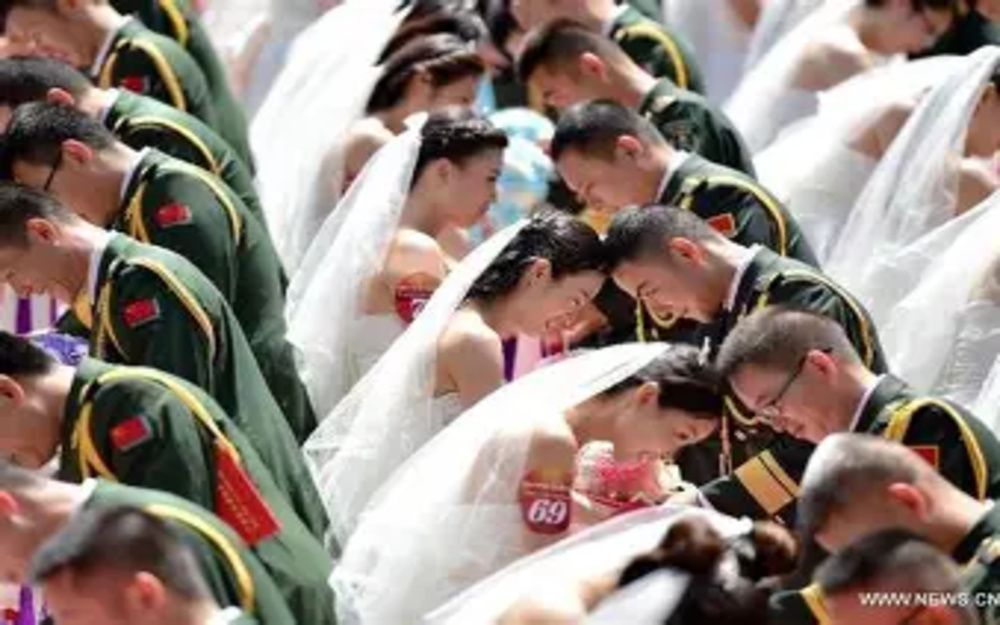
In recent weeks, a new policy proposal in China has drawn attention for its unusual focus. Several major state-linked organizations—including the All-China Federation of Trade Unions, the Communist Youth League, and the All-China Women’s Federation—have jointly released guidelines aimed at helping unmarried soldiers stationed in remote frontier regions find wives.
At first glance, the initiative seems harmless. The guidelines promise matchmaking services, relationship counseling, and family support for military personnel posted in isolated areas. Officials describe the move as part of a broader effort to implement President Xi Jinping’s military philosophy of “warming the hearts of soldiers.”
But when viewed through the lens of history, the policy appears less ordinary. The idea of solving military problems through marriage has deep roots in the Chinese Communist Party’s early years—especially in the far western region of Xinjiang.
A Marriage Policy With Strategic Motives
According to official descriptions, the new guidelines aim to address a practical issue: thousands of soldiers stationed in harsh frontier regions remain unmarried. Long separations from cities and families often make it difficult for them to build relationships.
To address this, authorities propose organizing matchmaking events, social programs, and support networks designed to help soldiers find partners and settle down.
On paper, the logic is straightforward. A soldier with a stable family life may feel more motivated and emotionally secure. Leaders argue that helping troops build families allows them to focus on strengthening national defense.
However, critics believe the policy reflects something deeper than simple welfare. They argue it may also be about ensuring loyalty and stability within the ranks at a time of internal uncertainty.
The Historical Echo From Xinjiang
China has tried something similar before.
In the early 1950s, shortly after the Communist Party came to power in the Chinese Civil War, the government faced a problem in Xinjiang. Hundreds of thousands of troops had been deployed to the remote frontier after the conflict ended.
Many of these soldiers were young men who had never married. Others had families thousands of kilometers away in eastern China. The region itself was sparsely populated and culturally distinct from the country’s heartland.
Party leaders feared that such a massive concentration of single soldiers could become unstable or disconnected from the state’s long-term goals.
Their solution was bold—and controversial.
The “8000 Hunan Girls” Campaign
In 1950, military leaders began recruiting young women from eastern provinces to move to Xinjiang. Recruitment campaigns promised opportunity, education, and adventure.
Posters and newspaper advertisements described Xinjiang as a land full of potential where young people could build a new future.
The requirements were simple. Applicants had to be unmarried women between roughly 16 and 25 years old with basic education.
What many recruits were not told, however, was that marriage to soldiers would become part of their future.
Within a year, thousands of young women—many from the province of Hunan—were recruited. The campaign became known historically as the “8000 Hunan Girls to Xinjiang.”
Many of these girls were teenagers filled with patriotic enthusiasm. Some registered without telling their parents. Others even exaggerated their age to qualify.
For them, the journey west symbolized a revolutionary mission.
Reality on the Frontier
When the trains carrying the recruits arrived in Xinjiang, the situation quickly became clear.
Instead of schools and factories, many women were assigned to agricultural or military settlements dominated by male soldiers. In some cases, a handful of women were placed among hundreds or even thousands of men.
Marriage soon followed.
Historical accounts describe a range of experiences. Some couples eventually built stable families. Others, however, faced forced or pressured marriages, isolation, and hardship.
The situation created profound emotional strain for many of the young women. Some historians describe the campaign as a large-scale social engineering project designed to stabilize the frontier population.
By the mid-1950s, women had become a significant portion of the population in the newly established Xinjiang Production and Construction Corps—a unique military-agricultural system designed to secure the region.
Marriage as a Tool of Control
Why did the government invest so much effort in relocating women to remote military settlements?
The answer lies in political logic.
A soldier with a family—especially one rooted in a frontier settlement—becomes tied to that land. Marriage creates responsibility. Children create long-term commitment.
In this way, family life can function as a stabilizing force within a military system.
For authoritarian political structures, family ties can also serve as a form of indirect control. A soldier with dependents may be less likely to take risks, rebel, or abandon his post.
This logic appears to be resurfacing today.
Why the Policy Is Returning
China’s military and political environment has changed significantly in recent years. Anti-corruption investigations and internal disciplinary campaigns have shaken parts of the armed forces.
Such efforts can sometimes create uncertainty among lower-ranking soldiers.
Against this backdrop, encouraging soldiers to settle down and build families could be seen as a way to strengthen loyalty and long-term commitment to the state.
By providing marriage opportunities and support services, authorities may hope to anchor soldiers socially as well as professionally.
A Very Different China Today
Yet China in 2026 is not the China of the 1950s.
Urbanization, economic growth, and shifting social values have dramatically changed attitudes toward marriage. Many young women today prioritize education, careers, and personal independence.
Moving to remote frontier regions—especially under uncertain conditions—may not appeal to large numbers of them.
China is already facing a declining birth rate and a growing number of young adults choosing to delay or avoid marriage entirely.
In this environment, the state may struggle to replicate the scale of recruitment seen decades ago.
History’s Lingering Questions
Whether the new policy succeeds remains uncertain.
Supporters argue that it offers practical assistance to soldiers serving in difficult conditions. Critics worry that it echoes a past in which women’s lives were shaped by the state’s strategic priorities.
What is clear is that the intersection of military strategy, social policy, and personal life remains deeply complex in China.
And as the government once again looks to marriage as a tool for stability, the echoes of history continue to raise difficult questions about how far the state should go in shaping the private lives of its citizens.
