

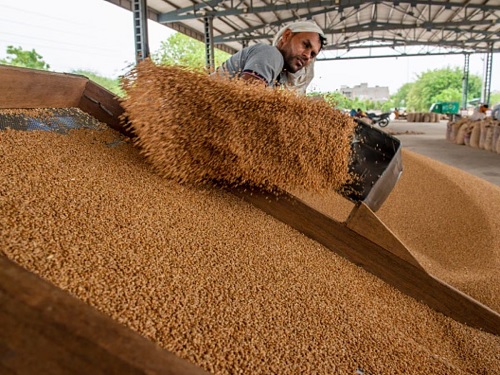
New Delhi, 9th Feb. The Government of India has taken decisive measures to manage food security and curb hoarding and speculative practices by imposing stock limits on wheat. The Removal of Licensing Requirements, Stock Limits, and Movement Restrictions on Specified Foodstuffs (Amendment) Order, 2023, issued on June 12, 2023, is in effect until March 31, 2024, across all States and Union Territories.
Under these regulations, traders, wholesalers, retailers, big chain retailers, and processors must adhere to prescribed stock limits and register on the wheat stock limit portal (https://evegoils.nic.in/wsp/
Entities exceeding the prescribed stock limits have 30 days from the notification to bring their stocks within the limits. Central and State Government officials will closely monitor enforcement to prevent artificial scarcity of wheat.
Additionally, the government has initiated the Open Market Sale Scheme (Domestic) [OMSS(D)] to increase wheat availability at affordable prices.
The Food Corporation of India (FCI) has allocated 101.5 LMT wheat for calibrated release into the domestic open market through weekly e-auctions, with a subsidized price of Rs. 2150/quintal. An additional 25 LMT may be offloaded under OMSS during Jan-Mar 2024 based on requirements.
Furthermore, FCI is supplying wheat to Central Co-operative organizations for processing into atta and sale under the ‘Bharat Atta’ brand at an affordable price of Rs. 27.50/kg. Targeted sales are conducted in areas with higher prices, and 7.5 LMT of wheat has been allocated for converting into Atta under the ‘Bharat Atta’ brand.
The Department of Food and Public Distribution is closely monitoring the wheat stock position to control prices and ensure easy availability nationwide. These measures aim to safeguard food security and ensure fair access to essential commodities for all citizens.
