
Census 2027 Sparks Controversy: Why Caste Enumeration Is Creating Political and Social Tensions

Paromita Das
New Delhi, 18th June: A New Chapter in Bharatiya Demographics Begins
The buzz around the Census 2027 began not with a grand announcement but with a flicker of confusion. On social media, misinformation mushroomed across platforms, particularly X (formerly Twitter), suggesting that the central government had quietly backtracked on its promise to include caste data in the upcoming census. The confusion grew loud enough to warrant a formal rebuttal.
By evening on June 17, the Press Information Bureau (PIB) took to the same platform to quash the rumors, clarifying unequivocally that caste enumeration will indeed be part of the Census 2027. It asked the public to rely only on authentic sources and ignore unverified content. Still, the damage was done — the seeds of doubt had already taken root in public discourse.
Several social media posts are claiming that the Central Government is not including the Caste enumeration in Census 2027.#PIBFactCheck
❌ These claims are misleading.
✅ The Government has already announced that the Caste enumeration will be conducted along with Census… pic.twitter.com/TXQ7eavetx
— PIB Fact Check (@PIBFactCheck) June 16, 2025
This census is shaping up to be the most technologically ambitious and politically sensitive enumeration in Bharat’s independent history. But why is it generating so much heat?
A Century-Old Question Returns
Caste enumeration is not new in Bharat, but it’s certainly controversial. The last time caste was comprehensively recorded was in 1931 under British colonial rule. Since independence, Bharatiya governments have largely avoided this task, opting instead to focus on broader socio-economic data. The one exception was the Socio-Economic and Caste Census (SECC) of 2011, which failed to gain traction due to data discrepancies and lack of political consensus on its usage.
So when the Modi government announced through a Cabinet Committee decision on April 30 that Census 2027 would include caste enumeration, it marked a pivotal policy shift. For many, it was long overdue; for others, it opened a Pandora’s box.
Digital Census Meets Political Minefield
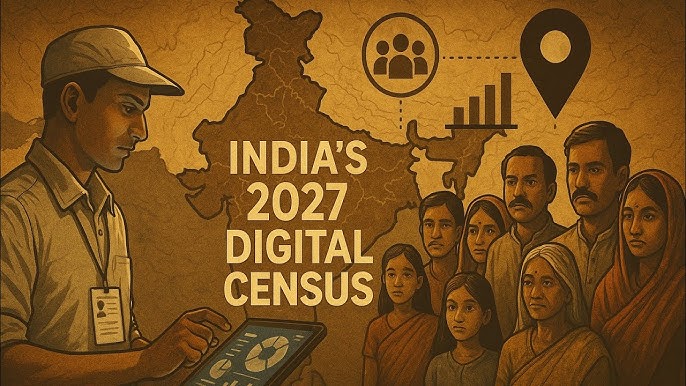
The upcoming census will be conducted in two phases: first, the House listing Operation (HLO) that focuses on assets, housing conditions, and amenities; and second, Population Enumeration (PE), which records demographic and socio-economic details. For the first time, it will also include caste data.
It’s a logistical behemoth — involving over 34 lakh enumerators, supervisors, and functionaries across the nation, armed with mobile apps and self-enumeration options. Yet, despite the tech upgrades, the political landmines remain old and unresolved.
Caste enumeration, critics argue, can disrupt Bharat’s already fragmented social fabric. They worry about data misuse, vote bank politics, and reigniting inter-caste rivalries. Supporters, on the other hand, believe that without data, social justice is mere lip service. For welfare schemes, reservations, and resource distribution to be truly equitable, they argue, we must know who needs what and how much.
The Opposition Smells a U-turn
The latest controversy ignited when Congress General Secretary Jairam Ramesh raised questions about the official gazette notification issued on June 17. Though the government reiterated its stand, Ramesh called the silence on caste enumeration in the gazette “another U-turn,” accusing the Centre of playing a double game — promising inclusion in public while avoiding written commitment.
He urged the adoption of the Telangana model, where caste-based data collection includes detailed socio-economic markers. This model, he argued, reflects real-time inequalities more effectively and allows for better policy-making.
What was meant to be a technical announcement quickly turned into a charged political debate. The central government found itself once again defending its credibility, with Home Minister Amit Shah personally reviewing the census preparations to underline the seriousness of the exercise.
Data is Power — And That’s the Real Conflict
At the heart of the controversy lies a single truth: caste is not just a social identity — it’s political capital. The inclusion or exclusion of caste from the national census is more than administrative. It determines electoral narratives, budgetary allocations, and policy priorities.
This is why the stakes are so high. Some fear that acknowledging the deep caste divides will only widen them. Others argue that the only way to fix inequality is to face it head-on, with honest numbers. In a democracy that prides itself on equal opportunity, refusing to count caste is akin to refusing to see the full picture.
The noise around Census 2027 reflects this deeper tension — a society that knows caste matters, but is still uneasy about admitting how much.
A Turning Point for Bharatiya Governance
With a reference date of March 1, 2027, for most of Bharat and October 1, 2026, for snow-bound regions like Ladakh, the Census 2027 promises to be historic. It will offer the first glimpse into a modern Bharat grappling with its past — not just with numbers, but with identity, equity, and truth.
The path ahead won’t be easy. Verifying data, ensuring privacy, and combating political misuse are real challenges. But if done right, this census could change how Bharat understands itself — not as a monolith, but as a mosaic of communities, needs, and aspirations.
Counting More Than People
Census 2027 is more than a statistical exercise. It is Bharat’s attempt to come to terms with its evolving social contract. The inclusion of caste may cause discomfort, disagreement, and even disruption. But it also holds the promise of recognition and reform.
A nation cannot solve what it refuses to measure. For all its flaws, caste enumeration might just be the bold step Bharat needs to make justice a reality, not just a principle.
