
Canada’s Burning Churches: A Disturbing Pattern of Religious Intolerance

Poonam Sharma
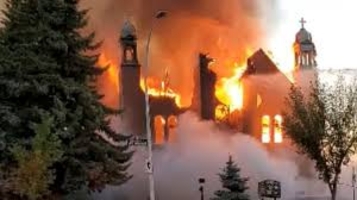
In recent years, Canada has been forced to confront an uncomfortable and escalating reality: the systematic targeting of Christian places of worship. With 113 churches either burned to the ground or vandalized across the country, what might once have been dismissed as isolated incidents now appears to be part of a disturbing pattern. The latest attack on the Notre Dame des Sept Allégresses church in Quebec once again brings into focus the growing wave of religious intolerance directed against non-Islamic faiths, raising questions about security, multicultural coexistence, and the role of radical Islamist networks in Canada.
A Nation of Tolerance Under Siege
Canada has long prided itself on being a bastion of religious freedom and multicultural tolerance. Its constitution guarantees the right of every citizen to worship as they choose, and its cities are mosaics of cultures, languages, and traditions. Yet this very openness is being challenged by extremist forces who exploit Canada’s freedoms while working to undermine its social fabric.
The repeated attacks on Christian churches represent more than mere acts of vandalism—they are symbolic assaults on Canada’s cultural heritage and on the principles of peaceful coexistence. The torching of churches, particularly in rural and immigrant-sensitive areas, sends a chilling message: that radical ideologies are attempting to erase the presence and legacy of Christianity in a land historically shaped by it.
From “Love Jihad” to “Land Jihad”
The spread of Islamist extremism has never been limited to the Middle East or South Asia. It has taken multiple forms worldwide, often adapting itself to local contexts. Analysts point to strategies such as “love jihad”—where interfaith relationships are allegedly manipulated to alter demographics—and “land jihad,” where aggressive encroachments or disputes over territory are framed in religious terms.
In Canada, such narratives are beginning to resonate with disturbing clarity. While violent attacks on churches are the most visible markers, there are subtler currents at play: demographic pressures in certain neighborhoods, the promotion of radical literature in mosques and community centers, and organized attempts to silence critics under the guise of “Islamophobia.” These developments echo global patterns where Islamist zealots push to dominate the cultural and political space of non-Islamic societies.
The Quebec Attack: A Symbolic Warning
The destruction of the Notre Dame des Sept Allégresses church is particularly symbolic. Quebec, with its strong Catholic heritage, has long been the spiritual heartland of French-Canadian identity. An attack here is not just on bricks and mortar but on centuries of tradition. The very name of the church—dedicated to the “Seven Joys” of the Virgin Mary—stands in stark contrast to the ideology of hate espoused by those who target it.
For many Quebecers, this act represents not only religious intolerance but also an assault on their cultural identity. As attacks multiply, ordinary citizens are beginning to question whether the state has the will—or even the capacity—to protect the nation’s Christian heritage.
Silence of the Liberal Establishment
One of the most troubling aspects of this crisis is the muted response from Canada’s political and media establishment. In their eagerness to avoid offending minorities or being accused of bigotry, many leaders hesitate to call out Islamist extremism by name. Instead, they prefer vague references to “acts of hate” or “criminal vandalism,” stripping the incidents of their ideological context.
This silence only emboldens radicals. When perpetrators realize that their actions will be downplayed or sanitized, they are encouraged to push further. Worse, the lack of honest discussion about the ideological roots of such violence risks alienating ordinary Canadians, who increasingly feel betrayed by elites who seem unwilling to defend the country’s core values.
Lessons from Europe
Canada need not look far to see the consequences of ignoring this problem. Across Europe, countries such as France, Germany, and Sweden have witnessed waves of Islamist violence—from church beheadings to attacks on synagogues and Hindu temples. In many cases, governments initially responded with denial, only to realize too late that unchecked radicalization had created parallel societies hostile to national culture.
If Canada continues on its current path, it risks importing the same tensions. The burning of churches is not an end in itself—it is a precursor to broader attempts at intimidation, demographic manipulation, and cultural erasure.
Defending Pluralism with Strength
True pluralism does not mean turning a blind eye to intolerance. For Canada to remain a nation of coexistence, it must confront the reality that radical Islamist movements are actively working against it. This requires:
Clear Acknowledgment – Political leaders must name Islamist extremism as the driving force behind these attacks, rather than hiding behind euphemisms.
Law Enforcement Action – Security agencies should treat church burnings not as isolated crimes but as part of a larger ideological war. Networks providing funding, propaganda, or logistical support must be dismantled.
Community Responsibility – Moderate Muslims in Canada must speak out against radicals within their own ranks. Silence or denial only creates suspicion and division.
Cultural Education – Schools and civic organizations should emphasize Canada’s Christian and Indigenous heritage, reminding all citizens that diversity does not mean erasure of foundational traditions.
A Wake-Up Call for Canada
The burning of over a hundred churches should serve as a wake-up call for Canadians across political divides. Religious freedom is meaningless if one faith is systematically targeted while authorities look away. Canada cannot afford to repeat the mistakes of nations that allowed ideological extremism to fester until it erupted in violence on their streets.
If Canadians truly value tolerance, they must defend it vigorously—not through silence or appeasement, but by standing firm against those who seek to impose religious supremacy. The attacks on churches are not isolated crimes; they are signals of a deeper agenda. Recognizing this truth is the first step toward preserving Canada’s pluralist identity.
