
Budget 2026-27 Puts Textiles at Heart of India’s Growth Plan
Mega parks, MSME liquidity, skilling push and export reforms to strengthen India’s textile value chain

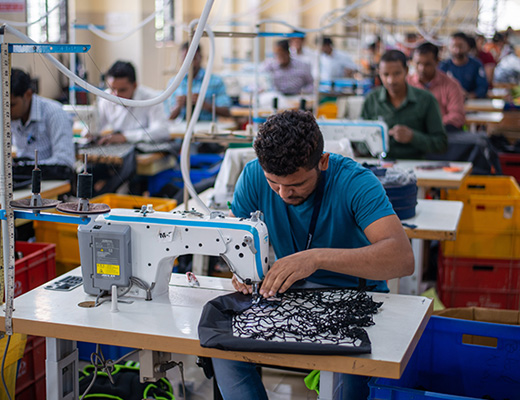
- Textiles positioned as a core growth and employment engine in Budget 2026–27
- Integrated programme to boost fibres, clusters, handlooms and green manufacturing
- Mega Textile Parks, MMF and technical textiles get major policy push
- MSMEs, artisans and exporters supported through liquidity, skilling and trade reforms
GG News Bureau
New Delhi, 4th Feb: The Union Budget 2026–27 has placed the textile sector at the centre of India’s growth strategy, underscoring its role as a key driver of employment, exports, rural livelihoods and sustainable manufacturing.
One of India’s oldest and most diverse industries, textiles have been identified as a strategic frontier sector in the Budget, with a clear policy thrust on scaling up manufacturing, improving competitiveness and strengthening India’s position in global textile value chains.
India’s intrinsic strengths in textiles remain robust. The country is the world’s largest cultivator of cotton by acreage, the largest producer of jute, the second-largest producer of silk and cotton, and a major global hub for man-made fibres (MMF), polyester and viscose.
Integrated Programme for Textiles
The Budget announces a comprehensive Integrated Programme for the textile sector, covering the entire value chain—from fibre to fashion and from village industries to global markets. The programme is built around five key components.
The National Fibre Scheme aims to strengthen self-reliance across natural fibres such as silk, wool and jute, alongside MMF and new-age fibres, reducing import dependence and promoting innovation in advanced materials.
The Textile Expansion and Employment Scheme focuses on modernising traditional clusters through capital support for machinery, technology upgradation and common testing and certification facilities, with an emphasis on job creation.
A unified National Handloom and Handicraft Programme will integrate and strengthen existing schemes to support weavers and artisans, improve incomes, ensure market access and preserve India’s textile heritage. Financial assistance will also be provided for natural and vegetable dyes and dye houses through cluster-based infrastructure projects.
The Tex-Eco Initiative seeks to align Indian textile and apparel manufacturing with global sustainability standards, enabling access to emerging green markets.
Samarth 2.0, an upgraded skilling programme, will modernise the textile skill ecosystem through deeper industry–academia collaboration to ensure industry-ready manpower.
Mega Textile Parks and Technical Textiles
The government has announced the development of Mega Textile Parks in challenge mode to provide integrated infrastructure, enable economies of scale and promote value addition. These parks will also support the expansion of technical textiles used in industrial, medical, defence and infrastructure applications.
Under the PM Mega Integrated Textile Region and Apparel (PM MITRA) scheme, seven parks have already been approved with an outlay of ₹4,445 crore. Investment MoUs worth over ₹27,000 crore have been signed, and infrastructure works are underway across all seven states.
MSME Liquidity and Export Support
To strengthen liquidity for textile MSMEs, the Budget enhances the Trade Receivables Discounting System (TReDS), through which over ₹7 lakh crore has already been facilitated. Measures include mandatory TReDS use by CPSEs, credit guarantee support for invoice discounting, linking GeM with TReDS and enabling secondary market participation.
Export promotion measures include extending the export obligation period from six months to twelve months for textile and allied sector exporters using duty-free imported inputs, easing compliance and working capital pressures.
A ₹10,000 crore SME Growth Fund has also been announced to nurture future “Champion SMEs”.
Employment, Exports and Outlook
The textile sector remains India’s second-largest employment generator after agriculture, providing direct employment to over 45 million people. It contributes around 11 per cent of manufacturing GVA and nearly 9 per cent of India’s total exports.
India is currently the world’s sixth-largest exporter of textiles and apparel, with exports rising to $37.75 billion in FY25 despite a subdued global trade environment. Export growth in 2025 was broad-based across more than 118 countries, with strong momentum in handicrafts, ready-made garments and MMF products.
Trade developments further strengthen the outlook. The India–EU Free Trade Agreement offers zero-duty access for textiles and clothing, with tariffs reduced by up to 12 per cent, a move expected to significantly boost exports to Europe, as noted recently by Piyush Goyal.
A Forward-Looking Textile Vision
With continued emphasis on scale, sustainability, MSME participation and value addition, the Union Budget 2026–27 reinforces a coordinated and future-ready roadmap for the textile sector. The Ministry of Textiles, working with states, industry, artisans and skilling institutions, aims to expand textile exports from around ₹3 lakh crore to nearly ₹9 lakh crore by 2030, positioning India as a competitive, reliable and globally integrated textile and apparel hub.
