
BRICS Expanding its Size: Creating ‘Stronger Platform’ for Economic Cooperation and Viability

GG News Bureau
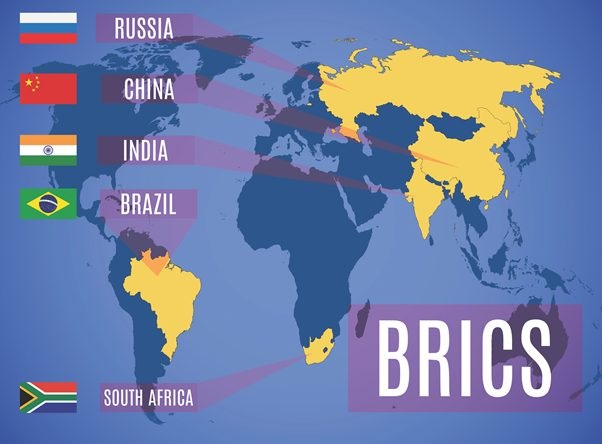
New Delhi, 10th Jan. Exciting news reverberates across the international stage as the BRICS bloc of top emerging economies, consisting of Brazil, Russia, Bharat, China, and South Africa, officially announces its expansion and induction of five full members in an attempt to increase its strategic heft against the backdrop of Western dominance in world affairs. The decision to include Argentina, Egypt, Ethiopia, Iran, Saudi Arabia, and the United Arab Emirates (UAE) underscores the BRICS’ commitment to integrating a more substantial, more equitable platform for economic cooperation and viability.
The coalition was formed in September 2006 and included Brazil, Russia, Bharat, and China (BRIC). It was called BRICS after South Africa became a full member in September 2010.
During a three-day meeting in Johannesburg in August, world leaders discussed the future of these dynamic economies, underscoring the staggering expansion.
#BRICSza | H.E. President Ramaphosa . Johannesburg II Declaration adopted . The XV Summit has adopted guiding principles on the BRICS EXPANSION.Following countries invited to join .
Argentina
Egypt
Ethiopia
Iran
Saudi Arabia
UAETo take effect from the 1st of January 2024 pic.twitter.com/OOa9uqCXqs
— BRICSza (@BRICSza) August 24, 2023
South African President Cyril Ramaphosa, who is hosting the current conference, announced the unprecedented decision to enlarge the BRICS organisation. At a joint press conference following the summit meeting, President Ramaphosa spoke with a sense of accomplishment: “As five BRICS countries, we have reached an agreement on the guiding principles, standards, criteria, and procedures on the BRICS expansion process, which has been in discussion for quite a while.”
Prime Minister Narendra Modi congratulated President Ramaphosa on a successful conference. PM Modi stated unequivocally that India will continue to support the extension of BRICS membership.
“India has always believed that the addition of new members will further strengthen BRICS as an organization and it will give our shared efforts a new impetus,” he asserted. His sentiment echoed the assumption that this growth will revitalise the organization’s global presence.
Prime Minister Modi also emphasised the broader significance of the expansion, claiming that the progress of BRICS represents the necessity for all global institutions to grow with the times. He emphasised the initiative’s transformative aspect, arguing that it may pave the way for reforms in other twentieth-century institutions. His implication was clear: a modernising BRICS might be a forerunner of larger systemic reforms needed on a global scale, mirroring continuing calls for UN Security Council reform and expansion.
As Moscow assumed the presidency of BRICS, Russian President Vladimir Putin announced last week that the grouping has grown to ten members, with Egypt, Ethiopia, Iran, Saudi Arabia, and the United Arab Emirates joining as new members, adding that work on modalities to induct new categories of partner nations would begin immediately.
Russia assumed the BRICS presidency, succeeding South Africa in 2023.
According to the Russian President Vladimir Putin, BRICS is drawing an increasing number of followers and like-minded countries who share its core ideas of sovereign equality, openness, consensus, the desire to establish a multi-polar international order, and a fair global financial and trading system.
BRICS, which includes Brazil, Russia, India, China, and South Africa, accounts for a quarter of the world economy and has long been a primary driver of global economic growth.
“Of course, we will consider the degree to which many other countries, about 30 of them, are prepared to join the BRICS multi-dimensional agenda in one form or another,” Russian President Vladimir Putin said. “To this end, we will start working on the modalities of a new category of BRICS partner country,” he told reporters.
Putin stated that the Russian presidency of the grouping will focus on strengthening BRICS’ role in the world monetary system, expanding inter-banking cooperation, and increasing the use of national currencies in mutual commerce.
He stated that Russia’s 2024 BRICS presidency, under the motto strengthening multilateralism for equitable global development and security,’ will prioritise good and constructive collaboration with all relevant countries.
He went on to say that efforts will be made to enhance all facets of the BRICS relationship in three major areas: politics and security, business and finance, and cultural and humanitarian relations.
Russia would prioritise improved foreign policy coordination among member nations, as well as collaborative efforts to address issues and threats to international and regional peace and stability. Putin stated that the Russian leadership of the grouping will prioritise cooperation in science, high technology, and healthcare, environmental protection, culture, and sports.
Putin stated that the Russian BRICS presidency will focus on contributing to the practical implementation of the BRICS economic partnership strategy 2025 and the action plan for the grouping’s innovation cooperation 2021-2024 in order to ensure energy and food security.
President Vladimir Putin also said he plans to increase BRICS’ role in the international financial system and will “spare no effort to ensure that we facilitate the harmonious integration of new participants” in activities.
Russia will occupy the chair for one year under the motto “Strengthening Multilateralism for Equitable Global Development and Security” and will host the BRICS annual summit in Kazan in October.
The newly expanded BRICS have a combined population of around 3.5 billion people and a GDP of more than $29.82 trillion, or roughly 28% of the world economy which includes Brazil: $2.27 trillion, Russia: $1.9 trillion, India: $4.11 trillion, China: $18.56 trillion, South Africa: $401 billion, Egypt: $357 billion, Ethiopia: $192 billion, Iran: $386 billion, Saudi Arabia: $1.11 trillion, and the UAE: $536 billion.
This group expansion could signal a shift in the geopolitical environment, while observers are unsure whether it will benefit or hinder BRICS members.
The BRICS countries are hopeful that the expansion will result in increased representation for emerging economies and the opportunity to transition away from dependency on the US dollar.
Amazingly, the BRICS expansion has had a substantial geopolitical impact: six of the world’s top nine oil producers are now members of this growing coalition. This statistical coincidence emphasises the size of the expansion and its ability to reset global dynamics.
The development of BRICS represents, beyond an organisational synthesis, the flexible attitude required for institutions to remain relevant in an ever-changing world. It demonstrates the eagerness of its member nations to mould the organisation in ways that reflect an evolving global order.
In essence, BRICS expansion is more than just a numerical increase; it is a message that reflects the dynamics of our day. This announcement with the support of leaders such as Prime Minister Modi shines as a beacon of cooperation, adaptation, and togetherness in a world in perpetual flux. The growing BRICS family not only seeks economic partnership, but also represents the spirit of evolution and reform, generating confidence that other global institutions would embrace change to create a more multifaceted equitable world.
