

By Anjali Sharma
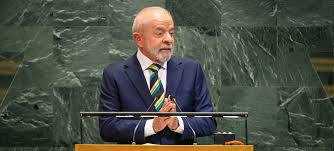
UNITED NATIONS – President of Brazil Luiz Inácio Lula Da Silva on Tuesday told the world community that the UN symbolizes the highest expression of the aspiration for peace and prosperity but the ideals that inspired its founding 80 years ago are under threat as never before.
Lula said “Our democracy and sovereignty are non-negotiable.”
He noted that a former head of State Bolisario was convicted of attacking democracy the first time in 525 years of Brazilian history. The right to defend himself in court was upheld something that would be denied under a dictatorship, he added.
That sent a message to “aspiring autocrats” and their supporters that Brazil’s democracy is not negotiable, he declared.
Brazil has and will continue to defend against unilateral measures targeting its judiciary and economy, he said.
He told the high level session that “Multilateralism is at a new crossroads” and the world is “witnessing the consolidation of an international order marked by repeated concessions to power play, attacks on sovereignty, arbitrary sanctions and unilateral interventions are becoming the rule.”
Lula said that “throughout the world, anti-democratic forces are trying to subjugate institutions and stifle freedoms. They worship violence, praise ignorance, act as physical and digital militias and restrict the press.”
He said that “even under unprecedented attack, Brazil chose to resist and defend its democracy regained 40 years ago”.
Lula referred to his predecessor’s recent conviction for attacking the democratic rule of law, marked a first in his country’s 525-year history.
“Before the eyes of the world, Brazil sent a message to all aspiring autocrats and those who support them: our democracy, our sovereignty are non-negotiable,” he said.
He noted that Latin American and the Caribbean “are experiencing a time of growing polarization and instability.”
“The path to dialogue must not be closed in Venezuela. Haiti has the right to a violence free future. And it is unacceptable that Cuba be listed as a country that sponsors terrorism”.
Lula said that “the comparison between crime and terrorism is worrying” and the most effective way to combat drug trafficking is through cooperation to suppress money laundering and limit arms trade.
“Using lethal force in situations that do not constitute armed conflict is tantamount to executing people without trial,” he added
Lula stressed that “the path to dialogue must not be closed in Venezuela. Haiti has the right to a violence free future, and it is unacceptable that Cuba be listed as a country that sponsors terrorism.”
On the Middle East crisis he stressed “no situation is more emblematic of the disproportionate and illegal use of force” than the situation in Palestine.”
He warned that “the Palestinian people are at risk of disappearing” and “will only survive with an independent State integrated into the international community”, which over 150 UN Member States have reaffirmed.
On Climate action, Lula said the COP30 conference in the Brazilian city of Belém “will be the time for world leaders to prove the seriousness of their commitment to the planet.”
He acknowledged that developing countries are confronting climate change in the face of other challenges, while rich nations “enjoy a standard of living reached at the expense of 200 years of greenhouse gas emissions.”
“Demanding greater ambition and greater access to resources and technology is not a matter of charity, but of justice,” he said.
Lula said “The only war of which everyone can emerge victorious is the one we wage against hunger and poverty.”
Brazil has been taken off the Food and Agriculture Organization’s Hunger Map in 2025 though globally, 2.3 billion people face food insecurity, Lula stated.
He said that the international community’s priorities must change to focus on reducing arms spending, increasing development aid, debt relief for the poorest nations and set a minimum global tax “so that the super-rich pay more taxes than workers”.
Lula emphasized that it must regulate the Internet, which does not mean restricting the freedom of expression, but ensuring that what is “illegal in the real world is treated that way in the virtual environment”.
He said objections to regulation cover up crimes such as human trafficking and pedophilia, recalled that “the Brazilian Parliament was right to rush to address this issue” in recent legislation.
