
Blue Economy Will Power India’s Future Growth: Dr Jitendra Singh
Minister highlights ocean energy, mineral wealth and climate risks at IISF 2025

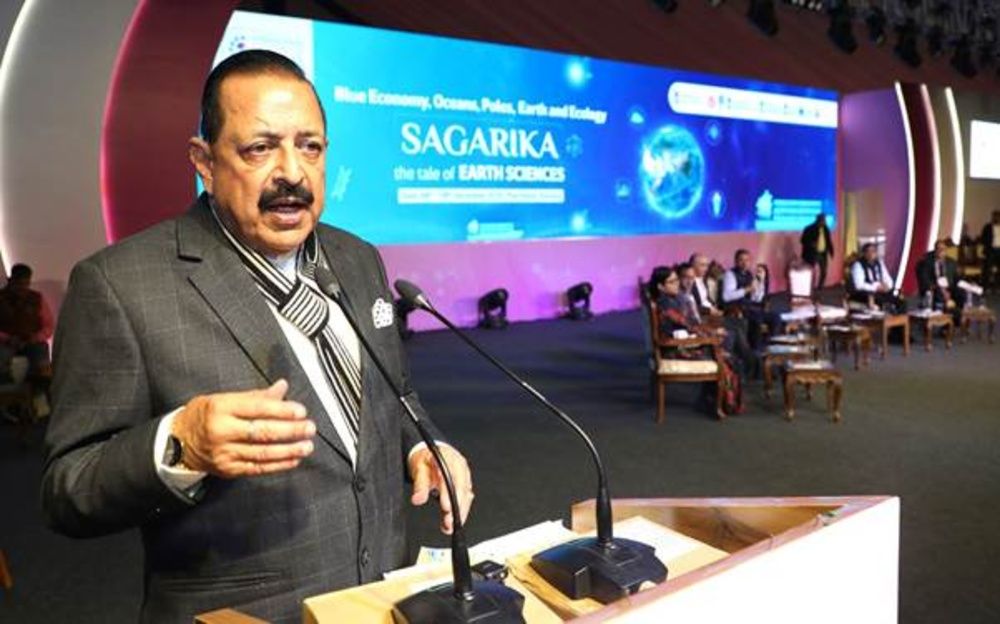
- Dr Jitendra Singh says oceans are India’s untapped national asset and key to Viksit Bharat 2047
- Calls tidal, thermal and offshore wind power critical for India’s clean energy transition
- Warns of climate threats and marine pollution; stresses urgent scientific mapping of resources
- Notes oceans hold minerals, energy and biodiversity equal to 60% of India’s landmass
GG News Bureau
Newb Delhi, 8th Dec: Union Minister for Science and Technology Dr Jitendra Singh on Monday said the blue economy is poised to become a major engine of India’s future growth, calling the country’s oceans a vast yet underutilised national asset. Speaking at the India International Science Festival (IISF) 2025 during a session on Earth sciences, he underlined that ocean-based resources would be central to achieving the vision of a developed India by 2047.
The Minister noted that while oceans have always been integral to India’s civilisational memory, large-scale scientific and economic engagement with marine resources has gained momentum only in recent years. He said the Prime Minister’s Independence Day speeches in 2023 and 2024 — which identified the blue economy as a national priority — reflect this renewed focus.
Highlighting India’s geographical advantage, Dr Singh pointed out that the nation has more than 11,000 km of coastline and an Exclusive Economic Zone extending over 2.37 million sq km. “Nearly 60 per cent of our landmass-equivalent lies in the ocean, yet its contribution to value creation has remained limited so far,” he said, urging a shift beyond land-based resources to meet future developmental needs.
Dr Singh emphasised that oceans can significantly boost India’s clean energy mix. He cited opportunities in offshore wind, tidal and wave power, ocean thermal gradients, and even saline gradient energy. These, he said, will be vital for India’s transition to renewable energy, complementing solar and wind infrastructure on land.
He added that the Deep Ocean Mission will play a pivotal role in expanding ocean research, marine biodiversity studies, deep-sea mining technologies and exploration of mineral reserves.
The Minister warned that rising climate threats — including coastal erosion, marine heatwaves, and stronger cyclones — along with non-climatic dangers such as marine litter and pollution, demand immediate scientific interventions. Detailed resource mapping, advanced oceanographic tools, and stronger private-sector involvement will be essential to mitigate risks and sustainably tap ocean wealth.
Dr Singh also highlighted the geopolitical significance of the blue economy. Sustainable use of ocean resources, he said, would strengthen India’s strategic position, especially as marine transport, deep-sea exploration, biotechnology, and ocean-derived pharmaceuticals emerge as new economic frontiers.
Senior officials from the Department of Biotechnology and the Haryana government joined the session, reinforcing the need for coordinated action among government agencies, scientific institutions and industry stakeholders.
Concluding his address, Dr Singh called for collective responsibility in exploring ocean resources wisely. Decisions made today, he said, will determine India’s economic strength and ecological resilience in the decades ahead.
