
Bihar Elections 2025: Welfare Promises, Poster Wars, and the Battle for Political Legacy

Paromita Das
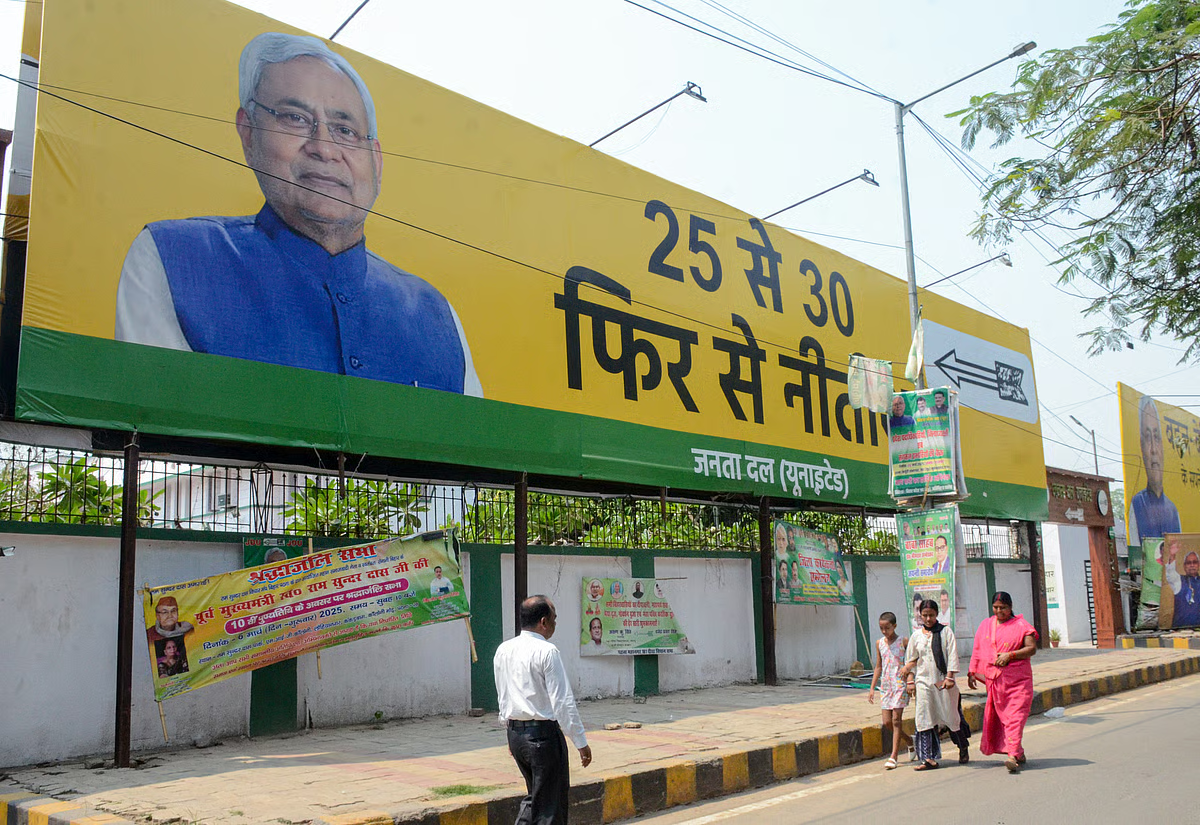
New Delhi, 23rd June: As Bihar gears up for its 2025 assembly elections, the political climate is heating up—not just in the corridors of power but on the streets of Patna, where a fierce poster war is unfolding between the ruling Bharatiya Janata Party (BJP) and the Rashtriya Janata Dal (RJD). But this election isn’t just about satirical slogans or street-level sniping. It’s also a contest of policies, legacy, and public trust.
Chief Minister Nitish Kumar has attempted to rise above the chaos with a major social welfare announcement aimed at the state’s most vulnerable. In stark contrast, the BJP and RJD are engaged in an escalating visual war, exchanging jibes about corruption, nepotism, and incompetence. The result is a campaign season where social security measures and street mockery exist side by side—both trying to win hearts and votes.
Nitish Kumar’s Pension Boost: A Calculated Social Push
In the midst of this noisy backdrop, Chief Minister Nitish Kumar unveiled a significant increase in the Social Security Pension Scheme, raising monthly assistance from ₹400 to ₹1,100 for widows, senior citizens, and persons with disabilities. Set to benefit over 1.09 crore people, the pension will now be disbursed by the 10th of every month beginning July.
Kumar’s move is not just timely—it’s strategic. By expanding the social safety net just months ahead of the elections, he seeks to consolidate support from those most impacted by inflation and unemployment. This initiative positions Nitish not only as a seasoned administrator but also as a welfare-oriented leader in contrast to his opponents, who are locked in personal attacks.
The Poster War: From Satire to Smear Campaign
While Nitish leans into governance, the BJP has taken a more combative route by targeting its chief political rival, the RJD, with a poster campaign that borders on personal vilification.
Lalu Prasad Yadav has been labeled a ‘fodder thief’, a reference to the infamous ₹950 crore Fodder Scam during his chief ministerial tenure. Posters mocking him and bringing up his conviction are meant to keep corruption in the public discourse. Tejashwi Yadav, the RJD’s current face, hasn’t been spared either. Satirical posters have branded him as ‘Toti Chor’ (tap thief), and ‘Feelswi Yadav’, playing on both his alleged involvement in water project scams and questions over his educational qualifications.
The BJP’s strategy is clear: anchor the RJD to its corruption-stained past and cast doubt on its present leadership. These attacks are designed to chip away at the RJD’s credibility and present the party as a relic of misgovernance.
RJD’s Counterattack: Turning the Mirror
Not to be outdone, the RJD has responded with its own poster campaign. Its counter-narrative accuses the BJP of focusing on mudslinging instead of real issues like education, employment, and rural infrastructure. RJD’s messaging champions its past welfare schemes and criticizes the BJP for “failed governance” under Nitish’s alliance.
Tejashwi Yadav, in a series of public statements, has accused the BJP of indulging in “desperate tactics” and not presenting any new vision for Bihar. The RJD believes the electorate is more interested in who can create jobs and improve public services than who stole fodder three decades ago.
Fodder Scam Resurfaces, But Is It Still Politically Potent?
The Fodder Scam, one of Bharat’s largest financial scandals, continues to haunt Lalu and the RJD. Interestingly, Jagannath Mishra, another former CM of Bihar who was also convicted in the case, has largely escaped political scrutiny in this election cycle. This selective memory reflects the BJP’s strategy to keep Lalu as the face of corruption.
However, voters—especially younger ones—may not resonate as deeply with a 1990s scandal. While corruption remains a serious issue, the electorate’s growing concerns around job creation, health care, and inflation may weaken the effectiveness of this line of attack.
Policies Must Win Over Posters
Bihar has long been a crucible of caste-based politics, emotional appeals, and dynasty-versus-development debates. But this time, the stakes seem different. With a young and increasingly aspirational electorate, welfare initiatives may prove more persuasive than poster wars.
Nitish Kumar’s pension increase reflects an understanding of this shift. The BJP’s focus on exposing the RJD’s past wrongdoings could backfire if not matched with forward-looking policy proposals. Meanwhile, Tejashwi must offer a compelling vision that transcends his father’s legacy.
For voters, the question is simple: who can offer real governance in a state that still grapples with poverty, migration, and lack of infrastructure?
Bihar’s Crossroads—Populism or Performance?
As the 2025 assembly elections approach, Bihar stands at a political crossroads. On one side lies the pull of legacy, nostalgia, and personality-driven politics. On the other lies the promise of structured governance and social upliftment. The contrasting campaign styles—poster politics vs. pension policies—perfectly reflect this dichotomy.
Whether Nitish Kumar’s welfare-driven strategy can outweigh the BJP’s aggressive jibes or whether the RJD can reframe its narrative away from its corruption-tainted past remains to be seen. What is certain is that this election won’t just determine who governs Bihar—it will shape how future elections are fought in one of Bharat’s most politically conscious states.
