
Bihar Boils Again: The Minority Question Shadowing Tejashwi’s Coronation
“Tejashwi’s Turn or Trouble? Bihar’s Political Chessboard Heats Up Over INDIA Bloc’s Power Equation.”

Paromita Das
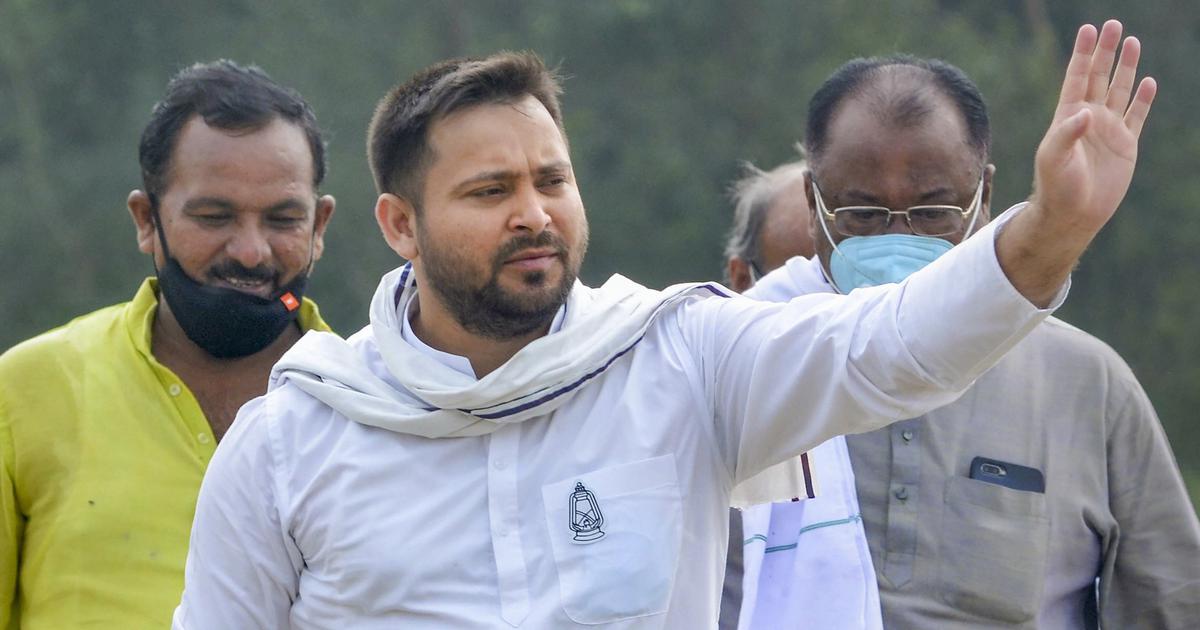
New Delhi, 27th October: In Just as Bihar’s political landscape seemed to settle into predictable chaos, a new jolt has shaken the state’s power equations. The announcement of RJD leader Tejashwi Yadav as the INDIA bloc’s Chief Ministerial candidate, with VIP chief Mukesh Sahani as his Deputy CM face, has ignited a storm of debate within the opposition alliance and beyond. What was meant to be a unifying declaration has instead exposed the fragile balance of caste, community, and representation that defines Bihar’s politics.
As congratulations trickled in from loyalists, criticism rose sharply from unexpected corners—most notably from minority leaders and former allies, who accused the alliance of ignoring proportional representation. Their question is piercingly simple: how can an alliance built on inclusivity exclude the state’s largest minority community from visible power?
The Nomination that Redrew Lines

The naming of Tejashwi Yadav, though expected, marks the official passing of Bihar’s opposition mantle to the RJD scion. His combination of political lineage, youthful energy, and electoral recall from the 2020 elections made his projection almost inevitable. Yet, the simultaneous inclusion of Mukesh Sahani, a leader from the Mallah (boatmen) community, as Deputy CM face signaled more than partnership—it was a delicate attempt to blend backward-caste mobilisation with sub-caste balancing and symbolic inclusion.
However, what followed was a storm of dissent on social media. Muslim leaders questioned why the INDIA bloc’s core message of “collective representation” failed to reflect in its top-tier leadership symbols. For them, the optics of two OBC faces—without any Muslim figure upfront—betrayed a selective politics of alliance arithmetic. In a state where Muslims constitute roughly 18% of the population, the absence felt deliberate.
The Minority Question Revives Old Fault Lines

The controversy deepened when voices like AIMIM spokesperson Asim Waqar argued that Muslims were once again being treated as a “vote shield,” not as power partners. Chirag Paswan, the LJP (Ram Vilas) leader, sharpened the point further with his charged social media post accusing the INDIA bloc of perpetuating “bonded vote-bank politics.” His barbed remark—that even in 2005 RJD refused a Muslim Chief Minister—wasn’t just electoral rhetoric; it was an attempt to reopen historical resentment between Muslim voters and their so-called secular protectors.
Paswan’s criticism carried both political purpose and personal positioning. By targeting Tejashwi while appealing to Muslim frustration, he aimed to fracture the INDIA bloc’s traditional social coalition—a theatrical but potentially potent move in Bihar’s tightly contested caste grid.
Tejashwi’s Rebuttal and Balancing Act

Tejashwi Yadav, ever conscious of the fine line between assertion and apology, sought to turn the controversy into a narrative of inclusivity. “An extremely backward community’s son has been nominated as Deputy CM,” he declared, arguing that the move represented empowerment beyond rhetoric. Tejashwi also hinted that the alliance would soon announce more Deputy Chief Ministers—possibly including a Muslim face—to quell discontent.
This statement was both tactical and telling. It revealed Tejashwi’s growing comfort with managing alliance optics while underscoring the RJD’s reliance on caste symbolism. Still, in trying to appease one side without offending another, Tejashwi must walk a political tightrope—a risk familiar to every inheritor of Bihar’s fractured legacy.
A Game of Arithmetic and Anxiety

Bihar’s electoral politics has always balanced two competing equations: caste solidarity and minority reassurance. The INDIA bloc’s latest configuration tries to knit together backward-caste unity with progressive optics. The RJD under Tejashwi commands the Yadav vote (around 13%) and draws substantial Dalit and EBC support through alliance partners. Mukesh Sahani adds a 2–3% Mallah vote base, strategically important in riverine constituencies. However, alienating the 18% Muslim vote could dismantle this fragile construction.
For decades, the Muslim-Yadav (MY) alliance was the foundation of RJD’s political dominance, turning Lalu Prasad Yadav into a near-mythic figure. But in recent years, the sociopolitical chemistry has shifted. The younger, digitally active Muslim electorate is increasingly skeptical of symbolic representation without tangible power. Tejashwi’s challenge is not to just retain loyalty but to rebuild trust in a rapidly polarizing environment.
The BJP’s Opportunism and the Outsider Advantage

The BJP, sensing an opening, has amplified internal rifts with remarkable precision. Deputy CM Samrat Choudhary accused Tejashwi of inheriting his father’s “reign of nepotism,” while others mocked promises of “five Deputy CMs” as proof of the alliance’s confusion. The NDA narrative pivots on portraying the INDIA bloc as a transactional coalition—united not by vision, but by arithmetic.
Chirag Paswan, meanwhile, continues playing his dual role: criticizing RJD to appeal to upper-caste and Muslim dissatisfaction while maintaining his own independent brand of “Bihari pride politics.” In this crowded battlefield, Tejashwi’s biggest enemy isn’t the NDA’s aggression—it’s voter fatigue with recycled promises dressed in new slogans.
A Leadership Test Beyond Castes

The INDIA bloc’s decision reveals two overarching truths about Bihar’s evolving politics. First, regional alliances are still chained to caste calculus, often at the cost of social vision. Second, representation continues to be defined vertically (through symbolic leaders) rather than horizontally (through institutional inclusion).
Tejashwi Yadav stands at a historic juncture. His leadership has matured since 2020—he speaks now of jobs, industries, and investment instead of pure identity. Yet, symbolic missteps like delayed representation can undo hard-earned perception gains. For an electorate yearning for progress but anchored in old loyalties, rhetoric alone will not suffice.
Bihar’s Political Mirror
The INDIA bloc’s Bihar strategy is both daring and dangerous. By formalizing Tejashwi-Mukesh leadership, it seeks to consolidate the backward caste base ahead of a fierce contest. But by ignoring minority optics, it risks rupturing the social compact that once guaranteed its rise.
Tejashwi Yadav’s challenge now extends beyond winning elections—it’s about rewriting Bihar’s governance story without repeating his father’s political grammar. Whether he emerges as a unifier or another dynastic tactician will depend on how convincingly he can turn arithmetic into aspiration.
As Bihar watches, one truth endures: politics here has never been just about votes—it’s about belonging, balance, and the belief that power should also represent who you are.
