
Bharat’s Trade Talks with the US: Negotiating from Strength, Not Submission
“From resilience under tariffs to global credibility, Bharat’s confidence at the negotiating table marks a turning point in US–Bharat trade relations.”

Paromita Das
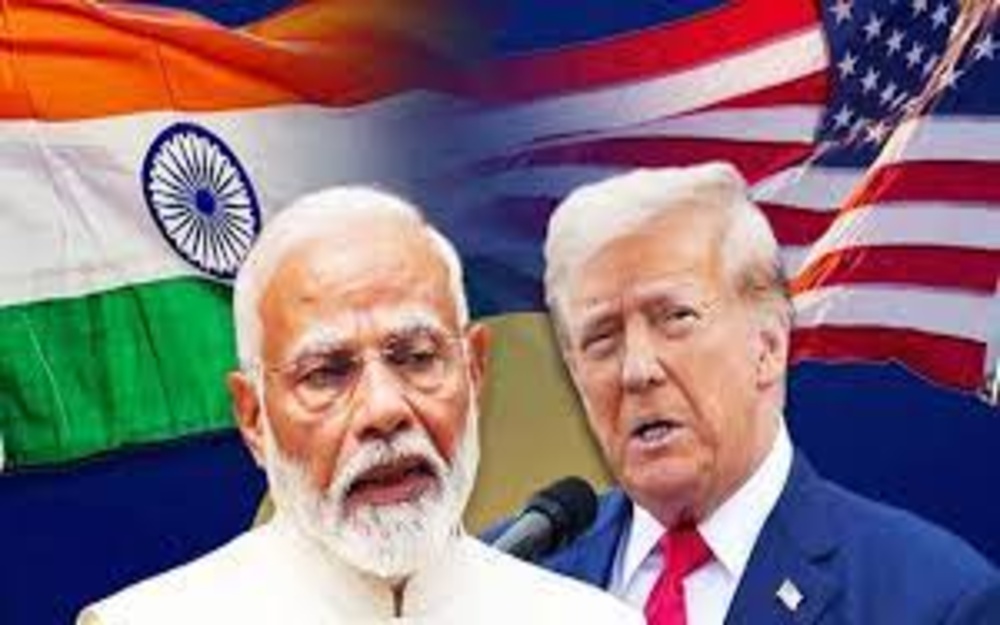
New Delhi, 27th November: In international diplomacy, confidence is currency. And as speculation grows that Bharat and the United States are nearing the conclusion of their long-awaited bilateral trade agreement, New Delhi appears to be negotiating from a position of rare economic and strategic assurance. What was once viewed as an uneven equation—between the world’s largest and fifth-largest economies—now feels far more balanced.
This shift is not accidental. Behind Bharat’s newfound assertiveness lies a combination of economic resilience, deft policy maneuvering, and a maturing foreign trade outlook that refuses to bow to external pressure. As global uncertainty deepens and tariff tensions rise, Bharat has chosen to anchor its diplomacy in self-assured pragmatism, signaling that this deal, if finalized, will be one of equals—not one of appeasement.
The Confidence Behind the Calm
Union Commerce Minister Piyush Goyal recently encapsulated this approach, calling the US a “trusted partner” but insisting that any deal must be “fair, equitable, and balanced.” This isn’t diplomatic grandstanding—it reflects a new economic reality.
Despite months of back-and-forth negotiations, Bharat has held firm on its red lines, especially in politically sensitive sectors like agriculture and dairy. Historically, smaller economies have yielded to Washington’s trade demands for fear of economic repercussions. This time, however, Bharat has demonstrated strategic patience. “We’ve avoided the worst impact of the 50% US tariffs,” a senior government official told Reuters. “If needed, we are ready to wait.”
That confidence is not built on rhetoric—it’s built on resilience.
A Resilient Economy in a Volatile World
When the US imposed a sweeping 50% tariff on Bharatiya goods—half of it linked to Bharat’s discounted Russian oil purchases—many predicted an economic jolt. Yet the Bharatiya economy not only absorbed the shock but also continued to expand at one of the fastest rates in the world.
The International Monetary Fund (IMF) recently upgraded Bharat’s growth forecast from 6.4% to 6.6%, citing robust domestic demand and effective policy responses. Even Forbes, in an October analysis, noted that “Bharat’s GDP growth has remained largely unaffected by President Trump’s tariffs,” crediting targeted fiscal measures and a resilient consumer base.
The government’s September GST cuts further boosted consumption, particularly in manufacturing and retail sectors, while the export numbers began showing early signs of recovery. Exports to the US fell 8.6% year-on-year in October—an improvement over September’s 12% dip—and marked the first month of positive turnaround after five consecutive declines.
Tariff Rollbacks: Washington Blinks First
Perhaps the most telling indicator of changing dynamics came from Washington itself. Facing domestic inflation and voter discontent, the Trump administration quietly rolled back tariffs on over 200 food products—including tea, mangoes, and spices—key items in Bharat’s export basket.
These exemptions, worth nearly $1 billion annually, have reopened US market access for Bharatiya exporters who had begun diversifying toward Europe and the Middle East. Darpan Jain, Joint Secretary in the Commerce Ministry, welcomed the move, saying, “Now our exports will have a level playing field.”
The rollback underscores a subtle but significant reality: Bharat’s economic leverage is now recognized even in Washington’s policy calculus. For an administration known for its transactional approach, this gesture signals pragmatism—a realization that Bharat’s trade partnership is as much about strategic stability as it is about commerce.
Recalibrating Energy Diplomacy
Energy has been another flashpoint in the talks. The US linked a portion of its tariff escalation to Bharat’s purchases of discounted Russian crude. But New Delhi’s response has been swift and strategic. State-run refiners have cut Russian oil imports by nearly 45%, while private giant Reliance Industries confirmed it has stopped processing Russian crude in its Jamnagar refinery.
Simultaneously, Bharat signed a one-year agreement with the US to import 2.2 million tonnes of LPG—roughly 10% of its projected 2026 requirement. This pragmatic diversification not only softened American criticism but also opened new pathways for energy cooperation. What was once a point of friction has evolved into an avenue of strategic alignment.
Market Jitters but Firm Fundamentals
The prolonged negotiations have rattled markets temporarily. Foreign portfolio investors have withdrawn around $16.5 billion from Bharatiya equities this year, and the rupee briefly hit a record low of ₹89.49 against the dollar in late November. But economists argue that these tremors reflect global monetary tightening and dollar strength rather than Bharat’s trade posture.
Underlying indicators—strong tax collections, buoyant manufacturing output, and steady foreign direct investment inflows—paint a far more stable macroeconomic picture. The volatility, in short, has not dented Bharat’s credibility as a durable growth engine.
A Deal Defined by Self-Belief
For the first time in decades, Bharat is approaching a trade agreement with Washington not as a concession-seeker but as a confidence-holder. The days of defensive diplomacy appear to be giving way to a new realism—one that prioritizes reciprocity and respect over short-term optics.
If both sides maintain the present tempo, negotiators believe the deal could be finalized by year’s end. Such an outcome would offer investors long-awaited clarity and mark a decisive moment in the evolution of Bharat–US economic relations.
The Dawn of Equal Partnership
In many ways, these trade talks are about more than tariffs and quotas—they symbolize a shifting balance in global economics. Bharat is no longer content with being a passive participant in international trade frameworks. It is shaping them.
The Modi government’s insistence on fairness reflects a broader national mood—a desire to assert sovereignty, uphold domestic priorities, and still engage globally with confidence. As Bharat heads toward becoming the world’s third-largest economy, this balanced assertiveness will likely define its external economic strategy for years to come.
Strength Through Stability
The Bharat–US trade deal, if concluded, will not merely be a document of commercial understanding—it will represent a milestone in Bharat’s emergence as a confident global actor. With the economy holding steady, exports stabilizing, and Washington signaling flexibility, the stage is set for a deal born not of pressure, but of parity.
In a world where trade negotiations often tilt toward the powerful, Bharat’s calm, calculated persistence stands out. It is proof that true economic strength lies not just in numbers—but in the quiet confidence to say, “We can wait.”
