
Bharat’s Silent Border Crisis Ticking Beneath Political Noise

Paromita Das
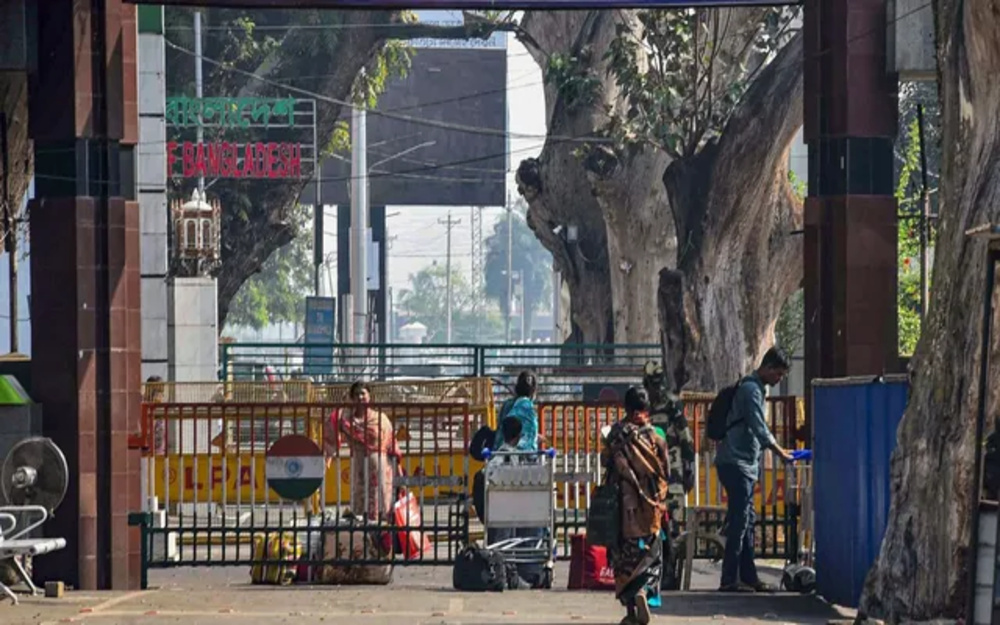
New Delhi, 4th December: The West Bengal–Bangladesh border has always been a sensitive fault line, but today it stands at the centre of a national security debate far larger than partisan politics. Stretching across 2,216 kilometres, this border is one of Bharat’s longest and most porous frontiers. Yet, shockingly, nearly 600 kilometres remain unfenced, leaving vast patches of land vulnerable to infiltration, illegal migration, smuggling networks and security risks that demand urgent attention.
What makes this crisis more concerning is not the scale of the unfinished work, but the deliberate delays, bureaucratic resistance and political deflections unraveling around it. At a time when threats across international borders are evolving rapidly—from human trafficking syndicates to extremist infiltration—Bharat cannot afford a 600-kilometre blind spot. And that is exactly why the ongoing standoff between the Centre, the West Bengal government, and the judiciary has become a national conversation.
A National Problem Caught in State-Level Politics
The Central Government has already sanctioned funds and cleared the way for fencing the vulnerable stretches. But the power to acquire land—a crucial step before construction begins—rests entirely with the state government, and this is where progress has ground to a halt. According to multiple accounts, the ruling TMC government has repeatedly delayed the land acquisition process, citing administrative and logistical hurdles.
As the delays piled up, the matter reached the Calcutta High Court. On 14 November 2025, the Court demanded a detailed affidavit from the West Bengal government explaining the status of land acquisition and the causes of delay. When the government returned to court on 28 November, instead of providing updates, it requested seven more days merely to file the affidavit.
This pattern has frustrated the bench, which reminded the government that the issue is not political but a matter of national security. Every lost day leaves Bharat exposed to risks far beyond ordinary administrative failures.
The Argument That Raised Eyebrows
The State’s defence has added another layer of controversy. The West Bengal government argued that the Centre could simply deploy more BSF personnel instead of building fences. They presented a calculation: if a soldier is placed every 100 metres across 600 kilometres, two shifts would require 12,000 personnel, barely five percent of BSF’s total strength of 2.7 lakh.
On paper, the math seems convenient. In reality, it reveals a troubling misunderstanding of how border security works. Fences—and the surveillance systems built into them—exist precisely because no country can deploy human forces across every metre of an international border indefinitely. Bharat’s borders with Pakistan and Bangladesh have demonstrated repeatedly that force alone cannot substitute infrastructure.
Moreover, BSF forces are not static guards; they are required for active patrolling, operations, coordination with intelligence units and rapid response deployments. Using them as human boundary markers is neither efficient nor sustainable.
A Crisis of Intent, Not Capacity
This stalemate forces a difficult question: Is the delay truly administrative, or is it political?
The lack of urgency from the state government raises concerns about intent. Border fencing projects move fastest where state governments cooperate—Punjab, Rajasthan and Assam have all seen completed and upgraded fencing in record time.
In West Bengal, however, the recurring delays, shifting justifications and resistance to court directives paint a different picture. Critics argue that these delays enable continued cross-border movements that have shaped local political equations for decades. Whether or not this is intentional, the outcome is the same: Bharat’s security remains compromised.
The High Court’s Last Warning
The Calcutta High Court has now issued what many view as its final warning. The government has been given its requested seven days, but with a clear message—politics cannot override national safety. The court reminded the state of a principle once articulated by Atal Bihari Vajpayee:
“Governments will come and go. The nation must remain.”
This sentiment lies at the heart of the matter. The border fence is not a BJP issue, nor a TMC issue. It is an Bharat issue. And the longer the delay continues, the more the nation pays the price.
Time to Step Beyond Politics
Bharat cannot afford to let a 600-kilometre vulnerability define its security posture. The world’s geopolitical climate is shifting rapidly, and borders everywhere are tightening. Technology, surveillance, and infrastructure—not political hesitation—are the tools modern nations rely on.
If West Bengal continues to stall, it forces the court and the Centre to intervene more aggressively, possibly through mechanisms that bypass state-level inaction. No democratic institution wants this; cooperation is always more productive. But when a border becomes a soft entry point for illegal activity, the luxury of political posturing disappears.
The state government must recognise that security is not optional, and it certainly cannot be conditioned by ideology or electoral calculus. Fencing the border is not an act against the state or its people; it is a protective measure for both.
The Fence Must Rise, and Fast
The Bengal–Bangladesh border crisis highlights a simple truth: national security cannot wait for political convenience. With funds already sanctioned and a clear mandate from the judiciary, the responsibility now rests squarely on the state government to act with urgency.
Delay is no longer a bureaucratic lapse—it is a risk.
Compliance is no longer a procedural necessity—it is a duty.
If Bharat is to safeguard its borders, uphold the rule of law and preserve national integrity, the fence must rise—not in files, not in courtrooms, but on the ground where it matters most.

Comments are closed, but trackbacks and pingbacks are open.