
Bharat’s Growth Story Deserves Better Than a Colonial Throwback
“Breaking the Colonial Lens: Why Modi Says It’s Time to Bury the “Hindu Rate of Growth.”

Paromita Das
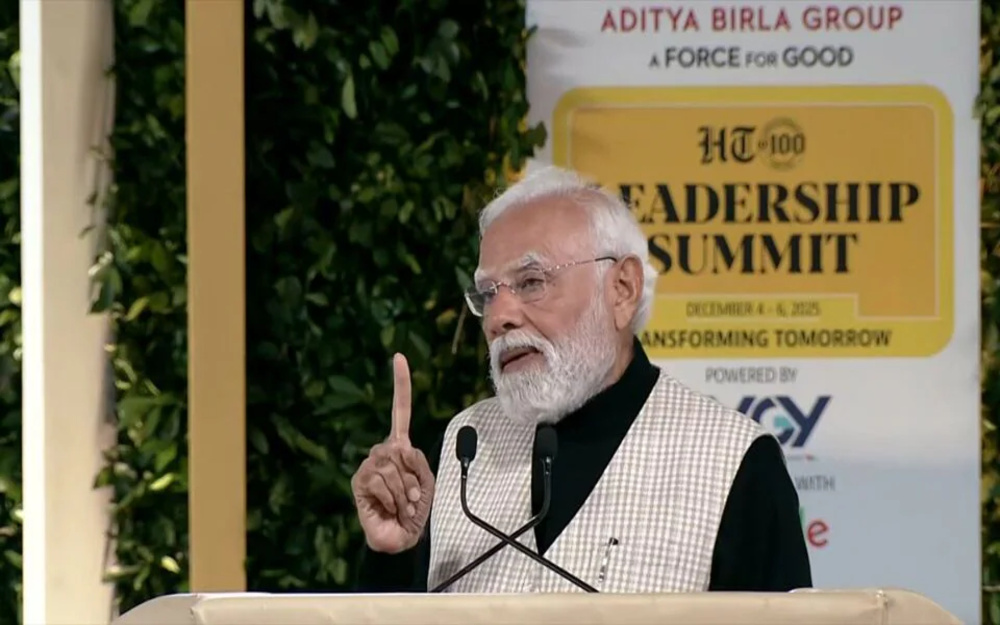
New Delhi, 9th December: For decades, Bharat has been viewed through a fogged colonial lens—one that often defined the country not by its potential, but by its supposed limitations. At the Hindustan Times Leadership Summit, Prime Minister Narendra Modi challenged this mindset head-on. In a fiery and unapologetic address, he urged the country to shed the “mental slavery” that still shadows national consciousness and denounced the long-abused phrase, “Hindu rate of growth.” It was more than political rhetoric; it was a call to reclaim agency over Bharat’s own narrative.
Speaking at the Hindustan Times Leadership Summit 2025. #HTLS2025@htTweets
https://t.co/D5ACi2xSwt— Narendra Modi (@narendramodi) December 6, 2025
At a time when global economies are weathering storms of inflation, recession, and conflict, Bharat stands as a “growth engine.” Yet the country’s economic rise is still restrained by an intellectual vocabulary shaped during an era when Bharat’s slow progress was unfairly pinned to its civilisation. Modi’s message was unmistakable: Bharat has surpassed these old judgments, and now it’s time to discard the vocabulary that once diminished it.
The Burden of an Unfair Label
The term “Hindu rate of growth,” coined in 1978 by economist Raj Krishna, was never about culture or religion, though it used both as rhetorical crutches. It described the sluggish economic expansion between the 1950s and 1980s—around 3.5% annually—an underperformance driven not by Hindu philosophy but by heavy regulations, socialist policies, the licence raj, and radical import substitution. Despite this, the phrase persisted, often wielded with a casual arrogance that ignored policy failures and instead subtly pointed fingers at Bharat’s majority identity.
In today’s hyper-sensitive world, such terminology would be dismissed as bigoted. Yet this one phrase survived, reproduced in textbooks and think tanks, shaping how generations perceived Bharat’s capabilities. And remarkably, while slumps were “Hindu,” modern success—8.2% growth in the recent quarter—somehow belongs to no culture at all.
This asymmetry, as Modi argued, reveals the deep-rooted colonial thinking that still underpins many academic and intellectual frameworks.
A Nation Rising in a World of Slowdowns
Modi’s claim that Bharat is a high-growth, low-inflation economy is not an abstract boast—it’s supported by numbers. While powerful G20 nations grapple with contractions, stagnation, and existential economic anxieties, Bharat continues its steady upward climb. In fact, Bharat recorded the highest year-on-year growth among G20 economies at 7.3%, far ahead of China, Indonesia, and far above recession-hit Germany, Italy, and Canada.
This divergence is striking. Countries once regarded as models of economic governance now look at Bharat as a stabilising force in a turbulent global climate. For them, Bharat is no longer a developing nation punching above its weight; it is a pillar of resilience.
Yet, strangely, this performance earns no cultural association. Growth is detached from the civilisation that fuels it. Slow growth was “Hindu,” but fast growth is simply “Bharat.” This is the hypocrisy Modi called out.
Why the Old Lens Was Always Flawed
Linking a civilisation to economic underperformance makes as little sense today as it did in the 1970s. Growth has always been shaped by governance, technology, trade policies, institutional frameworks, and global markets—not by religion. The starkest proof of this is the sweeping transformation that occurred after the 1991 liberalisation. Bharat’s trajectory changed the moment its policies changed, demonstrating that its earlier stagnation had nothing to do with Hindu culture and everything to do with state control.
Ironically, former RBI Governor Raghuram Rajan resurrected the term in 2023, predicting Bharat was sliding back into the “Hindu rate of growth.” Within a year, Bharat not only disproved the claim but surged ahead globally. Rajan, for five consecutive years, has warned of imminent collapse—warnings that were consistently upended by Bharat’s performance.
Critics who once used the term as an intellectual flourish now face a changed country that refuses to be boxed into outdated frameworks.
When Civilisation Is Blamed for Failures but Excluded from Success
Perhaps the most telling flaw in the old expression is its selective application. If Afghanistan grows at 2.3% or Pakistan at 3.2%, no one calls it the “Muslim rate of growth.” If China slows, no one attributes it to Buddhism, Confucianism, or Communist political culture. Religion is never blamed—except when it comes to Hinduism.
This inconsistency exposes the academic prejudice embedded in the original term. It was never descriptive economics; it was a cultural smear packaged as analysis. A more honest expression for the era of slow growth, as many now suggest, would be the “Nehru rate of growth,” considering it was his policies and planning frameworks that shaped the entire period.
But Bharatiya academia, long shaped by postcolonial Left narratives, found it easier to assign blame to civilisation than to leadership.
Bharat Steps Out of the Shadow
Modi’s call to reject the phrase is not merely symbolic. It is a political, cultural, and psychological attempt to rewrite the frameworks through which Bharat sees itself. For too long, Bharat’s economic self-image has been shaped by outsiders, many of whom failed to recognise the strengths embedded in its civilisation. Today’s Bharat—a nation of digital innovation, manufacturing expansion, world-class infrastructure, and global diplomatic presence—no longer fits those inherited stereotypes.
The country has evolved, but its terminology has not.
Time to Retire a Colonial Relic
The “Hindu rate of growth” was never an economic concept; it was a colonial echo, a convenient intellectual shortcut, and a subtle cultural jab. Bharat has outgrown the phrase, outpaced the era that created it, and outperformed the nations that once judged it.
As Modi said, the next decade must be spent freeing Bharat from mental slavery. And shedding this outdated expression is part of that journey. Bharat’s growth belongs to every citizen—but its civilisational identity is no liability. It is its strength.
It is finally time to bury the colonial vocabulary, reclaim the narrative, and let Bharat’s story be written by Bharat itself.
