
Bharat Steps Up at G20: A Civilisational Vision for the Global South
“Bharat’s Vision at G20 Johannesburg: A Civilisational Blueprint for Inclusive Global Growth.”

Paromita Das
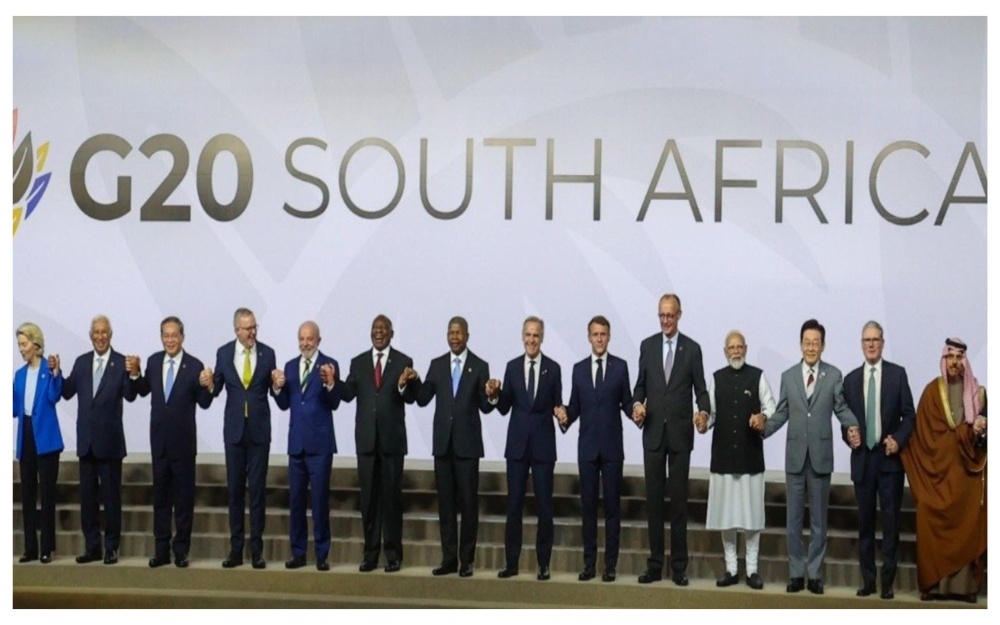
New Delhi, 24th November: In the sunlit halls of Johannesburg, where Africa hosted the G20 Summit for the first time in history, the global order seemed to pause for reflection. Prime Minister Narendra Modi, addressing the inaugural session, did not merely deliver a speech—he delivered a statement of global intent. Against the backdrop of fractured economies, deepening climate crises, and geopolitical turbulence, his words carried the conviction of a nation ready to lead with purpose.
Speaking at the session titled “Inclusive and Sustainable Economic Growth Leaving No One Behind,” PM Modi urged the world to rethink its economic frameworks. Development, he argued, cannot be measured only in profit margins and growth graphs; it must also be judged by compassion, sustainability, and human dignity. “With Africa hosting the G20 Summit for the first time, now is the right moment to revisit our development parameters,” he declared. It was both a philosophical reminder and a practical roadmap for a world at crossroads.
Bharat’s Civilisational Lens – Harmony as the Heart of Progress
PM Modi anchored his address in Bharat’s ancient philosophy of Integral Humanism, a principle that envisions balance between human welfare, social advancement, and environmental responsibility. This approach is neither abstract nor nostalgic—it represents a living, breathing model for modern governance.
In a world driven by competition and consumption, Bharat’s call for harmony between man, nature, and machine stands as a counterpoint to the unsustainable rush of industrial modernity. By invoking civilisational wisdom at a multilateral forum, Modi subtly reframed Bharat’s image—from a developing nation seeking aid to a civilisational power offering direction.
His central message was clear: global growth must be inclusive, sustainable, and rooted in shared prosperity. Economics without empathy, he implied, is a formula for global imbalance.
A Trio of Transformative Proposals – Bharat as a Catalyst for Change
- G20 Global Traditional Knowledge Repository – Preserving the Planet’s Ancient Wisdom
PM Modi proposed establishing a Global Traditional Knowledge Repository, inspired by Bharat’s Indian Knowledge Systems (IKS) framework. The goal is to document and disseminate indigenous ecological and sustainable practices from diverse cultures.
This was not just a cultural gesture—it was a profound recognition that the solutions to climate change might lie in the wisdom of our ancestors. By proposing Bharat as the custodian of such knowledge, Modi positioned the country as a global thought leader blending technology with tradition.
In essence, this repository reflects Bharat’s message: progress and preservation can coexist.
- G20–Africa Skills Multiplier Initiative – Empowering Through Partnership
With characteristic emphasis on the Global South, PM Modi unveiled the G20–Africa Skills Multiplier Initiative. The program envisions training one million certified instructors in Africa over the next decade, who will in turn empower millions more through skill development.
The move builds on Bharat’s instrumental role in bringing the African Union into the G20 during its 2023 presidency—a diplomatic milestone underscoring Bharat’s belief in equitable representation. By linking skill-building with partnership, the proposal highlights Bharat’s evolution from being a beneficiary of global frameworks to becoming a builder of global capacity.
It was a clear assertion: Bharat’s development is intertwined with the progress of the entire Global South.
- G20 Global Healthcare Response Team – Preparedness Beyond Borders
Drawing from Bharat’s humanitarian leadership during the COVID-19 pandemic, PM Modi suggested creating a G20 Global Healthcare Response Team. This international task force of trained professionals would serve as a first-response mechanism for global crises—whether pandemics, earthquakes, or cyclones.
This proposal carries echoes of Bharat’s “Vaccine Maitri” initiative, which supplied vaccines and medical support to over 150 countries. By formalizing such cooperation under the G20 umbrella, Modi elevated Bharat’s role from a reactive donor to a proactive guardian of global well-being.
His words captured the spirit succinctly: “We are stronger when we work together in the face of emergencies.”
Countering the Drug–Terror Nexus – A Security Imperative
In one of the session’s most crucial interventions, PM Modi raised alarm over the nexus between synthetic drugs and terrorism, a growing threat to global security. He proposed establishing a G20 Initiative on Countering the Drug–Terror Nexus, integrating financial tracking, intelligence sharing, and coordinated law enforcement.
This reflects Bharat’s expanding role as a security stabiliser, particularly in regions vulnerable to narco-terror and extremist financing. It also signals Bharat’s readiness to lead global efforts not only in development but also in defence of peace.
Bharat Rising in the Global Order – From Participant to Pathfinder
Each of Modi’s proposals—from knowledge preservation to health resilience—illustrates a deeper narrative: Bharat is no longer content to be a passive observer in global affairs. It is now a pathfinder nation, shaping discourse and designing frameworks for shared prosperity.
Bharat’s credibility rests on tangible achievements: its digital governance model, its balanced diplomacy, its democratic vitality, and its inclusive approach during the 2023 G20 Presidency. These have made it a moral and pragmatic leader amid competing global blocs.
At Johannesburg, the symbolism was unmistakable—Bharat stood not as a regional player, but as a civilisational leader offering solutions grounded in ethics and empathy.
A Human-Centric Model for a Divided World
The essence of PM Modi’s vision lies in redefining leadership through responsibility. At a time when global politics often swings between dominance and disengagement, Bharat’s approach of partnership and empathy offers a third way—cooperative, compassionate, and credible.
Yet, translating such ideals into action will demand consistent diplomacy, institutional commitment, and coalition-building across diverse nations. The test of leadership lies not only in vision but in sustained delivery—and here, Bharat’s track record gives reason for optimism.
Bharat’s Message from Africa to the World
The G20 Summit in Johannesburg was more than a diplomatic milestone; it was a moral turning point. By weaving ancient values with modern challenges, PM Modi presented a civilisational roadmap for inclusive global growth. His proposals on traditional knowledge, skills, healthcare, and security offer a model where humanity—not hegemony—defines progress.
In a world divided by competition, Bharat’s voice called for collaboration. And in that call lies the promise of a new global order—one that leaves no one behind.
