
Bharat–Russia’s Ocean Pact That Could Rewrite Asian Power Politics
“Why Bharat and Russia Are Quietly Rewriting Power Equations in the Indian Ocean.”

Paromita Das
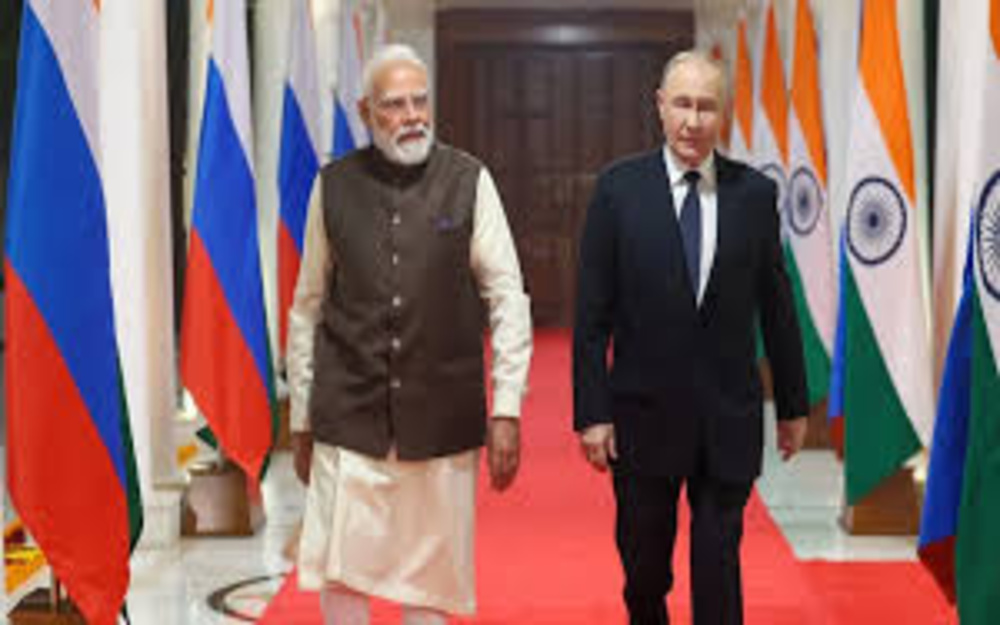
New Delhi, 8th December: In geopolitics, some moves make noise, and some reshape the chessboard in silence. The new reciprocal logistics agreement (RELOS) between Bharat and Russia belongs to the second category. It didn’t arrive with fanfare, but its impact could echo across oceans. For the first time, Russia’s powerful naval fleet will gain access to Bharatiya ports for refuelling, repairs and rest. In return, Bharatiya warships can use Russian bases in the Arctic and Far East.
To understand why this agreement matters, one must step away from headlines and look at the map—because this story is not just about diplomacy. It is about geography, energy, shipping routes and the rising contest for dominance in the world’s busiest ocean.
A New Chapter Opens in the Indian Ocean
The Indian Ocean is fast becoming the world’s most contested geopolitical hotspot. Nearly 80% of global maritime oil trade, a major share of international shipping and the strategic routes connecting the Middle East, Africa and East Asia pass through these waters.
Russia has long searched for stable access to the Indian Ocean. Its existing naval routes are slow, cold, expensive and vulnerable. The Northern Sea Route (NSR), which Moscow aggressively promotes as an alternative to the Suez Canal, still requires reliable warm-water access—and that inevitably brings Russia to Bharat.
With RELOS, Russia finally gains an entry point into the ocean it has eyed for decades.
Why Russia Needs Bharat’s Ports More Than Ever
There are three reasons Russia has pushed hard for this agreement:
- Strategic Access to Global Markets
The Indian Ocean is the doorway to the world’s most lucrative markets—Middle East, Africa, Southeast Asia. For Russia’s sanctions-hit economy, this access is not optional; it is survival.
- Faster Naval Operations
Until now, Russian ships returning to their bases for refuelling and repairs often lost weeks of time and millions in fuel. Through Bharatiya ports, Russia can maintain a near-continuous presence in warm waters.
- Support for the Northern Sea Route
The NSR—Russia’s dream project—connects Europe and Asia through the Arctic. But for it to become a global commercial corridor, it must link smoothly to the Indian Ocean. Bharat is that missing link.
In simple terms:
Without Bharat, Russia’s ocean strategy remains incomplete.
But Why Did Bharat Agree? The Answer Lies in the Ships Swarming the Ocean
Bharat’s motivations are deeper and more urgent. The Indian Ocean is crowded—almost uncomfortably so.
American, British, French, Australian and Japanese naval presence has grown exponentially. And above all, China’s PLA Navy has become the single biggest source of concern, with bases stretching from Djibouti to Gwadar to the Maldives.
For Bharat, the ocean that carries its name is becoming an increasingly contested arena.
New Delhi needed a partner that checks all the strategic boxes:
- Not unpredictable like the U.S., where alliances shift with domestic politics.
- Not politically intrusive like Europe, which often links security to ideology.
- Not tied to American interests the way Japan and Australia are.
- And crucially—not a rival like China, whose naval expansion directly threatens Bharat’s position.
When all the variables are laid out, Russia emerges as the only major power with both capability and neutrality from Bharat’s perspective.
It is no coincidence that Russia has the world’s third-largest navy, after the U.S. and China. Partnering with such a power gives Bharat not just operational advantages but strategic depth.
A Reliable Partner in Bharat’s Own Backyard
New Delhi has allowed Russian vessels into what it considers its most sensitive maritime backyard. This is not a favour—it is a strategic calculation.
Through this agreement:
- Bharat gains Russian logistical support in the Arctic and Far East.
- Bharatiya submarines and warships can extend their operations beyond the Indo-Pacific.
- Russia becomes a balancing force in a zone dominated by the U.S.-China rivalry.
- Both countries deepen interoperability without forming an alliance.
This is not a military pact, but the impact is equivalent to one in practice.
Bharat gets what it wants:
a major naval partner that brings strength without strings.
Russia gets what it wants:
entry into the world’s most important ocean.
The Larger Message Behind the Agreement
The RELOS deal sends a clear message to the world:
Bharat will choose its partners based on national interest, not ideological pressure.
Despite Western pushback after the Ukraine war, Bharat has expanded—not reduced—its partnership with Moscow. It has bought discounted oil, signed nuclear agreements, revived strategic projects and now opened its ports to Russian ships.
For a country that has always defended its “strategic autonomy”, this moment reinforces that doctrine more powerfully than any speech.
A Quiet Masterstroke in Bharat’s Long Game
This agreement is not just about logistics. It is about shaping the future of the Indian Ocean. The real winners in geopolitics are not those who shout the loudest, but those who place their pieces early and intelligently.
Bharat has done exactly that.
By giving Russia access to its ports, Bharat has gained:
- A counterweight to Chinese naval expansion
- A dependable friend not influenced by Western politics
- Strategic entry into the Russian Arctic circle
- A long-term partner for a multi-polar Indo-Pacific
In a world defined by shifting alliances, Bharat has expanded its room to manoeuvre.
Russia, meanwhile, has secured the warm-water access it has sought since the era of the Tsars.
Two Nations, One Ocean, and a New Strategic Equation
The Bharat–Russia reciprocal logistics pact is far more than a technical agreement. It is a reset of maritime power equations. It quietly binds two major powers in a long-term naval partnership at a time when the Indian Ocean region is becoming the epicentre of global competition.
This deal does not shout—but it signals.
It signals that Bharat is preparing for the oceanic battles of the future.
It signals that Russia is pivoting toward Asia with renewed urgency.
And it signals that together, the two nations are reshaping the strategic map of Indo-Pacific waters.
The world may not feel the tremors yet.
But make no mistake — a new maritime alignment has begun.
