
Bharat and Japan: Building the Blueprint for an Asian Century
“Prime Minister Modi’s Tokyo visit, his first standalone trip to Japan in nearly seven years, reinforced the Special Strategic and Global Partnership between the two nations, underlining new opportunities in AI, semiconductors, quantum computing, and green energy.”

Paromita Das
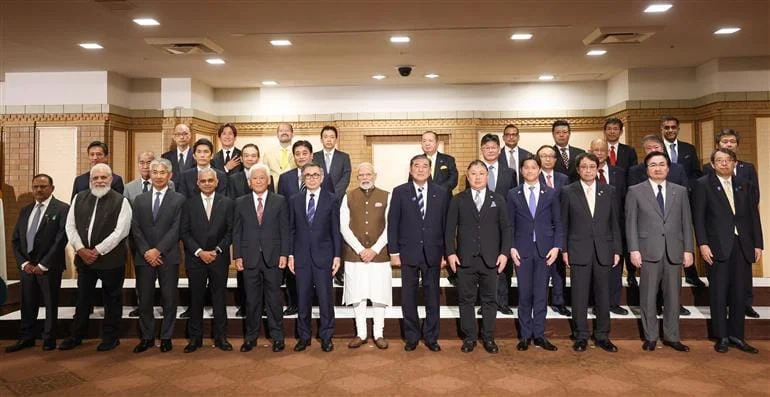
New Delhi, 30th August: When Prime Minister Narendra Modi stood before the Bharat-Japan Economic Forum in Tokyo this Friday, his words resonated with both ambition and pragmatism: “The world is not just watching Bharat, it is counting on Bharat.” In that single line, Modi captured the evolving global perception of Bharat—not merely as a rising power but as a crucial pillar of stability and growth in an uncertain world. His Japan visit, the first standalone trip to the country in nearly seven years, has turned into more than a diplomatic gesture; it has become a reaffirmation of how Bharat and Japan, two democracies with shared values, can collaborate to shape the future of Asia and beyond.
Japan and Bharat: Two Pillars of a Strategic Partnership

PM Modi emphasized that Japan has always been a vital partner in Bharat’s Vikas Yatra—the developmental journey that has seen Bharat move from being an emerging economy to a global growth engine. He highlighted how Japanese investments, over USD 40 billion so far, have been instrumental in sectors ranging from metro rail to semiconductors and startups. This isn’t just capital flow; it is a testimony to the trust that Tokyo places in New Delhi’s long-term potential.
Japanese Prime Minister Shigeru Ishiba echoed this sentiment by noting that “Japan’s advanced technology and Bharat’s outstanding talent complement each other.” His words capture the essence of the relationship: a collaboration where Japan brings precision, innovation, and technological excellence, while Bharat contributes scale, resilience, and human capital.
The Power of Technology and Talent

At the heart of Modi’s speech was a bold assertion: “Japan is a tech powerhouse and Bharat is a talent powerhouse.” Together, the two nations could lead the technology revolution of the 21st century.
Bharat has already taken ambitious initiatives in artificial intelligence, quantum computing, biotechnology, semiconductors, and space technology. By pairing Japan’s research and innovation capabilities with Bharat’s growing pool of skilled professionals, the partnership has the potential to redefine global supply chains and set new benchmarks in advanced manufacturing and clean technologies.
The newly signed agreement on a Joint Credit Mechanism for clean fuel cooperation underlines a forward-looking agenda—one that acknowledges the urgency of climate change while building a green growth pathway. This collaboration is not only about profit but also about sustainability and global responsibility.
Bharat’s Economic Confidence: Stability as a Strength

PM Modi’s speech also doubled as a pitch to the global business community. He underlined the pillars of Bharat’s economic confidence: political stability, economic stability, transparency in policy, and predictability.
Bharat today contributes 18 percent to global growth, has forex reserves nearing $700 billion, maintains low inflation, and continues to attract global capital. Modi reinforced that Bharat is not just a high-growth market but also a reliable partner.
His “reform, transform, and perform” mantra encapsulates the structural changes of the past decade. From GST reforms and simplified taxation to the creation of a single digital approval window and the rationalization of over 45,000 compliances, Bharat has sought to remove bottlenecks and improve the ease of doing business. Opening up defense, space, and even nuclear sectors to private players signals New Delhi’s determination to align policy with opportunity.
Shaping the Asian Century Together

One of Modi’s most impactful remarks was that the Bharat-Japan partnership is not just strategic, but smart. It is powered by economic logic and aimed at shared prosperity. He positioned Bharat as a springboard for Japanese businesses into the Global South, underscoring the role of this partnership in shaping an “Asian Century” marked by growth, stability, and innovation.
For Tokyo, Bharat represents not only a vast market but also a democratic counterweight in the Indo-Pacific. For New Delhi, Japan remains an indispensable partner in infrastructure, technology, and climate cooperation. Together, they have the capacity to ensure that Asia does not merely grow, but thrives on principles of fairness, sustainability, and inclusivity.
Why This Partnership Matters Now More Than Ever

At a time when the world grapples with trade wars, technological rivalries, and geopolitical uncertainties, the Bharat-Japan partnership stands out as a model of constructive engagement. Unlike alliances built purely on defense or competition, this partnership is rooted in complementarity and long-term vision.
The emphasis on clean energy cooperation is particularly noteworthy. With the global transition towards decarbonization, Bharat’s need for affordable green solutions and Japan’s technological expertise could redefine how emerging economies adapt to climate goals without compromising growth.
Moreover, in a multipolar world where both the U.S. and China are recalibrating their strategies, Bharat and Japan are demonstrating that middle powers can chart their own course—by building supply chains, fostering innovation, and driving inclusive growth.
A Partnership That Goes Beyond Diplomacy
Prime Minister Modi’s visit to Japan has reinforced that this is more than a bilateral relationship; it is a partnership with global implications. By blending Japan’s excellence with Bharat’s scale, the two nations are setting the stage for a transformative era.
In Modi’s words, “The world is not just watching Bharat, it is counting on Bharat.” That trust extends beyond borders, and with Japan as a steadfast partner, Bharat is not only shaping its own destiny but also contributing to a new architecture of global growth and stability.
The Bharat-Japan story, then, is not just about trade or investment. It is about two democracies, bound by history and vision, working to ensure that the 21st century truly becomes the Asian Century.
