
Bharat-Bhutan Rail Project: Linking Nations, Driving Growth
“Bharat’s first cross-border railway with Bhutan strengthens trade, regional connectivity, and strategic cooperation while boosting development in the Northeast.”

Paromita Das
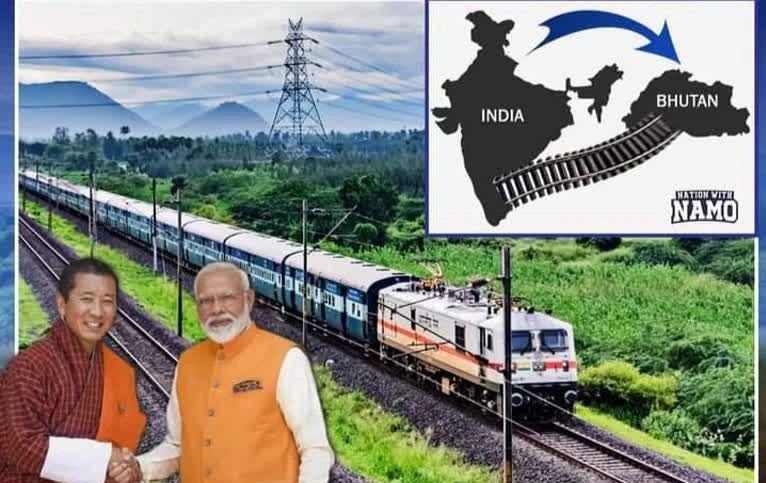
New Delhi, 3rd October: On 29th September, the Bharatiya government unveiled a landmark plan to establish rail connectivity with Bhutan—the first cross-border railway project in the Himalayan kingdom. The initiative, part of Bharat’s broader “Make in India” agenda, represents not just infrastructure development but a deeper strategic and economic partnership. Union Minister Ashwini Vaishnaw and Foreign Secretary Vikram Misri announced that the project, costing Rs 4,033 crore, will connect Samtse, an industrial hub, and Gelephu, a center for economic and administrative activity, to the Indian Railways network at Banarhat in West Bengal and Kokrajhar in Assam.
Promised & delivered – India & Bhutan to establish two cross-border rail links (89 km | ₹4,033 Cr) 🇮🇳🇧🇹
🛤️ Kokrajhar–Gelephu (69 km)
🛤️ Banarhat–Samtse (20 km)✅ This milestone will unlock new economic opportunities, strengthen connectivity, and deepen India–Bhutan ties. pic.twitter.com/J5fX60NS9k
— Ashwini Vaishnaw (@AshwiniVaishnaw) September 29, 2025
Foreign Secretary Misri emphasized that this is the first batch of rail connectivity projects between Bharat and Bhutan, reflecting a relationship founded on exceptional trust, mutual respect, and shared developmental goals. The agreements were formalized during the Bhutanese Foreign Secretary’s visit to New Delhi, with the Memorandum of Understanding rooted in Prime Minister Narendra Modi’s visit to Bhutan last March. The total length of the network will span roughly 90 kilometers, offering Bhutan access to Bharat’s vast railway infrastructure and, by extension, global trade networks.
Building Bridges Beyond Borders

Bharat’s investment in Bhutan’s rail lines will cover the cost of railway infrastructure and electrified Vande Bharat train coaches, all produced domestically. The Kokrajhar-Gelephu link, approximately 69 kilometers long, will feature six stations, two viaducts, 29 major bridges, 65 minor bridges, and a flyover, among other infrastructure components, at a cost of Rs 3,456 crore. The Banarhat-Samtse link, spanning 20 kilometers, includes two stations, 25 bridges, and 24 minor flyovers, costing Rs 577 crore.
Misri highlighted that these projects are more than transportation initiatives—they are strategic enablers for cargo and passenger movement, enhancing Bhutan’s connectivity to the Bharatiya subcontinent and beyond. New Delhi has also committed Rs 10,000 crore to Bhutan’s 13th Five-Year Plan (2024–2029) to develop sections inside Bhutanese territory. Security arrangements and new integrated check posts (ICPs) along the border will further ensure smooth cross-border operations.
Economic and Strategic Significance

Bhutan’s importance to Bharat extends beyond trade. Geographically, it is nestled between Bharat and China in the Eastern Himalayas, sharing borders with Assam, Arunachal Pradesh, West Bengal, and Sikkim. Strengthening rail connectivity enhances bilateral trade while reinforcing Bharat’s strategic influence in a region of heightened geopolitical sensitivity. Historical tensions, such as the Doklam standoff and the Galwan Valley clashes with China, underscore the criticality of close Bharat-Bhutan cooperation. By ensuring strong infrastructure links, Bharat not only supports Bhutan’s economic development but also fortifies its own strategic posture in the region.
The rail project will allow Bhutan access to Bharatiya seaports and neighboring markets, including Bangladesh and Nepal. It also facilitates smoother export of Bhutanese commodities, further integrating Bhutan’s economy with the broader regional trade network. For Bharat, this is a tangible demonstration of its “Neighbourhood First Policy,” aimed at fostering trade, connectivity, and diplomatic interdependence with nearby nations while counterbalancing external influences.
Revitalizing Bharat’s Northeast

The Bharat-Bhutan railway project is also a catalyst for development in the Northeastern states. Historically overlooked, the region has witnessed significant infrastructure growth under the Modi government, including projects like the Bairabi–Sairang line in Mizoram, Dimapur-Zubza in Nagaland, and Sevoke-Rangpo in Sikkim, along with engineering feats such as the Bogibeel Bridge in Assam. Improved connectivity not only advances socioeconomic growth but also strengthens national integration and security along sensitive borders.
By linking remote areas, fostering trade, and enhancing mobility, the railways will bring development opportunities to previously neglected regions. It aligns with PM Modi’s vision of “Vikas through connectivity,” combining infrastructure-led growth with strategic foresight to benefit both local populations and national security objectives.
Strengthening Cultural and Diplomatic Bonds

Bharat and Bhutan share deep cultural and civilizational ties, further reinforced by Buddhist heritage and longstanding people-to-people connections. Rail connectivity will enhance this integration, promoting tourism, commerce, and mutual understanding. It also showcases Bharat’s ability to invest in regional partners responsibly, building interdependencies that foster trust, stability, and collaboration.
Additionally, Bhutan’s hydroelectric potential complements Bharat’s energy needs, further cementing cooperative economic and strategic planning. These rail lines are not merely infrastructure; they are instruments of diplomacy, signaling Bharat’s commitment to being a reliable partner and a confident regional power.
A Milestone in Regional Leadership
The Bharat-Bhutan railway initiative represents more than an engineering achievement. It is a strategic masterstroke that strengthens bilateral ties, integrates Bhutan into regional trade networks, and reinforces Bharat’s influence in South Asia. By improving connectivity, enhancing security, and fostering economic growth in both Bhutan and Bharat’s Northeastern states, the project underscores the vision of a self-reliant, regionally engaged, and strategically confident Bharat. As the first cross-border railway project in Bhutan, it paves the way for a future where development, diplomacy, and infrastructure converge to create lasting regional stability and prosperity.
