
Beyond the Hug: What Modi–Putin Talks Really Mean for Global Geopolitics
“A Visit That Looked Familiar—But Was Anything But Ordinary”

Paromita Das
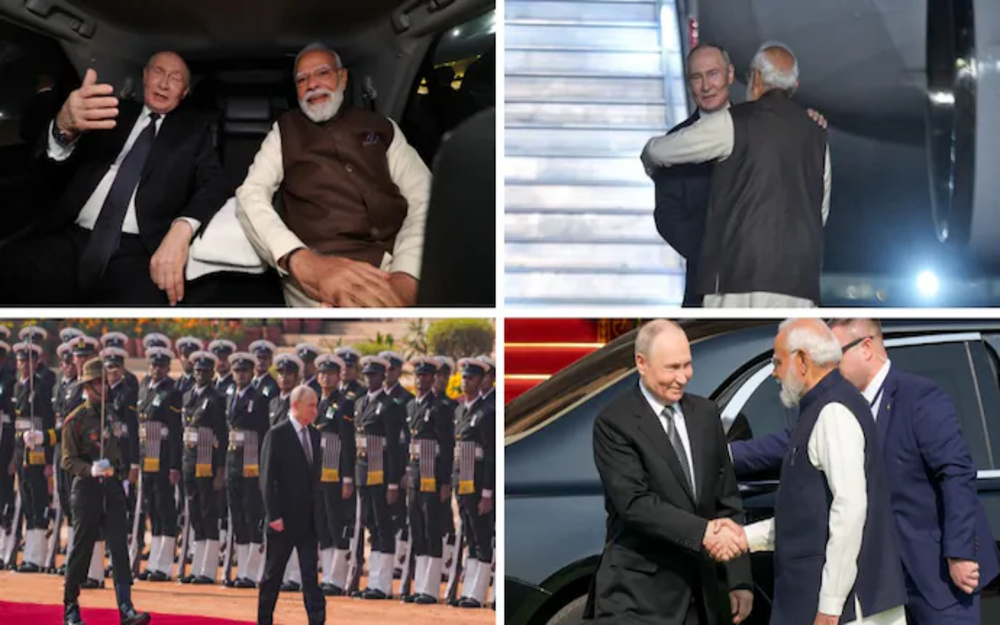
New Delhi, 8th December: The images were everywhere: Prime Minister Narendra Modi stepping forward at the Delhi airport, breaking protocol to welcome Vladimir Putin; the two driving together to the PM’s residence in a simple Toyota instead of ceremonial motorcades; the warm handshake, the relaxed body language, the familiarity.
For many, these visuals were enough to feel that something “big” had happened. But the real significance of Putin’s visit lies far beyond these moments. What unfolded during this trip wasn’t just a diplomatic exchange—it was a recalibration of global power, a shift that could alter Bharat’s place in the world for decades.
Most Bharatiya saw the warmth. Very few understood the strategy.
RT India: A New Voice Challenging the West’s Narrative Monopoly
Perhaps the most groundbreaking development—overshadowed by the optics—is the launch of RT India, Russia’s global media network now broadcasting directly from India. For years, India has fought a lonely battle against Western media narratives that often misrepresent, undermine or trivialise India’s achievements. Whether during defence operations or diplomatic stand-offs, Western coverage frequently cast India as chaotic, unstable or incompetent.
This is where RT India becomes transformative. Its chosen tagline—“Not anti-Western. Just not Western.”—captures a quiet rebellion. It signals an alternative worldview, one that is not filtered through London, New York or Brussels, but through Delhi.
And then came the moment that made history: journalist Runjhun Sharma being introduced by Vladimir Putin himself as the face of RT India. Never before has a foreign head of state inaugurated an Bharatiya TV journalist. The symbolism was unmistakable—Russia is placing narrative power in Bharatiya hands. And Bharat, for the first time, becomes a launchpad for global media influence.
A Logistics Pact That Rewrites Bharat’s Geography Without Moving an Inch
Much larger than the media moment, however, was a strategic agreement whose impact will ripple across oceans for years: the Reciprocal Exchange of Logistics Agreement—better known as RELOS.
On the surface, it is a simple arrangement allowing both nations to use each other’s ports, air bases and fuel hubs. But when placed in context, it becomes a tectonic shift.
For Bharat, RELOS opens entry to Russia’s Arctic ports and the Northern Sea Route—one of the world’s most promising shipping pathways as climate change reshapes global trade. Suddenly, Bharatiya naval and commercial vessels can access new routes without relying on Western chokepoints.
For Russia, the stakes are even higher. With European hostility at its peak, Russia has few stable routes to warm waters. Access to Bharatiya ports gives Moscow something it has sought for centuries: reliable entry into the Indian Ocean—one of the most contested and strategically vital regions on the planet. It strengthens Russia’s influence and gives Bharat a powerful ally in its maritime neighbourhood.
RELOS is not a routine military agreement. It is a geopolitical pivot.
Why Russia Needed This Visit—And Why Bharat Needed It Even More
For Russia, the motivations are clear. Sanctions have isolated it from Europe. China, though a partner, is increasingly overambitious in Central Asia and Siberia. Moscow cannot afford to be dependent on Beijing alone.
Bharat offers balance, markets, defence synergy and political stability. And unlike China, Bharat’s rise does not threaten Russia’s own strategic space.
But for Bharat, the gains may be even more consequential. The Indian Ocean today is a crowded chessboard—U.S., U.K., France, Japan, Australia and China all operate aggressively in the region. Bharat, despite being the resident power, faces enormous pressure to navigate this competition.
In that crowded arena, Russia becomes the rare partner that:
— does not follow Washington’s unpredictable moods,
— does not bring European ideological conditions,
— does not operate as a Western ally like Japan or Australia,
— and is not an aggressive rival like China.
Russia is a major power without being a threat. That makes it uniquely valuable.
The Moment We Must Understand Beyond the Celebration
Many celebrated the warmth between Modi and Putin. But this visit was not about camaraderie alone. It was about aligning two countries whose strategic futures are increasingly interlinked.
Bharat wants to be the voice of the Global South. Russia remains a dominant force of the Global North. Together, they can shape a genuine multipolar world—one that isn’t defined solely by Western frameworks.
But Bharat must be careful. What is at stake is not a moment of viral visuals, but a long-term strategic corridor. Bharat cannot afford to treat Russia as a temporary fallback whenever the West turns hostile. Nor should it allow domestic political noise to weaken the clarity of its global vision.
This is a moment to think with strategy, not sentiment.
A Quiet Power Shift—And Bharat at the Centre of It
Putin’s visit was not a ceremonial occasion. It was a signal. A recalibration. A repositioning.
Russia sees in Bharat a stable route to the future.
Bharat sees in Russia a partner without strings attached.
And the world sees two major powers stepping outside traditional alliances to build something new.
If Bharat uses this moment wisely, it will no longer be merely a “rising” power or a “balancing” force. It will be a shaping force, a defining pillar of a world that no longer belongs to one bloc, one ideology or one superpower.
A multipolar world is coming.
For once, Bharat is not reacting to it.
Bharat is building it.
